

Öz
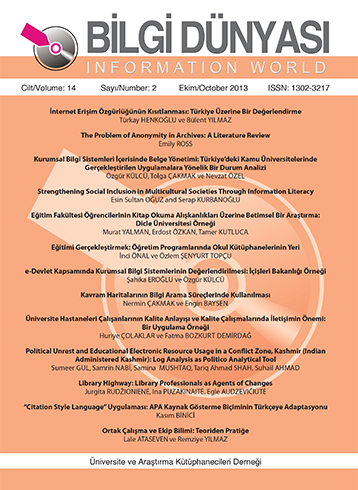
Arşivcilikte belgelerin işlenmesi, materyallerin kavramsallaştırılması ve aranabilir hale gelmesinde önemli olan yazarlık ve kaynak (menşe) gibi faktörlere dayanmaktadır. Ancak bir arşiv kullanıcısı olarak deneyimlerimizde defalarca isimsiz yazarlar tarafından bilinmeyen kişilere atfedilmiş mektuplar ve günlükler, bilinmeyen konuların fotoğrafları gibi anonim eserlerle karşılaşmaktayız. Bir zamanlar bu anonimlik bazen bir bilgi kaybı olarak görülürken bazen de belgenin yazarının yasal kınamaya maruz kalabildiği hicivli siyasi bir şiir örneğinde olduğu gibi eserin ilk etapta ortaya çıkmasını sağlamaktaydı. Bu literatür taramasında arşivlerde anonimlik sorunu hem pragmatik anlamda (konunun yönetimi için önerilen stratejiler) hem de felsefi anlamda (anonim belgelere uygun olarak bilinen yazarlı belgelerle aynı statüde) ele alınmaktadır.
Anahtar Kelimeler: Anonimlik, Yazarlar, Aslı bilinmeyen materyaller, Takma ad
Referanslar
- Bibliographic Services. (2011). Best Practices (General Documents). In The University of Southern Mississippi Libraries. The University of Southern Mississippi. Retrieved March 19, 2013, from http://www.lib.usm.edu/techserv/metadata/bestpractices/.
- Bureau of Canadian Archivists. (2008). Rules for Archival Description. The Association of Canadian Archivists. Retrieved March 19, 2013, from http://www.cdncouncilarchives.ca/RAD/RADComplete_July2008.pdf
- Buurma, R. S. (2007, Autumn). Anonymity, Corporate Authority, and the Archive: The Production of Authorship in Late-Victorian England. Victorian Studies, 15-42.
- Durden, M. (2003). Photography, Anonymity, and the Archive: Joachim Schmid. Parachute, 109.
- Etter-Lewis, G. (1996). Telling from behind her hand: African American women and the process of documenting concealed lives. In R. Josselon (Ed.), Ethics and Process in the Narrative Study of Lives (Vol. 4, pp. 114-28). Thousand Oaks: Sage Publications.
- Fisher, R. C. (2004). “The Grandmother’s Story”: Oral Tradition, Family Memory, and a Mysterious Manuscript. Archivaria, 57, 107-30.
- Garvey, E. G. (2006). Anonymity, Authorship, and Recirculation: A Civil War Episode. Book History, 9, 159-78.
- Ghosh, D. (2004). Decoding the Nameless: Gender, subjectivity, and historical methodologies in reading the archives of colonial India. In A new imperial history; culture, identity, and modernity in Britain and the Empire 1660-1840 (pp. 297-316).
- Griffin, R. (1999, Autumn). Anonymity and authorship. New Literary History, 30(4), 877-95.
- Griffin, R. (2007). Working with Anonymity: A Theory of Theory vs. Archive. Literature Compass, 4(2), 463-69.
- Hillmann, D. (2005, November 7). Using Dublin Core. Retrieved March 14, 2013, from http://www.dublincore.org/documents/usageguide/#whatis
- Hurley, C. (1995). Problems with provenance. Archives and Manuscripts, 23(2), 234-59.
- International Council on Archives. (2000). ISAD(G): General International Standard Archival Description. Committee on Descriptive Standards. Retrieved March 19, 2013, from http://repositories.lib.utexas.edu/bitstream/handle/2152/14140/ISAD%28G%29.pdf?sequence=2
- Laoire, C. N. (2007). To name or not to name: reflections on the use of anonymity in an oral archive of migrant life narratives. Social & Cultural Geography, 8(3), 373-90.
- McGuire, S. (2005). The Finnsburgh Fragment and provenance: A recordkeeping discussion. Archifacts, 27-36.
- Metatags Company, Inc. (2013). Dublin Core Metadata Initiative - DC Metadata Element Set. Retrieved March 19, 2013, from Metatags.org: http://www.metatags.org/dublin_core_metadata_element_set
- RDA Toolkit. (2010). RDA Co-publishers. Retrieved March 19, 2013, from http://www.rdatoolkit.org/
- Robson, M. (2008,). The Ethics of Anonymity. The Modern Language Review, 103(2), 350-63.
- Roe, K. D. (2010). Arranging and Describing Archives and Manuscripts. Chicago: Society of American Archivists.
- Rogers, P. (2002, Spring). Nameless names: Pope, Curll, and the uses of anonymity. New Literary History, 33(2), 233-45.
- Scott, J. C., Tehranian, J., & Mathias, J. (2002). The Production of Legal Identities Proper to States: The Case of the Permanent Family Surname. Comparative Studies in Society and History, 4-44.
- Society of American Archivists. (2007). Describing Archives: A Content Standard. Retrieved March 19, 2013, from http://files.archivists.org/pubs/DACS-2007.pdf
- Wells, S. (2006). Shakespeare and Co.: Christopher Marlowe, Thomas Dekker, Ben Jonson, Thomas Middleton, John Fletcher, and the Other Players in his Story. New York: Pantheon Books.
Lisans
Telif Hakkı (c) 2013 Yazar(lar). Açık erişimli bu makale, orijinal çalışmaya uygun şekilde atıfta bulunulması koşuluyla, herhangi bir ortamda veya formatta sınırsız kullanım, dağıtım ve çoğaltmaya izin veren Creative Commons Attribution License (CC BY) altında dağıtılmıştır.