

Öz
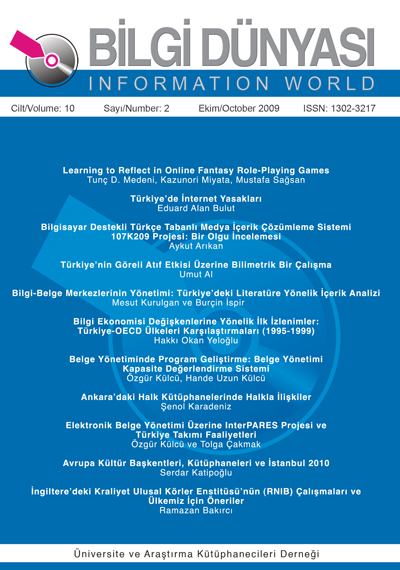
Gönüllüler tarafından oynanan ve ücretsiz olan çevrim içi rol oyunları ve sanal toplulukları, daha küçük oyun topluluklarıyla ilgili çalışmalar sınırlı sayıda olmasına rağmen, iş ve akademi çevresinde daha fazla cezbedici hale gelmiştir. Bu çalışmada bu küçük çevrim içi fantezi rol oyunları topluluklarından birisi olan Wold’un Dünyası ele alınmış ve katılımcılarla ilgili olarak İnternet görüşmeleri tekniği kullanılmıştır. Araştırmanın arka planıyla ilgili enformasyon verildikten sonra, araştırmanın üç kısımdan oluşan çerçevesi sunulmuştur. Bunlar, 1) öğrenme ve tefekkür için eşzamansız iletişim araçlarının kullanılması 2) tefekkürün kavramsallaştırılması 3) tefekkür ve öğrenmede hikâye anlatımı ve rol oyunlarının rolüdür. Bu çerçeve ışığında, 1) kişinin kendisi ile 2) bireysel olarak ve 3) kişiler arsında oluşan tefekkür ve öğrenmeye ilişkin bulgular, çevrimiçi rol oyunlarında tartışılmıştır. Çalışma, yapılan araştırmanın uygulanabilirliği ve sınırlılıklarıyla bir sonuca varmıştır. Umulmaktadır ki, bu olgudaki gelişme, öğrenmeyle ilgili tefekkürün oluşabilmesine yönelik gelişmekte olan sürdürülebilir sanal toplulukların çok oyunculu bir yönde değişim göstermesini ve katı teknolojiden daha hafif tefekküre yönelik öğrenme ve uygulamalara doğru bir amaca yönelimin gerçekleşmesini sağlayacaktır.
Anahtar Kelimeler: Bilgi paylaşımı, Bilgi üretimi, Rol oyunları, Yansıma (tefekkür), Uygulama toplulukları
Referanslar
- Aakhus, M. (2001). Designing web-based ınteractional tools to support learning from experience, paper presented at the Sixth International Workshop on the Language-Action Perspective on Communication Modelling (LAP 2001). Available online at: http://www-i5.informatik.rwth-aachen.de/conf/lap2001/papers/paper8.pdf (accessed 15.07.2006)
- Anderson, T. and Kanuka, H. (2003). E-research: Methods, strategies, and issues. Boston: Pearson Education.
- Ateşsoy Y. (n.d.). Yaran. Available online at: http://www.cankiri.gov.tr/ana/kultur/yaran.htm (accessed 15.07.2006)
- Barrett H. (2004a). The eportfolio as a story of deep learning: Digital storytelling as a part of a reflective portfolio, paper presented at the e-Portfolio Conference: Reflection Is Not a Mirror, It’s a Lens Available online at: http://electronicportfolios.org/portfolios/ReflectionUBC.pdf (accessed 15.07.2006)
- Barrett H. (2004b). Electronic portfolios as digital stories of deep learning: emerging digital tools to support reflection in learner-centered portfolios. Available online at: http://electronicportfolios.com/digistory/epstory.html (accessed 15.07.2006)
- Bernath, U. and Hülsmann, T. (2006). Asynchronous discussions in virtual seminars: might they work? Available online at: http://66.102.7.104/search?q=cache:fGmtE2kSznwJ:www.uni-oldenburg.de/zef/literat/eden0203.pdf (accessed 15.07.2006)
- Bernath, U. and Rubin, E. (1999). An international virtual seminar for university faculty and administrators: Professional development in distance education, paper presented at the 19th ICDEWorld Conference in Vienna. Available online at: http://www.uni-oldenburg.de/zef/literat/vienna2.htm (accessed 15.07.2006).
- Bodemer, D. and Sholvien, A. (2008). Support for Collaborative Multimedia Learning: Considering the Individual and the Group. ICCE 2008 Proceedings, pp.245-252.
- Collison, C. and Parcell, G. (2004). Learning to fly: Practical knowledge management from leading and learning organizations. Chichester: Capstone.
- Dourish, P. and Bellotti, V. (1992). Awareness and Coordination in Shared Workspaces. In J. Turner and R. Kraut (Eds.) CSCW 92 – Sharing Perspectives. Proceedings of the Conference on Computer-Supported Cooperative Work (pp. 107-114). Toronto: ACM/SIGOIS.
- Ebner, M. and Holzinger, A. (2006). Successful implementation of user-centered game based learning in higher education: An example from civil engineering. Computers and Education Elsevier.
- Elearnspace. (2005). Asynchronous Available online at: http://www.elearnspace.org/doing/asynchronous.htm (accessed 15.07.2006).
- Fader, S. (1998). Role-playing games Available online at: http://www.nycgoth.com/more/rpgs (accessed 15.07.2006).
- Filipczak, B. (1997). Training gets doomed, Training, August, 24–31.
- Fine, G. A. (2002). Shared fantasy: Role playing games as social worlds. Chicago: University of Chicago Press.
- Flores, F., Graves, M., Hartfield, B. and Winograd, T. (1988). Computer systems and the design of organizational interaction. ACM Transactions on Office Information Systems, 6(2), 153-172.
- Galarneau, L. (2004). PhD proposal: Spontaneous communities of learning. Available online at: http://www.oddwater.com/relevancy/index.php?p=81 (accessed 15.09.2005).
- Gee, J. P. (2003). What video games have to teach us about learning and literacy. New York: Palgrave Macmillan.
- Goldberg, M. (n.d.). Synchronous vs. asynchronous: Some thoughts. Available online at: http://www.webct.com/OTL/ViewContent?contentID=2339346 (accessed 15.07.2006).
- Griffiths, M. D. and Davies, M. N. O. (2002). Research note-excessive online computer gaming: implications for education. Journal of Computer Assisted Learning, 18(3), 379–380.
- Hamalainen, R. (2006). Designing and evaluating collaboration in a virtual game environment for vocational learning. Computers and Education, 50(1), 98-109.
- Joinson, N. A. (2003). Understanding the psychology of Internet behaviour: Virtual worlds, real lives. New York: Palgrave Macmillan.
- Jovchelovitch, S. (2007). Knowledge in context: Representations, community and culture. New York: Routledge.
- Karatekin Yaren Kültürü (n.d). Available online at: http://www.karatekin.net/yaren/ (accessed 15.07.2006).
- Kaye, A. (1992). Collaborative learning through computer conferencing: the Najaden papers. Berlin: Springer-Verlag.
- Koschmann, T. (1996). CSCL: theory and practice of an emerging paradigm. Mahwah, NJ: Lawrence Erlbaum.
- Koschmann, T. (1996). CSCL: Theory and practice of an emerging paradigm. Mahwah, NJ: LEA.
- Lacan, J. (1977). Ecrits. New York: Norton.
- Lave, J. and Wenger, E. (1991). Situated learning: Legitimate peripheral participation. Cambridge: Cambridge University Press.
- Lee, K. M. (2000). MUD and self efficacy. Educational Media International, 37(3), 177-183.
- Lortz, S. L. (1979). Role-playing. Different Worlds, 1,36-41.
- Lue, K. (2005). Building social capital on college campuses: Outside the classroom and online, (CVC Professional Development Center). Available online at: http://pdc.cvc.edu/common/article.asp?entry=1&idx=3708 (accessed 15.07.2006).
- Markel, S. (2001). Technology and education online discussion forums: It’s in the response’ Online Journal of Distance Learning Administration, 4(2). Available online at: http://www.westga.edu/~distance/ojdla/summer42/markel42.html (accessed 15.07.2006).
- McConnell, D. (1994). Implementing computer supported cooperative learning. London: Kogan Page.
- Medeni, T. (2004). Reflective management learning practice model, presented at the BAI 2004 International Workshop on Business and Information, Taiwan, 26-27 March 2004.
- Medeni, T. and Medeni T. İ. (2005). Virtual role-playing communities, “Wold” and World. E. Coakes and S. Clarke (Eds.). In Encyclopedia of communities of practice in information and knowledge management (pp.580-582). Hershey: Idea Group.
- Medeni, T. (2001). Reflections on IMPM reflective mindset module. Unpublished Dissertation presented for MA in Management and Organizational Learning, Lancaster University.
- Medeni, T. (2005). The living tradition of “Yaren Talks” as an indigenous community of practice in today’s knowledge society. E. Coakes and S. Clarke (Eds.). In Encyclopedia of communities of practice in information and knowledge management (pp.353-356). Hershey: Idea Group.
- Medeni, T. (2006). International Masters Program in Practicing Management (IMPM): Pedagogy of experienced reflection and phenomenon of refraction in management learning. Wankel, C. and DeFillippi, R. (Eds.). In New visions of graduate management education (pp.125-184). Charlotte, NC: Information Age.
- Medeni (ve başkl). (2008). Learning reflection and creativity in online game communities. G. D. Putnik and M. M. Cunha (Eds.). In Encyclopedia of Networks and Virtual Organizations Vol II. Hershey, New York: Information Science Reference.
- Mintzberg, H., (2004). Managers not MBAs: A hard look at the soft practice of managing and management development. San Francisco: Berrett-Koehler Publishers.
- Mitchell, A. and Savill-Smith, C. (2004). The use of computer and video games for learning: A review of the literature. London: Learning and Skills Development Agency. Available online at: http://www.lsda.org.uk/files/PDF/1529.pdf (accessed 15.07.2006).
- Murray, J. (2004). From game-story to cyberdrama. Available online at: http://www.electronicbookreview.com/v3/servlet/ebr?essay_id=murray&command=view_essay (accessed 27.09.2005).
- Nonaka, I. and Teece, D. J. (2001). Managing industrial knowledge: Creation, transfer and utilization. London: Sage.
- Nonaka, I. and Takeuchi, H. (1995). The knowledge creating company: How Japanese companies create the dynamics of innovation. New York: Oxford University Press.
- Powazek, D. M. (2001). Design for community: The art of connecting real people in virtual places. New Riders Press.
- Raybourn, E. M. (2007). Applying simulation experience design methods to creating serious game-based adaptive training systems. Interaction with Computers, 19(2), 206-214.
- Schön, D. (1983). The reflective practitioner: How professionals think in action. San Francisco: Jossey-Bass.
- Schön, D. (1988). Coaching reflective teaching. P. Grimmett and G. Erickson (Eds.). In Reflection in Teacher Education (pp.19-29). New York: Teachers College Press.
- Shih, J. L. and Su, H. Y. (2008). Analyzing children’s cognitive activities in digital problem-solving learning games “William Adventure”: An in-depth case study. In ICCE 2008 Proceedings (pp. 651-658).
- Steeples, C. (1998). Educational issues in collaborative learning. Available online at: http://www.law.warwick.ac.uk/seminars/98-2-cs.html (accessed 15.09.2005).
- Steinkuehler, C. A. (2005). Cognition and learning in massively multiplayer online games: A critical approach. Available online at: https://mywebspace.wisc.edu/steinkuehler/web/papers/Steinkuehler_ch4.pdf (accessed 15.09.2005).
- Suthers, D., Chu, K. H. and Joseph, S. (2008). Socio-technical capital in online learning: A preliminary investigation. In ICCE 2008 Proceedings (pp. 857-864).
- Takahashia, T., Bartneck, C., Katagiria, Y. and. Araic, N. H. (2005). TelMeA—Expressive avatars in asynchronous communications. International Journal Human-Computer Studies, 62(2), 193-209. Available online at: http://www.bartneck.de/work/takahashiBartneckIJHCS.pdf (accessed 15.07.2006).
- Techsoup.(2005). Asynchronous communication for online learning and collaboration. Available online at: http://www.techsoup.org/fb/index.cfm?forum=2008&fuseaction=forums.showSingleTopic&id=58245 (accessed 15.07.2006).
- Thinkanalogous. (2004a). Gaming group growth: Character interactions. Available online at: http://www.gamegrene.com/node/371 (accessed 15.07.2006).
- Thinkanalogous. (2004b). Role playing for self improvement. Available online at: http://www.gamegrene.com/node/339 (accessed 15.07.2006).
- Totty, M. (2005). Better training through gaming: Making work more like play The Wall Street Journal Online. Available online at: http://www.careerjournal.com/hrcenter/articles/20050428-totty.html?cjcontent=mail. (accessed 15.07.2006).
- Tsikalas, K. E. (2001). When the sims get real: An analysis of how digital playspaces promote learning in low-income, diverse communities. Available online at: http://66.102.9.104/search?q=cache:3q76a0FMqwYJ:playspace.concord.org/Documents/Learning%2520from%2520The%2520SIMS.pdf+When+The+Sims+Get+Real&hl=en&ct=clnk&cd=5 (accessed 14.07.2006).
- Twist, J. (2004). Virtual gamers reveal themselves BBC News. Available online at: http://news.bbc.co.uk/1/hi/technology/3683260.stm (accessed 15.07.2006).
- Umphrey, M. L. (2005) ALERT: Learning as narrative process. Available online at: http://www.edheritage.org/tools/alert.htm. (accessed 15.07.2006).
- Weick, K. E., (1995). Sensemaking in organizations. London: Sage.
- Wiszniewski, D. and Coyne, R. (2002). Mask and identity: The hermeneustics of self-construction in the information age. K. Ann Renninger (Ed.). In Building virtual communities: Learning and change in cyberspace (learning in doing: social, cognitive and computational perspectives) (pp.191-214). Cambridge: Cambridge University Press.
Lisans
Telif Hakkı (c) 2009 Yazar(lar). Açık erişimli bu makale, orijinal çalışmaya uygun şekilde atıfta bulunulması koşuluyla, herhangi bir ortamda veya formatta sınırsız kullanım, dağıtım ve çoğaltmaya izin veren Creative Commons Attribution License (CC BY) altında dağıtılmıştır.