

Öz
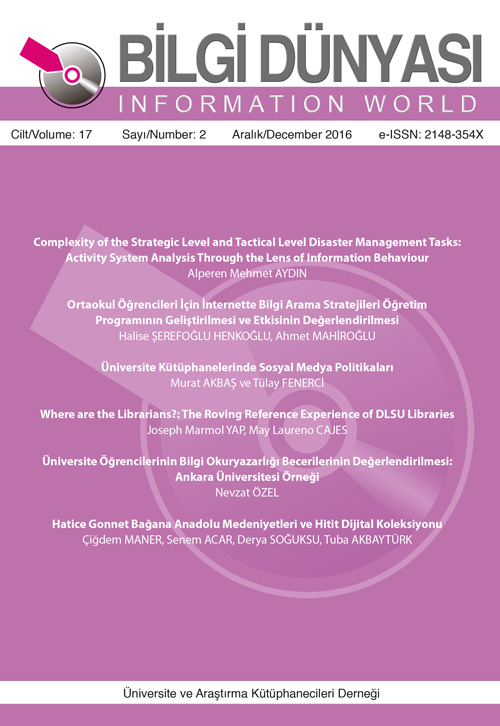
Bu araştırmanın amacı, ortaokul öğrencilerine internette bilgi arama stratejilerini öğretmek için bir öğretim programı geliştirmek ve bu programın etkililiğini değerlendirmektir. Araştırmada, tek grup öntest-sontest yarı deneysel desen kullanılarak; ortaokul 5, 6 ve 7. sınıfta öğrenim gören ve çalışmaya katılmaya gönüllü 98 öğrenciye, araştırma kapsamında geliştirilen “Ortaokul Öğrencileri İçin İnternette Bilgi Arama Stratejileri Öğretim Programı” çerçevesinde bir eğitim programı uygulanmıştır. Araştırmacılar tarafından geliştirilen “Ortaokul Öğrencilerinin İnternette Bilgi Arama Stratejileri Ölçeği” aracılığıyla öntest ve sontest olmak üzere iki aşamada toplanan verilerin analizinde ise ilişkili örneklemler t-testi ve Wilcoxon işaretli sıralar testi kullanılmıştır. Öğretim programının etkililiğinin değerlendirilmesi amacıyla çalışma grubundaki öğrencilerin uygulama öncesinde ve sonrasında ölçeğin bütününe ve alt boyutlarına ilişkin ölçümlerinin karşılaştırılması yapılmıştır. Elde edilen bulgular; çalışma grubundaki öğrencilerin ölçekte ifade edilen internette bilgi arama stratejilerine ilişkin ölçüm değerlerinin tamamında uygulama öncesinden uygulama sonrasına pozitif yönde anlamlı bir farklılığın olduğunu göstermektedir. Bu durum, araştırma kapsamında geliştirilen öğretim programı doğrultusunda verilen eğitim uygulamasının öğrencilerin internette bilgi arama stratejilerini geliştirmede önemli bir etkiye sahip olduğunu ortaya koymaktadır.
Anahtar Kelimeler: bilgi arama, öğretim programı, ortaokul öğrencileri, internet, web, strateji
Referanslar
- AASL. (2007). Standards for the 21st century learner. http://www.ala.org/aasl/sites/ala.org.aasl/files/content/guidelinesandstandards/learningstandards/AASL_Learning_Standards_2007.pdf adresinden erişildi.
- AASL ve AECT. (1998). Information literacy standards for student learning. Chicago: American Library Association.
- Argelagós, E. ve Pifarré, M. (2012). Improving information problem solving skills in secondary education through embedded instruction. Computers in Human Behavior, 28, 515-526.
- Babbie, E. (2010). The Practice of Social Research (12. ed.). USA: Wadsworth, Cengage Learning.
- Barrett, P. L. (2007). Information-seeking processes of fourth grade students using the internet for school assignment (Yayımlanmamış doktora tezi). Teachers College Columbia University, New York.
- Beheshti, J. ve Large, A. (2013). The information behavior of a new generation: Children and teens in the 21st century. Lanham, MD: Scarecrow Press.
- Bilal, D. (2012). Ranking, relevance judgment, and precision of information retrieval on children’s queries: Evaluation of Google, Yahoo!, Bing, Yahoo! Kids, and ask Kids. Journal of the American Society for Information Science and Technology, 63(9), 1879-1896.
- Brand-Gruwel, S., Wopereis, I. ve Vermetten, Y. (2005). Information problem solving by experts and novices: analysis of a complex cognitive skill. Computers in Human Behavior, 21, 487-508.
- Brand-Gruwel, S., Wopereis, I. ve Walraven, A. (2009). A descriptive model of information problem solving while using internet. Computers & Education, 53, 1207-1217.
- Callison, D. ve Preddy, L. B. (2006). The blue book on information age inquiry, instruction and literacy. USA: Libraries Unlimited.
- Chen, L. C. (2013). Teaching information literacy and reading strategies in fourth-grade science curriculum with inquiry learning. Worldwide Commonalities and Challenges in Information Literacy Research and Practice - Communications in Computer and Information Science, 397, 394-400.
- Demiralay, R. ve Karadeniz, Ş. (2008). İlköğretimde yaşam boyu öğrenme için bilgi okuryazarlığı becerilerinin geliştirilmesi. Cypriot Journal of Educational Sciences, 6, 89-108.
- Druin, A., Foss, E., Hatley, L., Golub, E., Guha, M. L., Fails, J. ve Hutchinson, H. (2010). How children search the internet with keyword interfaces. Proceedings of the Anonymous 8th International Conference on Interaction Design and Children, 89-96. doi:10.1145/1551788.1551804
- Eisenberg, M. B. (2003). Technology for a purpose: technology for information problem-solving with the Big6. TechTrends, 47(1), 13-14.
- Eisenberg, M. B. (2006). A Big6™ skills overview. http://big6.com/pages/about/big6-skills-overview.php adresinden erişildi.
- Eisenberg, M. B. ve Berkowitz, B. (1987). The Big6™ skills. http://big6.com/media/freestuff/Big6Handouts.pdf adresinden erişildi.
- Eisenberg, M. B., Johnson, D. ve Berkowitz, B. (2010). Information, communications, and technology (ICT) skills curriculum based on the Big6 skills approach to information problem solving. Library Media Connection, 24-27.
- Ekici, S. ve Özenç Uçak, N. (2012). İlköğretim öğrencilerinin İnternet’te bilgi arama davranışları. Türk Kütüphaneciliği, 26(1), 78-96.
- Field, A. (2009). Discovering statistics using SPSS (3 ed.). London: SAGE Publications Ltd.
- Gerjets, P. ve Hellenthal-Schorr, T. (2008). Competent information search in the World Wide Web: Development and evaluation of a web training for pupils. Computers in Human Behavior, 24, 693-715.
- Guinee, K. (2004). Internet searching by K-12 students: A research-based process model. http://edt2.educ.msu.edu/dwong/cep806library/guinee-internetsearchingbyk12studentsaresearchbasedprocessmodel.pdf adresinden erişildi.
- Hacettepe Üniversitesi. (2010). Hacettepe Üniversitesi bilgi okuryazarlığı programı http://hubo.hacettepe.edu.tr/bilgi_okuryazarligi.html adresinden erişildi.
- Head, A. J. ve Eisenberg, M. B. (2010). Truth be told: How college students evaluate and use information in the digital age. http://projectinfolit.org/pdfs/PIL_Fall2010_Survey_FullReport1.pdf adresinden erişildi.
- Jochmann-Mannak, H., Huibers, T. ve Sanders, T. (2008). Children’s information retrieval: beyond examining search strategies and interfaces. http://doc.utwente.nl/65025/1/Childrens_IR_Jochmann_Huibers_Sanders.pdf adresinden erişildi.
- Kuiper, E., Volman, M. ve Terwel, J. (2005). The Web as an information resource in K-12 education: strategies for supporting students in searching and processing information. Review of Educational Research, 75(3), 285-328.
- Kuiper, E., Volman, M. ve Terwel, J. (2008). Integrating critical Web skills and content knowledge: Development and evaluation of a 5th grade educational program. Computers in Human Behavior, 24, 666-692.
- Kurbanoğlu, S. (2002). WWW bilgi kaynaklarının değerlendirilmesi. Hacettepe Üniversitesi Edebiyat Fakültesi Dergisi, 19(1), 11-25.
- Kurbanoğlu, S. (2010). Bilgi okuryazarlığı: Kavramsal bir analiz. Türk Kütüphaneciliği, 24(4), 723-747.
- Lazonder, A. W. ve Rouet, J.-F. (2008). Information problem solving instruction: some cognitive and metacognitive issues. Computers in Human Behavior (24), 753-765.
- Madden, A. D., Ford, N. J., Miller, D. ve Levy, P. (2006). Children’s use of the internet for information seeking: What strategies do they use, and what factors affect their performance?. Journal of Documentation, 62(6), 744-761.
- Nesset, V. (2008). The information-seeking behaviour of grade-three elementary school students the context of a class project (Yayımlanmamış doktora tezi). McGill University School of Information Studies, Montreal.
- Nicholas, D. ve Rowlands, I. (2008). Digital consumers: Eshaping the information professions. London: Facet Publishing.
- Nicholas, D., Rowlands, I., Clark, D. ve Williams, P. (2011). Google Generation II: Web behaviour experiments with the BBC. Aslib Proceedings, 63(1), 28-45.
- Nunnally, J. C. (1978). Psychometric testing. New York: McGraw-Hill.
- OCLC. (2006). College students’ perceptions of the libraries and information resources: A report to the OCLC membership. http://www.oclc.org/content/dam/oclc/reports/pdfs/studentperceptions.pdf adresinden erişildi.
- OCLC. (2010). Perceptions of libraries, 2010: Context and community. http://www.oclc.org/content/dam/oclc/reports/2010perceptions/2010perceptions_all.pdf adresinden erişildi.
- Önal, İ. ve Şenyurt Topçu, Ö. (2013). Eğitimi gerçekleştirmek: öğretim programlarında okul kütüphanelerinin yeri. Bilgi Dünyası, 14(2), 306 - 328.
- Özenç Uçak, N. (2012). Öğrencilerin intihal algısı. Ö. Külcü, T. Çakmak ve N. Özel (Ed.), Prof. Dr. Gülbün Baydur’a armağan içinde (s.173 - 182). Ankara: Hacettepe Üniversitesi Bilgi ve Belge Yönetimi Bölümü.
- Peterson, J. W. (2008). Networked generation youth’s information seeking process: An examination of cognitive, affective, and physical information seeking behaviors and problem solving techniques (Yayımlanmamış doktora tezi). University of North Texas, Denton, Texas.
- Prensky, M. (2001a). Digital natives, digital immigrants, Part 1. http://www.marcprensky.com/writing/Prensky%20-20Digital%20Natives,%20Digital%20Immigrants%20-%20Part1.pdf adresinden erişildi.
- Prensky, M. (2001b). Digital natives, digital immigrants, Part 2: Do they really think differently? On the Horizon, 9(6), 1-6.
- Prensky, M. (2004). The emerging online life of the digital native: What they do differently because of technology, and how they do it. http://www.marcprensky.com/writing/PrenskyThe_Emerging_Online_Life_of_the_Digital_Native-03.pdf adresinden erişildi.
- Riedling, A. M. (2004). Information literacy: what does it look like in the school library media center. USA: Libraries Unlimited.
- Rowlands, I., Nicholas, D., Williams, P., Huntington, P., Fieldhouse, M., Gunter, B. ve Tenopir, C. (2008). The Google generation: The information behaviour of the researcher of the future. Aslib Proceedings, 60(4), 290-310.
- Rubin, A. ve Babbie, E. R. (2011). Research methods for social work (7 ed.). Belmond: Cengage Learning.
- Sakarya, S., Tercan, İ. ve Çoklar, A. N. (2011). İlköğretim öğrencilerinin interneti ve arama motorlarını kullanım durumları. http://web.firat.edu.tr/icits2011/papers/27621.pdf adresinden erişildi.
- Şahin, Ç. ve Altınay, Y. B. (2009). İlköğretim 1. kademedeki öğrencilerin düşünme becerilerini ve yaratıcılıklarını geliştirmek amacıyla aktif araştırmacı olarak araştırma tekniklerini kullanma becerilerinin değerlendirilmesi. http://www.eab.org.tr/eab/oc/egtconf/pdfkitap/pdf/375.pdf adresinden erişildi.
- Şerefoğlu Henkoğlu, H., Mahiroğlu, A. ve Keser, H. (2015). Ortaokul öğrencilerin bilgiye erişim aracı olarak internete yaklaşımları: Betimleyici bir çalışma. Turkish Online Journal of Qualitative Inquiry, 6(1), 72-110.
- Tu, Y.-W., Shih, M. ve Tsai, C.-C. (2008). Eighth graders’ web searching strategies and outcomes: The role of task types, web experiences and epistemological beliefs. Computers & Education, 51(3), 1142-1153.
- TÜİK. (2015). Hanehalkı bilişim teknolojileri kullanım araştırması. http://www.tuik.gov.tr/PreHaberBultenleri.do?id=18660 adresinden erişildi.
- UCL. (2008). A ciber briefing paper: Information behaviour of the researcher of the future. http://www.jisc.ac.uk/media/documents/programmes/reppres/gg_final_keynote_11012008.pdf adresinden erişildi.
- USC. (2013). The 2013 digital future report surveying the digital future year eleven. http://www.digitalcenter.org/wp-content/uploads/2013/06/2013-Report.pdf adresinden erişildi.
- Walraven, A., Brand-Gruwel, S. ve Boshuizen, H. P. A. (2008). Information-problem solving: a review of problems students encounter and instructional solutions. Computers in Human ehavior, 24(3), 623-648.
- Walraven, A., Brand-Gruwel, S. ve Boshuizen, H. P. A. (2009). How students evaluate information and sources when searching the World Wide Web for information. Computers & Education, 52(1), 234-246.
- Weiner, S. A. (2010). Information literacy: a neglected core competency. Educause Quarterly, 33(1). http://www.educause.edu/ero/article/information-literacy-neglected-core-competency adresinden erişildi.
- Wopereis, I., Brand-Gruwel, S. ve Vermetten, Y. (2008). The effect of embedded instruction on solving information problems. Computers in Human Behavior, 24, 738-752.
- Yolal, M. ve Kozak, R. (2008). Bilgiye erişim aracı olarak öğrencilerin internete yaklaşımı. Dumlupınar Üniversitesi Sosyal Bilimler Dergisi, 20, 115-128.
- Zhang, S. (2007). Instruction in the wwwdot approach to improving students’ evaluation of websites (Yayımlanmamış doktora tezi). Michigan State University, Department of Counseling, Educational Psychology, and Special Education, East Lansing, USA.
Lisans
Telif Hakkı (c) 2016 Yazar(lar). Açık erişimli bu makale, orijinal çalışmaya uygun şekilde atıfta bulunulması koşuluyla, herhangi bir ortamda veya formatta sınırsız kullanım, dağıtım ve çoğaltmaya izin veren Creative Commons Attribution License (CC BY) altında dağıtılmıştır.