Abstract
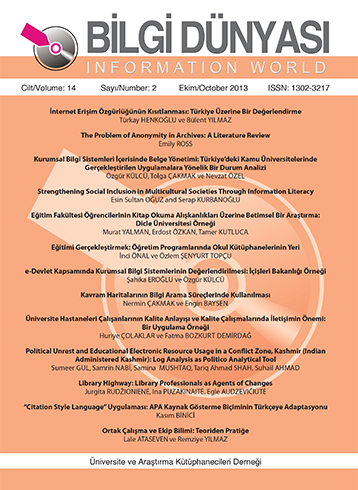
Archivists processing documents rely on factors such as authorship and provenance to contextualize their materials and render them searchable. But in my past experience as an archives user, I repeatedly came across instances of anonymity: letters and diaries by unnamed authors or to unknown recipients, photographs of unknown subjects. In some cases this anonymity is a loss of information that was once there, but in other case it enabled the material to come into existence in the first place: such as in the case of satirical political poetry, for which a writer might face legal censure. In this literature review, the issue of anonymity in the archives is explored, both in a pragmatic sense (recommended strategies for managing it), and a philosophical sense (according anonymous documents the same status as documents with known authors).
Keywords: Anonymity, Anonymous, Author, Material of unknown origin, Pseudonym
References
- Bibliographic Services. (2011). Best Practices (General Documents). In The University of Southern Mississippi Libraries. The University of Southern Mississippi. Retrieved March 19, 2013, from http://www.lib.usm.edu/techserv/metadata/bestpractices/.
- Bureau of Canadian Archivists. (2008). Rules for Archival Description. The Association of Canadian Archivists. Retrieved March 19, 2013, from http://www.cdncouncilarchives.ca/RAD/RADComplete_July2008.pdf
- Buurma, R. S. (2007, Autumn). Anonymity, Corporate Authority, and the Archive: The Production of Authorship in Late-Victorian England. Victorian Studies, 15-42.
- Durden, M. (2003). Photography, Anonymity, and the Archive: Joachim Schmid. Parachute, 109.
- Etter-Lewis, G. (1996). Telling from behind her hand: African American women and the process of documenting concealed lives. In R. Josselon (Ed.), Ethics and Process in the Narrative Study of Lives (Vol. 4, pp. 114-28). Thousand Oaks: Sage Publications.
- Fisher, R. C. (2004). “The Grandmother’s Story”: Oral Tradition, Family Memory, and a Mysterious Manuscript. Archivaria, 57, 107-30.
- Garvey, E. G. (2006). Anonymity, Authorship, and Recirculation: A Civil War Episode. Book History, 9, 159-78.
- Ghosh, D. (2004). Decoding the Nameless: Gender, subjectivity, and historical methodologies in reading the archives of colonial India. In A new imperial history; culture, identity, and modernity in Britain and the Empire 1660-1840 (pp. 297-316).
- Griffin, R. (1999, Autumn). Anonymity and authorship. New Literary History, 30(4), 877-95.
- Griffin, R. (2007). Working with Anonymity: A Theory of Theory vs. Archive. Literature Compass, 4(2), 463-69.
- Hillmann, D. (2005, November 7). Using Dublin Core. Retrieved March 14, 2013, from http://www.dublincore.org/documents/usageguide/#whatis
- Hurley, C. (1995). Problems with provenance. Archives and Manuscripts, 23(2), 234-59.
- International Council on Archives. (2000). ISAD(G): General International Standard Archival Description. Committee on Descriptive Standards. Retrieved March 19, 2013, from http://repositories.lib.utexas.edu/bitstream/handle/2152/14140/ISAD%28G%29.pdf?sequence=2
- Laoire, C. N. (2007). To name or not to name: reflections on the use of anonymity in an oral archive of migrant life narratives. Social & Cultural Geography, 8(3), 373-90.
- McGuire, S. (2005). The Finnsburgh Fragment and provenance: A recordkeeping discussion. Archifacts, 27-36.
- Metatags Company, Inc. (2013). Dublin Core Metadata Initiative - DC Metadata Element Set. Retrieved March 19, 2013, from Metatags.org: http://www.metatags.org/dublin_core_metadata_element_set
- RDA Toolkit. (2010). RDA Co-publishers. Retrieved March 19, 2013, from http://www.rdatoolkit.org/
- Robson, M. (2008,). The Ethics of Anonymity. The Modern Language Review, 103(2), 350-63.
- Roe, K. D. (2010). Arranging and Describing Archives and Manuscripts. Chicago: Society of American Archivists.
- Rogers, P. (2002, Spring). Nameless names: Pope, Curll, and the uses of anonymity. New Literary History, 33(2), 233-45.
- Scott, J. C., Tehranian, J., & Mathias, J. (2002). The Production of Legal Identities Proper to States: The Case of the Permanent Family Surname. Comparative Studies in Society and History, 4-44.
- Society of American Archivists. (2007). Describing Archives: A Content Standard. Retrieved March 19, 2013, from http://files.archivists.org/pubs/DACS-2007.pdf
- Wells, S. (2006). Shakespeare and Co.: Christopher Marlowe, Thomas Dekker, Ben Jonson, Thomas Middleton, John Fletcher, and the Other Players in his Story. New York: Pantheon Books.
License
Copyright (c) 2013 The author(s). This is an open access article distributed under the Creative Commons Attribution License (CC BY), which permits unrestricted use, distribution, and reproduction in any medium or format, provided the original work is properly cited.