Abstract
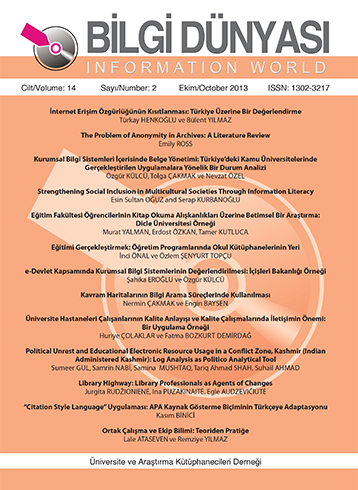
Apparently, almost all studies conducted on reading habits in Turkey have revealed that individuals in the society do not such habits at all as reading books and benefiting from libraries. Due to the fact this overall situation in the society is also reflected on university students, the present study is considered to be important for determining the reading habits of university students in our country. The purpose of this study, which was designed to examine the views of education faculty students about reading books, was to describe the participating students’ reading habits as well as the content of this habit. The study was carried out with 220 students attending the Education Faculty of Dicle University in the Spring Term of the academic year of 2011-2012. The results of the study demonstrated that more than half of the preservice teachers enjoyed reading books; that they bought the books or borrowed them from their friends; and that they preferred adventure novels. In addition, a majority of the students reported that they failed to read for such reasons as their intensive course programs. Based on the results, it was concluded that the most important factor in impressing the idea of reading is the person’s self as well as the parent(s).
Keywords: Reading, Reading habit, Preservice teacher, Dicle University
References
- Arıca, A.F. (2008). Okumayı niye sevmiyoruz? Üniversite öğrencileri ile mülakatlar. Mustafa Kemal Üniversitesi Sosyal Bilimler Enstitüsü Dergisi, 10.
- Arslan, Y. Çelik, Z. ve Çelik, E. (2009). Üniversite öğrencilerinin okuma alışkanlığına yönelik tutumlarının belirlenmesi. Pamukkale Üniversitesi Eğitim Fakültesi Dergisi, 26, 113-124.
- Aytaş, G. (2005). Okuma eğitimi. Türk Eğitim Bilimleri Dergisi, 3(4), 461-470.
- Çepni, S. (2010). Araştırma ve proje çalışmalarına giriş. Trabzon.
- Demirel, Ö. (1990). Yabancı dil öğretimi ilkeler-yöntemler-teknikler. Ankara: Ussem Yayınları.
- Esgin, A. ve Karadağ, Ö. (2000). Üniversite öğrencilerinin okuma alışkanlıkları. Popüler Bilim, 25(175), 19-20.
- Gömleksiz, M.N. (2004). Geleceğin öğretmenlerinin kitap okumaya ilişkin görüşlerinin değerlendirilmesi (Fırat Üniversitesi Eğitim Fakültesi örneği). Yüzüncü Yıl Üniversitesi, Elektronik Eğitim Fakültesi Dergisi, 1(1), 1–21.
- Güneş, F. (2007). Türkçe öğretimi ve zihinsel yapılandırma. Ankara: Nobel Yayın ve Dağıtım.
- Meriç, C. (1994). Bu ülke. İstanbul: İletişim Yayınları.
- Odabaş, H., Odabaş, Z. Y. ve Polat, C. (2008). Üniversite öğrencilerinin okuma alışkanlığı: Ankara üniversitesi örneği. Bilgi Dünyası, 9(2), 431-465.
- Saracaloğlu, A. S., Bozkurt, N. ve Serin, O. (2003). Üniversite öğrencilerinin okuma ilgileri ve okuma alışkanlıklarını etkileyen faktörler. Eğitim Araştırmaları Dergisi, 4(12), 148-157.
- Sever, S. (2011). Türkçe öğretimi ve tam öğrenme. Ankara: Anı Yayıncılık.
- Yılmaz, B. (2004). Öğrencilerin okuma ve kütüphane kullanma alışkanlıklarında ebeveynlerin duyarlılığı. Bilgi Dünyası, 5(2), 115-136.
- Yılmaz, B. (2002). Ankara’daki ilköğretim öğretmenlerinin okuma ve halk kütüphanesi kullanma alışkanlıkları üzerine bir araştırma, Türk Kütüphaneciliği, 16(4), 441-460.
- Yılmaz, M. (2009). Üniversite öğrencilerinin okuma alışkanlığı üzerine bir inceleme (Cumhuriyet Üniversitesi Eğitim Fakültesi Türkçe Eğitimi Bölümü örneği). Çukurova Üniversitesi Eğitim Fakültesi Dergisi, 3(37), 144-167.
- Türkiye okuma kültürü haritası. (2013). 28 Eylül 2013 tarihinde http://www.kygm.gov.tr/Eklenti/55,yonetici-ozetipdf.pdf?0 adresinden erişildi.
License
Copyright (c) 2013 The author(s). This is an open access article distributed under the Creative Commons Attribution License (CC BY), which permits unrestricted use, distribution, and reproduction in any medium or format, provided the original work is properly cited.