Abstract
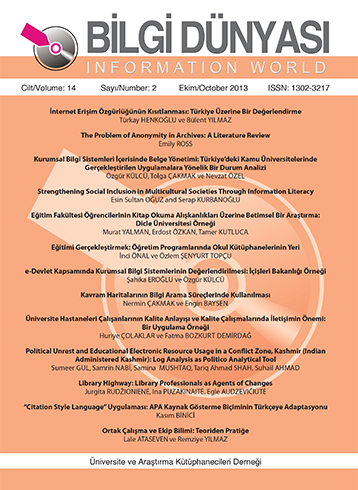
Electronic resource usage has proved as one of the best decision making tools in the library setups. Electronic resource usage in relation to the political disturbance can act as one of the tools to highlight the impact of political disturbance on educational setups in general and the electronic resource usage in particular. The study takes a serious look in the electronic resource usage in Kashmir and the impact of unrest on it. The paper highlights a relational platform between education and conflict studies. How conflict affects the electronic resource usage in a conflict zone has been highlighted in the study. Transaction logs in the form of COUNTER Report deliberating the usage of Project Muse journal titles at University of Kashmir were analyzed to know the extent of usage of e-resources by the academia of Kashmir during the time of conflict from a time period of January 2008- December 2010. Peace has a great role to play in the development of any community from every aspect. Political disturbance hampers the educational sector to a greater extent. The usage logs helped to reveal the actual picture of academic behaviour of Kashmiris in the time of conflict. The study clearly reflects that political disturbance has a negative effect on the educational sphere in general and electronic resource usage in particular. The study was confined to the analysis of the transactions logs generated from Project Muse at University of Kashmir. The study can lay a base for the policy makers associated with education to take some immediate and curative steps that can control the devastating effects on the academia caused because of frequent disturbances in the valley of Kashmir. The study is an eye opener for the academicians and the policy makers in Kashmir. The study will be helpful in visualizing the utility of log analysis in reflecting the ill effects of political disturbance on academic circles. The paper is first of its kind trying to link education and conflict studies of a politically simmering area, Kashmir. The research can further be extended to analyze the impact of political normalcy on the academia of Kashmir. How normalcy acts as an indicator of enhanced e-resource usage can be studied.
Keywords: Log analysis, Electronic resource usage, Information seeking behaviour, Education policies, policy, India, Kashmir
References
- Aggarwal, J. C., & Agrawal, S. P. (1995). Jammu and Kashmir at a glance. Modern history of Jammu and Kashmir: Including select documents and comprehensive reference bibliography covering all aspects of Jammu and Kashmir, 1844-1994. (p.2). New Delhi: Concept Pub. Co.
- Bose, S. (1997). the challenge in Kashmir: democracy, self-determination and a just peace. New Delhi: Sage.
- Chatterji, A. P. (2011). The militarized zone. In Tariq Ali, Hilal Bhat, Arundhati Roy, Angana P. Chatterji & Pankaj Mishra (Eds.). Kashmir: the case for freedom (p.121). New York, N.Y: Verso.
- Colenso, P. (2005). Education and social cohesion: developing a framework for education sector reform in Sri Lanka. Compare, 35(4), 411–428. doi:10.1080/03057920500331470
- Covey, D.T. (2002). Usability and Usability Assessment: Library Practices and Concerns, Council on Library and Information Resources. Washington, January 2002. Retrieved from http://www.clir.org/pubs/reports/pub105/pub105.pdf.
- Dehlvi, S. (2009). Interview. Conveyor, 1(3), p. 48.
- Inden, R. (2008). Kashmir as paradise on earth. A. Rao, T.N. Madan (Eds.), In the valley of Kashmir: the making and unmaking of a composite culture? (p.523). New Delhi: Manohar Publishers.
- Jaisingh, H. (1998). Signals from the valley: Kalashnikovs in paradise. S. Kaul. & O. Kachru. (Eds.), In Jammu, Kashmir, ladakh: Ringside views (p.14). New Delhi: SehyogPrakashan.
- Kazi, S. (2009). Kashmir, India, the nation-state and South Asia. Conveyor, 1(3), p.24.
- Mohan, S. (2000). Kashmir, is there a solution? (p.1).Delhi: Indian Publishers Distributors
- Navlakha, G. (2009). Anatomy of status quo. Conveyor, 1(4), p.34.
- Nicholas, D., Huntington, P., Lievesley, N., & Withey, R. (1999). Cracking the code: web log analysis. Online Information Review, 23(5), 263-269. doi:10.1108/14684529910334074
- Nicholas, D., Huntington, P., & Watkinson, A. (2005). Scholarly journal usage: the results of deep log analysis. Journal of documentation, 61(2), 246-280. doi:10.1108/00220410510585214
- Paulson,J., & Rappleye, J. (2007). Education and conflict: essay review. International Journal of Educational development, 27(3), 340-347. doi:10.1016/j.ijedudev.2006.10.010
- Peters, T.A. (1993). The history and development of transaction log analysis. library hi tech,11(2), 41-66.doi:10.1108/eb047884
- Roy, A. (2011). Seditious Nehru. Tariq Ali, Hilal Bhatt, Angana. P.Chatterji, HabbahKhatun, Pankaj Mishra & Arundhati Roy (Eds.), In Kashmir : the case for freedom (p.125). New York, N.Y: Verso
- Seitz, K. (2004 a). Education and conflict: the role of education in the creation, prevention and resolution of societal crises—consequences for development cooperation (pp. 8-9). Germany: German Technical Cooperation/Deutsche Gessellschaft fur TechnischeZusammenarbeit (GTZ). Retrieved from http://reliefweb.int/sites/reliefweb.int/files/resources/1F610940FB2A51B749256FFE001BD784-EDandConflict-GTZ.pdf
- Seitz, K. (2004 b). Education and conflict: the role of education in the creation, prevention and resolution of societal crises—consequences for development cooperation (p. 21). Germany: German Technical Cooperation/Deutsche Gessellschaft fur TechnischeZusammenarbeit (GTZ). Retrieved from http://reliefweb.int/sites/reliefweb.int/files/resources/1F610940FB2A51B749256FFE001BD784-EDandConflict-GTZ.pdf
- Stewart, F. (2003). Conflict and the millennium development goals. Journal of human development, 4(3), 325–351. doi:10.1080/1464988032000125737
- Sudan, F. K. (2010). Social and economic costs of armed conflicts on children: Evidence from displaced camps in Jammu and Kashmir, India. Oxford, United Kingdom: Households in Conflict Network, February 1. Retrieved from http://www.hicn.org/FifthWorkshop_Sudan.pdf
- Tomlinson, K., & Benefield, P. (2005 a). Education and conflict: Research and research possibilities. National Foundation for Educational Research (pp.12-13). Retrieved from http://www.nfer.ac.uk/research-areas/pims-data/outlines/education-and-conflict-a-scoping study.cfm
- Tomlinson, K., & Benefield, P. (2005 b). Education and conflict: research and research possibilities. National Foundation for Educational Research (p.341).Retrieved from http://www.nfer.ac.uk/research-areas/pims-data/outlines/education-and-conflict-a-scoping-study.cfm
- Udell, J. (1996). Damn lies. byte. February, Retrieved from www.byte.com/art/9602/sec12/art1.htm
- UNESCO Institute for Statistics. (2010). The hidden crisis: Armed conflict and education. Education for all: Global monitoring report 2011. Montreal, Canada: UNESCO. Retrieved from http://unesdoc.unesco.org/images/0019/001913/191304e.pdf
- Watkins, K. (2000). the Oxfam Education Report. Dorset, England: Oxfam.
License
Copyright (c) 2013 The author(s). This is an open access article distributed under the Creative Commons Attribution License (CC BY), which permits unrestricted use, distribution, and reproduction in any medium or format, provided the original work is properly cited.