Abstract
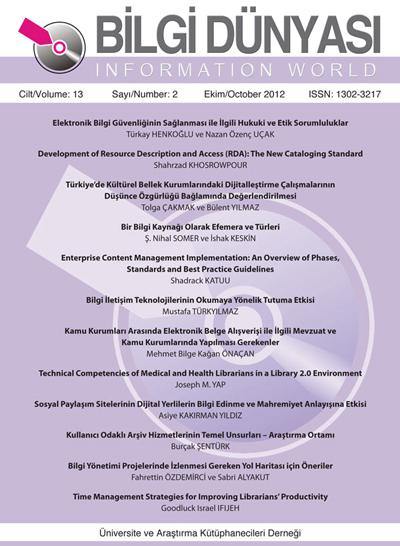
Resource Description and Access (RDA) is a new standard for describing and accessing information specifically designed for the digital environment. It is a shift from Anglo American Cataloging Rules II (AACR2) and it aims to provide a more user friendly service to library users in locating information in the library online catalogs. It is also targeting to facilitate a cataloging standard which can be shared globally and be edited simultaneously by the catalogers and other users when needed. There are similarities as well as diff erences between these two cataloging standards. Since the development of RDA started in 2005, there has been a hot discussion among catalogers about the advantages and disadvantages of the two standards against each other. There are also arguments on the changes that RDA would introduce to the cataloging standards and questioning if this is the right time to move forward with these changes. This paper provides the reader an overview of the development of RDA standards and the outcome of this new standard yet to be adopted.
Keywords: Library catalogs, Anglo-American Cataloging Rules II (AACR2), Resource Description and Access (RDA), Bibliographic control, Functional Requirements for Bibliographic Records (FRBR), Functional Requirements for Authority Data (FRAD), RDA
References
- Bai, H., Qiao, X. & Liang, B. (2011). Semantic bibliography based on ontology and Linked Data. In Proceedings of the International Conference on Dublin Core and Metadata Applications, (DC 2011--The Hague Proceedings), (pp.178-181). Retrieved March 3, 2012, from http://dcpapers.dublincore.org/index.php/pubs/article/view/3641/1867
- Bowen, J. & Lindahl, D. (2011, April 8). RDA and the eXtensible Catalog. Retrieved November 22, 2011, from http://hdl.handle.net/1802/14588
- Chapman, A. (2006, October). RDA: A new international standard. Ariadne, 49. Retrieved November 22, 2011, from http://www.ariadne.ac.uk/issue49/chapman
- Coyle, K. & Hillman, D. (2007, January/February). Resource Description and Access (RDA): Cataloging rules for the 20th century. D-Lib Magazine, 13(1/2).
- Cronin, C. (2011, September 27). RDA update and next steps: What you need to know. Retrieved August 21, 2012, from http://www.oclc.org/ca/fr/multimedia/2011/files/GoodPracticesChicagoCronin.pdf
- Gorman, M. (2007). RDA: Imminent Debacle. American Libraries, 38(11), 64-65.
- Hennelly, J. (2011, November 8). RDA Toolkit blog: RDA Toolkit release- November 8, 2011 [Web log post]. Retrieved December 26, 2011, from http://www.rdatoolkit.org/content/274
- International Federation of Library Associations and Institutions (IFLA). (2012). Functional Requirements for Authority Data: A conceptual model. [IFLA series on bibliographic control 34, by G. E. Patton (Ed.)]. Retrieved August 16, 2012, from http://www.ifla.org/publications/ifla-series-on-bibliographic-control-34
- Joint Steering Committee for development of RDA (JSC). (2010). RDA: Resource Description and Access- Frequently Asked Questions, 9. Adopting RDA- 9.2. Retrieved August 20, 2012, from http://www.rda-jsc.org/rdafaq.html#9-2
- Joint Steering Committee for development of RDA (JSC). (2012). JSC membership 1974 - . Retrieved August 20, 2012, from http://www.rda-jsc.org/jscmembers.html
- Joint Steering Committee for development of RDA (JSC). (2012). RDA: Resource Description and Access-Background. Retrieved August 16, 2012, from http://www.rda-jsc.org/rda.html#background
- Kiorgaard, D. (2005). RDA: Resource Description and Access Part I of RDA- Constituency review of December 2005 draft (Joint Steering Committee for revision of AACR, 5JSC/RDA/Part I). Retrieved January 20, 2012, from http://www.rda-jsc.org/docs/5rda-part1.pdf
- Lewis, P. R. (1978). Preface to the Anglo-American Cataloguing Rules, Second Edition (1978). Retrieved August 16, 2012, from http://www.rda-jsc.org/docs/aacr2preface1978.pdf
- Library of Congress (LC). (1998). MARC 21: Harmonized USMARC and CAN/MARC. Retrieved March 10, 2012, from http://www.loc.gov/marc/annmarc21.html
- Library of Congress (LC). (2008). On the record: Report of the Library of Congress Working Group on the Future of Bibliographic Control. Retrieved March 3, 2012, from http://www.loc.gov/bibliographic-future/news/lcwg-ontherecord-jan08-final.pdf
- Library of Congress (LC). (2011). Report and recommendations of the U.S. RDA Test Coordinating Committee: 9 May 2011 revised for public release 20 June 2011. Retrieved February 15, 2012, from http://www.loc.gov/bibliographic-future/rda/source/rdatesting-finalreport-20june2011.pdf
- Library of Congress (LC). (2011). Report on the RDA/MARC Working Group discussion of identifying entity types in MARC records. Retrieved August 21, 2012, from http://www.loc.gov/marc/marbi/WEMI_report.html
- Library of Congress (LC). (2012). U.S. RDA implementation updates from the U.S. RDA Test Coordinating Committee. Retrieved February 28, 2012, from http://www.loc.gov/aba/rda/pdf/RDA_updates_16jan12.pdf
- Library of Congress (LC). (2012). Library of Congress announces its long-range RDA training plan. Retrieved March 2, 2012, from http://www.loc.gov/catdir/cpso/news_rda_implementation_date.html
- Library of Congress (LC). (2012). Program for Cooperative Cataloging: What’s new, decisions, policies and tasks- PCC day one for RDA authority records. Retrieved August 23, 2012, from http://www.loc.gov/aba/pcc
- Maliaburton. (2010). Learning about RDA, The future of bibliographic control: Data infrastructure [Web log post]. Retrieved October 10, 2011, from http://Learningaboutrda.wordpress.com
- Maxwell, R. L. (2012). Maxwell’s handbook for RDA: Explaining and illustrating RDA, Resource description and access, using MARC21. Chicago, Illinois: American Library Association.
- McCallum, S. H. (2005). Using MARC 21 with FRBR: Record configurations. Retrieved August 21, 2012, from http://www.loc.gov/marc/marbi/2005/2005-report02.pdf
- Medeiros, N. (2005). The future of the Anglo American Cataloging Rules. OCLC Systems & Services 21(4), 261-63.
- Oliver, C. (2011). Preparing for transition: Here comes RDA!. Retrieved August 25, 2012, from http://www.rda-jsc.org/docs/CLA2011-Preparing-for-transition-Oliver.pdf
- Online Computer Library Center (OCLC). (2011). OCLC policy statement on RDA cataloging in WorldCat for the U.S. testing period and beyond. Retrieved August 22, 2012, from http://www.oclc.org/rda/policy.htm
- Scottish Library and Information Council and European RDA Interest Group (SLIC & EURIG). (2011). European RDA Interest Group: Documents. Retrieved February 28, 2012, from http://www.slainte.org.uk/eurig/documents.htm
- Seikel, M. & Steele, T. (2011). How MARC has changed: The history of the format and its forthcoming relationship to RDA. Technical Services Quarterly, 28(3), 322-334.
- Spero, S. (2012). RDA-L, LISTSERV.LAC-BAC.GC.CA Library and Archives Canada - Bibliotheque et Archives Canada. Retrieved May 18, 2012, http://www.lsoft.com/scripts/wl.exe?SL1=RDA-L&H=LISTSERV.LAC-BAC.GC.CA
- Spicher, K. M. (1996). The development of the MARC format. Cataloging & Classification Quarterly, 21(3-4), 75-90.
- Suber, P. (2004). A very brief introduction to Open Access. Retrieved November 28, 2011, from http://www.earlham.edu/~peters/fos/brief.htm
- Tillett, B. (2003). FRBR (Functional Requirements for Bibliographic Records). Technicalities, 23(5), 1-13.
- Tillett, B. & Patton, G. (2008). A review of the feasibility of an International Standard Authority Data Number (ISADN). Retrieved August 16, 2012, from http://archive.ifla.org/VII/d4/franar-numbering-paper.pdf
License
Copyright (c) 2012 The author(s). This is an open access article distributed under the Creative Commons Attribution License (CC BY), which permits unrestricted use, distribution, and reproduction in any medium or format, provided the original work is properly cited.