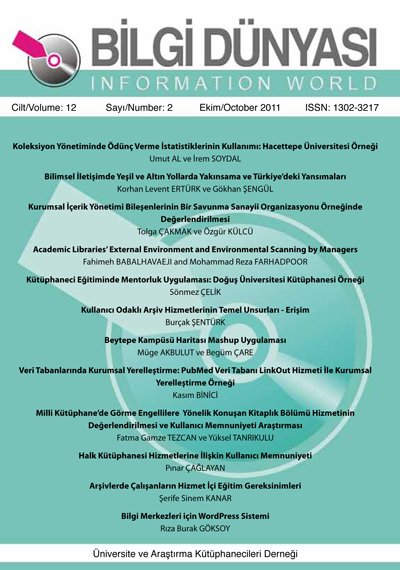
Abstract
The purpose of this study is to evaluate the library services for the visually handicapped users by handling the “Talking Library” department in National Library and carry out a user satisfaction survey in respect of these evaluations. In this context, a questionnaire has been applied on November-December 2010 for visually handicapped users of National Library. A face to face interview was held with Altı Nokta Association of The Blind members, the staff of Rehabilitation Center for Visually handicapped, the students and teachers of Mitat Enç Visually Disabled Primary School, the students of Cumhuriyet High School and the visually disabled personnel of National Library and the other visually disabled users there, and some surveys were applied. Besides, the questionnaires were sent to the members of “Talking Library” department by e-mails via the personnel of “Talking Library” and answered. Totally 45 visually disabled people were mutually interviewed and among them 32 visually disabled users who have been using National Library Talking Library service or the ones used it before answered the questionnaire. By the findings obtained from the questionnaire, the user satisfaction has been assessed. The results of the questionnaire have revealed that the service for the visually disabled users in National Library Talking Library Department is not satisfactory and sufficient and some solutions have been offered within this scope.
Keywords: Talking library, Visually impaired users, User satisfaction, National Library
References
- Bakırcı, R. (2009). Milli Kütüphane’de görme engellilere sunulan hizmetler ve gelişmeler. Bilgi Dünyası, 10(1), 100–104
- Büyüksan, F. Y. (2009). Görme engellilere yönelik konuşan kitaplık hizmetinin geliştirilmesi: Milli Kütüphane örneği. Yayınlanmamış uzmanlık tezi.
- Çanak Akbaytürk, T. (2005, 22-24 Aralık). Kütüphanelerde kullanıcı memnuniyeti anketleri: Koç üniversitesi Suna Kıraç kütüphanesi deneyimi. ÜNAK’05 Bilgi Hizmetlerinin Organizasyonu ve Pazarlanması konferansında sunulan bildiri. http://kaynak.unak.org.tr/bildiri/unak05/u05-20.pdf adresinden erişildi.
- Özkan, M. (2001). Görme engellilere yönelik eğitim kurumlarında mekansal problemlerin irdelenmesi ve çözüm önerileri. Yayınlanmamış Yüksek Lisans Tezi. Dokuz Eylül Üniversitesi, Fen Bilimleri Enstitüsü, İzmir.
- Halk kütüphaneleri hizmeti: IFLA/UNESCO ilkeleri (2004). (B. Yılmaz Çev.). İstanbul: TKD İstanbul Şubesi.
- Kanık, L. (1994). Görme engellilere yönelik kütüphane hizmetleri. Yayınlanmamış yüksek lisans tezi Hacettepe Üniversitesi, Ankara.
- Kaynar, M. (1992). Görme özürlüler için kütüphane hizmeti. Türk Kütüphaneciliği, 6(2), 114–117.
- Kazak, M. (2008). Görme engellilere yönelik kütüphanecilik hizmetlerinde Türkiye’deki son gelişmeler: Gazi Üniversitesi merkez kütüphanesi görme engelliler bolumu örneği. Türk Kütüphaneciliği, 22(2), 216 – 221.
- Subaşıoğlu, F. (2007). Görme engellilere yönelik kütüphanecilik ve ders programları. Ulusal Körler ve Kütüphanecilik Sempozyumu: Bitmeyen Gece Doç. Dr. Mithat Enç Anısına 16-17 Ekim 2007. Ankara.
- Tunçkanat, H. (1990). Ulusal bilgi birikiminin denetlenmesi ve ulusal kütüphanemiz. Türk Kütüphaneciliği, 4(4), 170–174.
- Özmen, B.B. (2005). Görme engelliler için konut iç mekanları ve donatı elemanlarının tasarım ve biçimlenişi. Yayınlanmamış yüksek lisans tezi Hacettepe Üniversitesi, Ankara.
- Yılmaz, B. (2009). Bilgi ve belge yönetiminde (kütüphanecilikte) etik: kuramsal bir yaklaşım. Kamu Etik Sempozyumu 25–26 Mayıs 2009 TODAİE/Ankara içinde (ss.395–404). Ankara: TODAİE.
- Yılmaz, E. (2004, 11-13 Şubat). Üniversite kütüphanelerinde web tabanlı kullanıcı memnuniyeti ölçümü. Akademik Bilişim 2004 (Karadeniz Teknik Üniversitesi, 11- 13 Şubat, Trabzon) Konferansı’nda sunulan bildiri. http://ab.org.tr/ab04/program/7.html adresinden erişildi.
License
Copyright (c) 2011 The author(s). This is an open access article distributed under the Creative Commons Attribution License (CC BY), which permits unrestricted use, distribution, and reproduction in any medium or format, provided the original work is properly cited.