Abstract
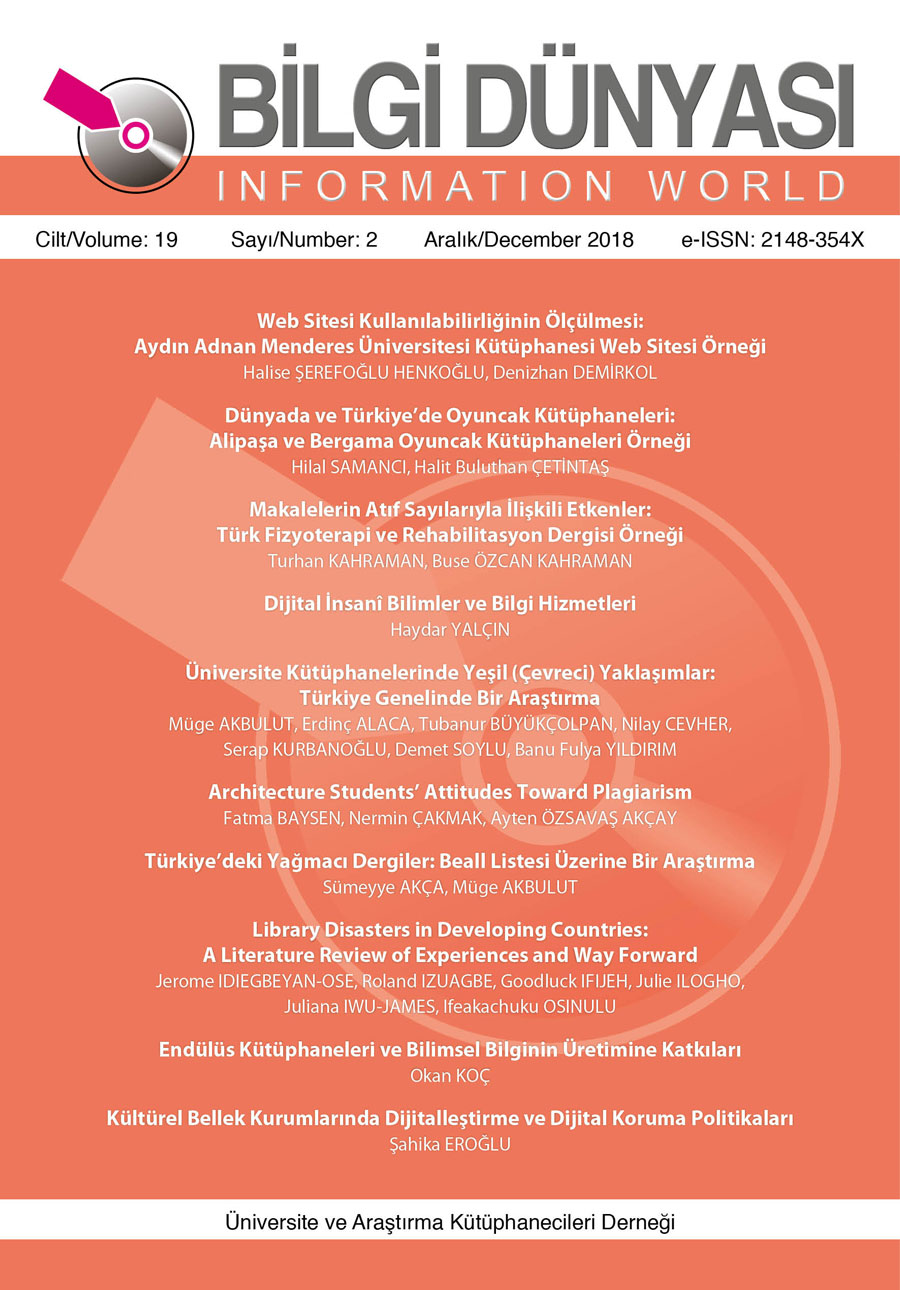
In this study predatory journals originated from Turkey in the Beall list, which situated in the context of the literature as an authority, have been identified and studied in detail. Results show that 3.2% of the journals in the list originated from Turkey. Accordingly, it is seen Turkey ranks second after India in the list. While the number of Turkish journals in the list was at a certain level from 2003 to 2010 (seven journals in 2010), it started to show a sudden increase since 2011 and reached 41 in 2016. We believe that the criteria discussed by the researchers (the criteria set by Beall or the others who criticize the Beall list) will guide the researcher to determine the predatory journals in order to be able to avoid them.
Keywords: Predatory journals, Beall list, hijacked (Illegitimate) journals, Jeffrey Beall
References
- Al, U., ve Soydal, İ. (2015). Bilimsel iletişimin farklı bir yüzü: Geri çekilen makaleler [The other face of scholarly communication: Retracted articles]. Prof. Dr. İrfan Çakın’a Armağan içinde (ss. 22-37).
- Anderson, R. (2015a, 11 Mayıs). Should we retire the term “predatory publishing”? [Web blog yazısı]. https://scholarlykitchen.sspnet.org/2015/05/11/should-we-retire-the-term-predatory-publishing/ adresinden erişildi.
- Anderson, R. (2015b, 17 Ağustos). Deceptive publishing: Why we need a blacklist, and some suggestions on how to do it right [Web blog yazısı]. https://scholarlykitchen.sspnet.org/2015/08/17/deceptive-publishing-why-we-need-a-blacklist-and-some-suggestions-on-how-to-do-it-right/ adresinden erişildi.
- Anderson, R. (2017a, 25 Temmuz). Cabell’s new predatory journal blacklist: A review [Web blog yazısı]. https://scholarlykitchen.sspnet.org/2017/07/25/cabells-new-predatory-journal-blacklist-review/ adresinden erişildi.
- Anderson, R. (2017b, 4 Aralık). Federal Trade Commission and National Institutes of Health take action against predatory publishing practices [Web blog yazısı]. https://scholarlykitchen.sspnet.org/2017/12/04/federal-trade-commission-national-institutes-health-take-action-predatory-publishing-practices/ adresinden erişildi.
- Türkiye sahte akademik makale basım merkezlerinden biri. (2018, 8 Ağustos). artigercek.com. https://www.artigercek.com/haberler/turkiye-sahte-akademik-makale-basim-merkezlerinden-biri adresinden erişildi.
- Beall, J. (2012). Predatory publishers are corrupting open access. Nature, 489(7415), 179.
- Beall J. (2016a). Dangerous predatory publishers threaten medical research. Journal of Korean Medical Science, 31(10), 1511-1513. https://doi.org/10.3346/jkms.2016.31.10.1511 adresinden erişildi.
- Beall, J. (2016b). Essential information about predatory publishers and journals. International Higher Education, (86), 2-3. https://ejournals.bc.edu/ojs/index.php/ihe/article/viewFile/9358/8368 adresinden erişildi.
- Cahit Arf Bilgi Merkezi. (2018a). TR Dizin Sıkça Sorulan Sorular. http://cabim.ulakbim.gov.tr/tr-dizin/tr-dizin-sikca-sorulan-sorular/ adresinden erişildi.
- Cahit Arf Bilgi Merkezi. (2018b). DergiPark Sıkça Sorulan Sorular. http://cabim.ulakbim.gov.tr/dergipark/dergipark-sikca-sorulan-sorular/ adresinden erişildi.
- Christopher, M. M. ve Young, K. M. (2015). Awareness of ”predatory” open-access journals among prospective veterinary and medical authors attending scientific writing workshops. Frontiers in Veterinary Science, 2, 22. doi:10.3389/fvets.2015.00022
- Cress, P. (2017a, 11 Aralık). Guest post: When authors get caught in the predatory (illegitimate publishing) net [Web blog yazısı]. https://scholarlykitchen.sspnet.org/2017/12/11/guest-post-authors-get-caught-predatory-illegitimate-publishing-net/?informz=1 adresinden erişildi.
- Cress, P. E. (2017b). Are predatory conferences the dark side of the open access movement? Aesthetic Surgery Journal, 37(6), 734-738. doi: 10.1093/asj/sjw247
- Farmer, H. (2017, 23 Ocak). Beall’s list and what we need to replace it. [Blog yazısı]. https://www.science20.com/hontas_farmer/bealls_list_and_what_we_need_to_replace_it-224844 adresinden erişildi.
- Garfield, E. (1972). Citation analysis as a tool in journal evaluation. Science, 178, 471-479. doi: 10.1126/science.178.4060.471.
- Gasparyan A. Y, Yessirkepov M, Diyanova S. N. ve Kitas G. D. (2015). Publishing Ethics and Predatory Practices: A Dilemma for All Stakeholders of Science Communication. J Korean Med Sci, 30(8),1010-1016. https://doi.org/10.3346/jkms.2015.30.8.1010 adresinden erişildi.
- Kaptan, S. (1977). Bilimsel araştırma teknikleri. Ankara: Tekışık Matbaası.
- Markowitz, D. M., Powell, J. H. ve Hancock, J. T. (2014, 15-18 Haziran). The writing style of predatory publishers. 121st ASEE Annual Conference & Exposition’da sunulan bildiri, Indianapolis, IN. http://www.asee.org/public/conferences/32/papers/8614/view adresinden erişildi.
- Meadows, A. (2017, 5 Aralık). Illegitimate journals and how to stop them: An interview with Kelly Cobey and Larissa Shamseer [Web blog yazısı]. https://scholarlykitchen.sspnet.org/2017/12/05/illegitimate-journals-stop-interview-kelly-cobey-larissa-shamseer/ adresinden erişildi.
- Moher, D. ve Srivastava, A. (2015). You are invited to submit. BMC Medicine, 13(180), 1-4. doi:10.1186/s12916-015-0423-3
- Moher, D., Shamseer, L., Cobey, K. D., Lalu, M. M., Galipeau, J., Avey, M. T., ... Ziai, H. (2017). Stop this waste of people, animals and money. Nature News, 549, 23-25. https://www.nature.com/polopoly_fs/1.22554!/menu/main/topColumns/topLeftColumn/pdf/549023a.pdf adresinden erişildi.
- Nelson, N. ve Huffman, J. (2015). Predatory journals in library databases: How much should we worry? Serials Librarian, 69(2), 169-192. doi:10.1080/0361526X.2015.1080782
- Nwagwu, W. E. ve Ojemeni, O. (2015). Penetration of Nigerian predatory biomedical open access journals 2007-2012: A bibliometric study. Learned Publishing, 28(1), 23-34. doi:10.1087/20150105
- The Organisation for Economic Co-operation and Development. (2018). DAC List of ODA recipients effective for reporting on 2018, 2019 and 2020 flows. https://www.oecd.org/dac/financing-sustainable-development/development-finance-standards/DAC_List_ODA_Recipients2018to2020_flows_En.pdf adresinden erişildi.
- Oermann, M. H., Conklin, J. L., Nicoll, L. H., Chinn, P. L., Ashton, K. S., Edie, A. H. ve Budinger, S. C. (2016). Study of predatory open access nursing journals. Journal of Nursing Scholarship, 48(6), 624-632. https://pdfs.semanticscholar.org/7035/dc08ea5d07d5d76166fa1da375e2e6e9ac71.pdf adresinden erişildi.
- Olijhoek, T., Bjørnshauge, L. ve Mitchell, D. (2015). Criteria for open access and publishing. ScienceOpen Research, 0(0), 1-8. doi: 10.14293/S2199-1006.1.SOR-EDU.AMHUHV.v1
- Shamseer, L. ve Moher, D. (2017, 27 Mart). Thirteen ways to spot a ‘predatory journal’ (and why we shouldn’t call them that) [Web blog yazısı]. https://www.timeshighereducation.com/blog/thirteen-ways-to-spot-a-predatory-journal-and-why-we-shouldnt-call-them-that adresinden erişildi.
- Shamseer, L., Moher, D., Maduekwe, O., Turner, L., Barbour, V., Burch, R. ve Shea, B. J. (2017). Potential predatory and legitimate biomedical journals: can you tell the difference? A cross sectional comparison. BMC medicine, 15(1), 1-14.
- Shen, C. ve Björk, B. C. (2015). “Predatory” open access: A longitudinal study of article volumes and market characteristics. BMC Medicine, 13(1), 1-15. http://doi.org/10.1186/s12916-015-0469-2 adresinden erişildi.
- Stenson, L. (2011). The development of Directory of Open Access Journals. ScieCom Info, 7(1). https://www.scienceopen.com/document/read?vid=2befee62-f9c0-4dc8-93c5-790d6102877d adresinden erişildi.
- Şahin, M. K, İğde, F. A. A. ve Dikici, M. F. (2017). Predatör dergilere dikkat. Türkiye Aile Hekimliği Dergisi, 21(3), 102-105.
- Şencan, İ. (2017). Ya “Sahte”yse? Türk Kütüphaneciliği, 31(4), 445-448. doi: 10.24146/tkd.2017.20
- Taşkın, Z. (2018). Çöp yayınlar başarıyı ölçmemeli. Herkese Bilim Teknoloji, 108.
- Tonta, Y. (2015). Açık bilim ve açık erişim. U. Al ve Z. Taşkın (Yay. Haz.). Prof. Dr. İrfan Çakın’a Armağan içinde (ss. 235-250). Ankara: Hacettepe Üniversitesi Bilgi ve Belge Yönetimi Bölümü.
- Wicherts, J. M. (2016). Peer review quality and transparency of the peer-review process in open access and subscription journals. PloS One, 11(1), 1-19. doi:10.1371/journal.pone.0147913
- Xia, J., Harmon, J. L., Connolly, K. G., Donnelly, R. M., Anderson, M. R. ve Howard, H. A. (2015). Who publishes in “predatory” journals? Journal of the Association for Information Science & Technology, 66(7), 1406-1417. doi:10.1002/asi.23265
License
Copyright (c) 2018 The author(s). This is an open access article distributed under the Creative Commons Attribution License (CC BY), which permits unrestricted use, distribution, and reproduction in any medium or format, provided the original work is properly cited.