Abstract
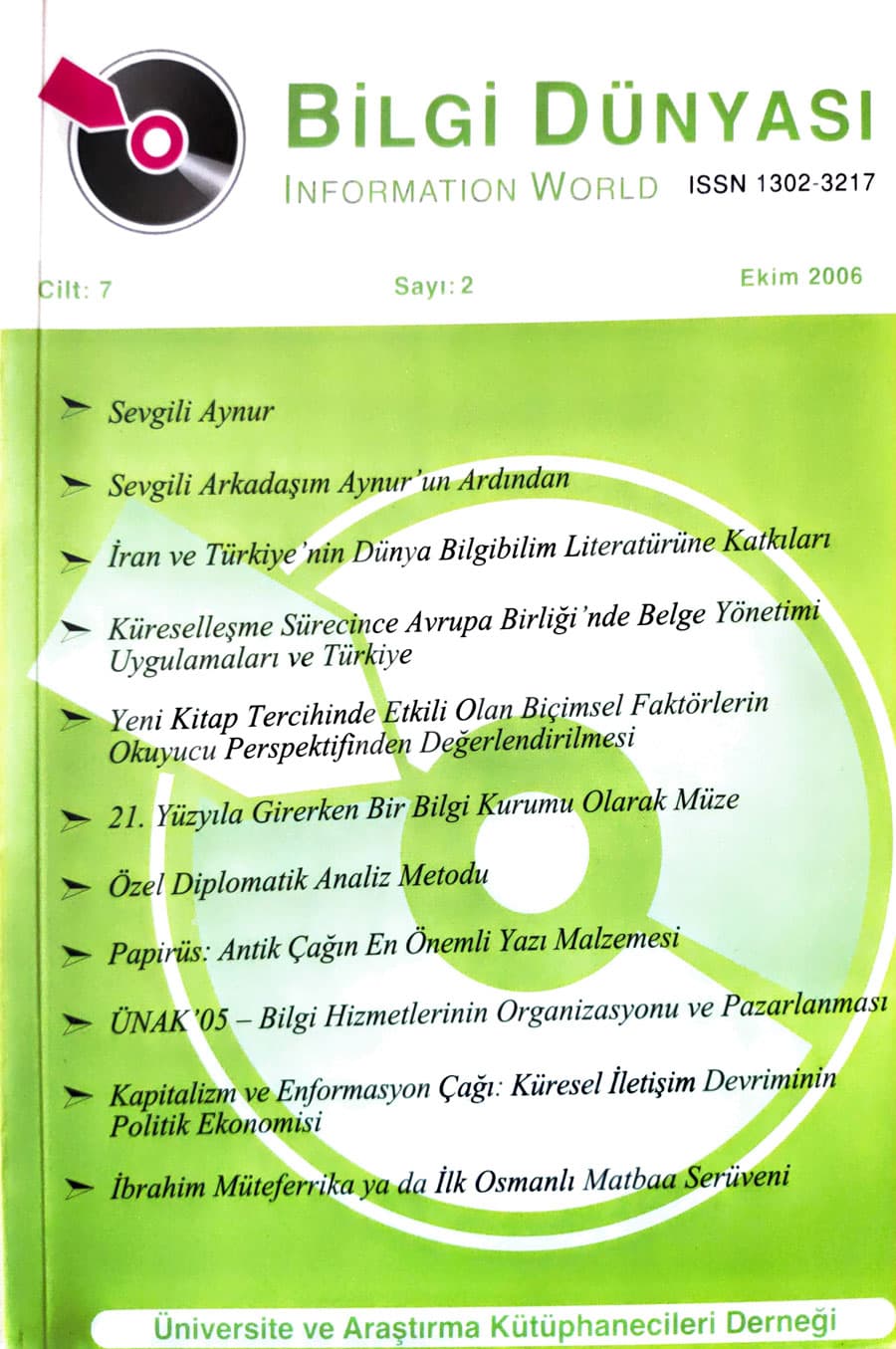
At the beginning of the 21st century, museums are influenced by the conditions that had been shaped in the previous century in the context of their accessibilty to public. One of these methods, which is the most common one, is using information in their work and services. This method, prevents museums from being just show and recreation centers, supporting their service in the developing society. In this article, a classification has been suggested for museums defining, how information can be used in museums of our age to analyse their use of information.
Keywords: Museum information services, Museum information systems, Museums-Information processing
References
- Ar›kbo¤a, F. fi. (2003). Entellektüel sermaye. ‹stanbul: Derin Yay›nlar›.
- Barutçugil, ‹. (2002). Bilgi yönetimi. ‹stanbul: Kariyer Yay›nlar›.
- Burke, P. (2001). Gutenberg’den Diderot’ya: Bilginin toplumsal tarihi. (Mete Tunçay, Çev.). ‹stanbul: Tarih Vakf› Yurt Yay›nlar›.
- DADABASE. (2006). Frequently Asked Questions. 10 Ekim 2006 tarihinde Museum of Modern Art Web sitesinden eriflildi: http://moma.org/research/library/dadabase.html.
- Feather, J. (2003). Theoretical perspectives on the information society: Challenge and change in the information society. (S. Hornby ve Z. Clarke, Ed.). London: Facet Publishing.
- Franz, E. G. (1978). Archive, Bibliotheken, Museen. Der Archivar, 31, sütun 26.
- Hayes, R. M. (1993). Measurement of information. Information Processing and Management, 29(1), 1-11.
- Hein, H. S., (2000). Museum in transition: A philosophical perspective, USA: Smithsonian Institution.
- Hooper-Greenhill, E. (1999a). The Educational role of the museum (2. bs.), London; New York: Routledge.
- Hooper-Greenhill, E. (1999b). Müze ve galeri e¤itimi (Meltem Örge Evren, Emine Gül Kapç›, Çev). Bekir Onur (Yay. Haz.), Ankara: Ankara Üniversitesi Çocuk Kültürü Araflt›rma ve Uygulama Merkezi Yay›nlar›.
- International Council of Museums Code of Ethics. (2004a). Definition of a Museum. 20 Nisan 2005 tarihinde http://icom.museum/ethics.html#intro adresinden eriflildi.
- International Council of Museums Code of Ethics. (2004b). Personnel. 20 Nisan 2005 tarihinde http://icom.museum/ethics.html#preamble1 adresinden eriflildi.
- J. P. Getty. Museum. Conducting Research. 12 Nisan 2006 tarihinde http://www.getty.edu/research/conducting_research/ adresinden eriflildi.
- Leonhardt, H. A. (2000). Kütüphane malzemesi nedir, arfliv ve müze malzemesi nedir? (‹shak Keskin, Çev.) Arfliv Araflt›rmalar› Dergisi, 2, 79-95.
- Mattelart, A. (2004). Bilgi toplumunun tarihi. ‹stanbul: ‹letiflim Yay›nlar›.
- Nazi-Era Provenance Internet Portal. About The Portal. 12 Nisan 2006 tarihinde http://www.nepip.org/public/info/about.cfm?menu_type= adresinden eriflildi.
- Orna, E. ve Pettitt, C. (1998). Information management in museums. England: Gover Publishing.
- Özdemirci, F. (1996). Kurum ve kurulufllarda belge üretiminin denetlenmesi ve belge yönetimi. ‹stanbul: Türki Kütüphaneciler Derne¤i ‹stanbul fiubesi.
- Schubert, K. (2004). Küratörün yumurtas›: Müze kavram›n›n Frans›z ‹htilalin den günümüze kadar olan evrim (Rana Smith, Çev.). ‹stanbul: ‹stanbul Sanat Müzesi Vakf›.
- Sherman, D. J. (2000). Museum culture: Histories, discourses, spectacles (4. bs.). USA: University of Minesota Press.
- Tate Research. (2000). Culture Mining: Time Based Cultural Documents and Online Audio/Video (Re)search Tools. 15 Nisan 2006 tarihinde http://www.tate.org.uk/research/tateresearch/majorprojects/data_mining.htm adresinden eriflildi.
- The World Bank. (1998). World Development Report: Knowledge for Development. 18 Nisan 2006 tarihinde http://wdsbeta.worldbank.org/external/default/WDSContentServer/IW3P/IB/1998/11/17/000178830_98111703550058/Rendered/PDF/multi0page.pdf adresinden eriflildi.
License
Copyright (c) 2006 The author(s). This is an open access article distributed under the Creative Commons Attribution License (CC BY), which permits unrestricted use, distribution, and reproduction in any medium or format, provided the original work is properly cited.