Abstract
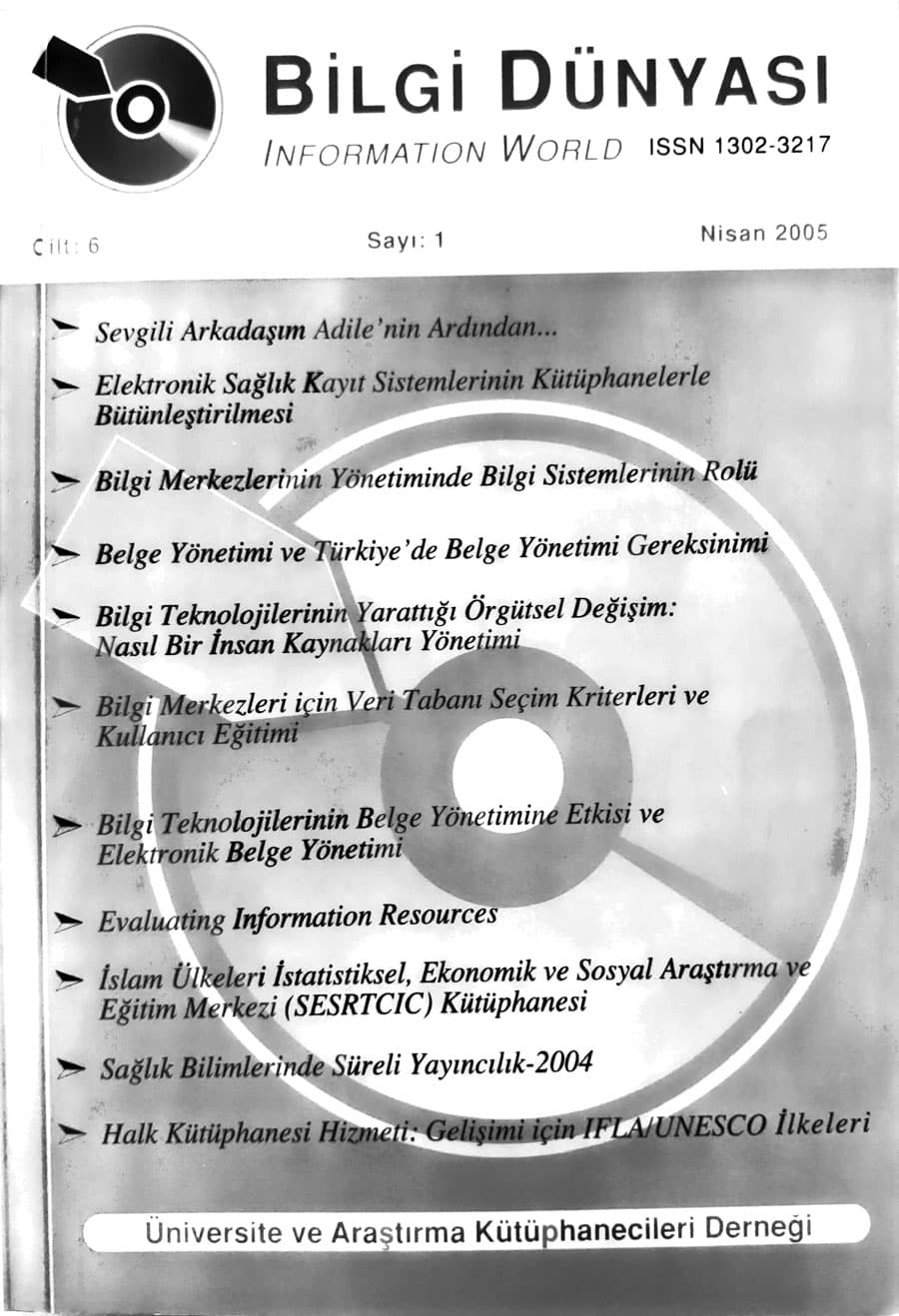
This article discusses the reasons why electronic resources are included in library collections, and the criteria of selecting the mentioned electronic resources. Apart from the usual criteria for the development of library collections through printed publications, there exist also other preconditions for the inclusion of electronic resources, and such were extensively discussed. Moreover, the most important question that would arise in selecting and supplying the electronic resources, namely the end-user education, was exemplified on the basis of a sample illustration.
Keywords: Electronic resources, Database, Collection development, Selection criteria
References
- Allison, D.A. (2000). Database selection. College and Research Libraries, 61(1), 56-63.
- Flecker, D. (2001). Preserving scholarly e-jornals. D-Lib Magazine, 7(9), 47-51.
- Gardner, R.K. (1981). Library collections: Their origin, selection and development. New York: McGraw Hill.
- Holleman, C. (2000). Electronic Resources: Are basic criteria for the selection of material changing. Library Trends, 48(4), 694-710.
- Johnson, S. (1999). Using information technology to improve collection management. Library Computing, 18(2), 98-104.
- McGeachin, R.B. (1998, Spring). Selection criteria for web-based resources in a science and technology library collection. Issues in Science and Technology Librarianship, Spring 1998. http://www.library.ucsb.edu/istl/98-spring/article2.html.
- Okerson, S.A. (1999). Buy or Lease: Two models for scholorly at the and (or the beginning) of an era. Deadalus, 125(4), 55-76.
- Pearlmutter, J. (1999). Which online resources are right for your collection? School Library Journal, 45(6), 27-29.
- Tonta, Y. (2000). Elektronik yayıncılıkta son gelişmeler. Bilgi Dünyası, 1(1), 89-132.
- Tonta, Y. (2001). Collection development of electronic information resources in Turkish university libraries. Library Collections, Acquisitions and Technical Services, 25(3), 291-298.
- Yamak, U. (1998). Kalite odaklı yönetim. İstanbul: Komputron.
License
Copyright (c) 2005 The author(s). This is an open access article distributed under the Creative Commons Attribution License (CC BY), which permits unrestricted use, distribution, and reproduction in any medium or format, provided the original work is properly cited.