Abstract
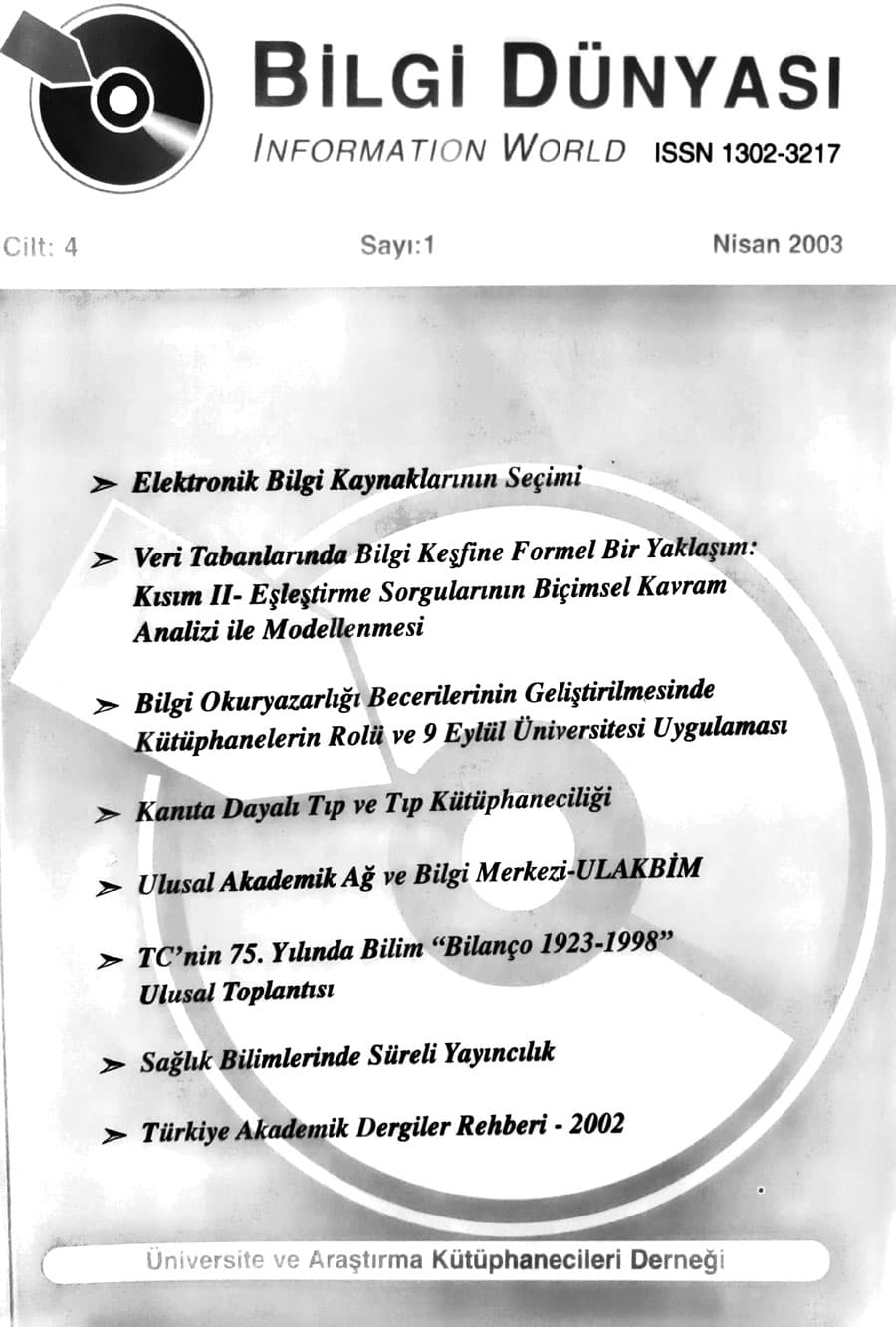
In this study we utilize formal concept analysis to model association rules. Formal concept analysis provides a topological structure for a universe of objects and attributes. By exploiting the relationship between objects and attributes, formal concept analysis then introduces an entity called a concept. A concept is a set of attributes and objects. The attributes are maximally possessed by the set of objects and similarly the objects are the maximal set which all possess the set of attributes. Formal concept analysis deals with formal mathematical tools and techniques to develop and analyze relationship between concepts and to develop concept structures. We propose and develop a connection between association rule mining and formal concept analysis. We show that dependencies found by an association query can be derived from a concept structure. We have extended formal concept analysis framework to the association rule mining. We use analysis of market-basket problem, a specific case of association rule mining, to achieve this extension. This extension provides a natural basis for complexity analysis of the association rule mining. This extension can also help in developing a unified framework for common data mining problems.
Keywords: Formal concept analysis, Association query, Dependency relationships, Concept structures
References
- Agrawal, R., Imielinski, T. ve Swami, A. (1993). Mining association rules between sets of items in large databases. ACM SIGMOD Record, Proceedings of the 1993 ACM SIGMOD International Conference on Management of Data. 22 (2): 207-216.
- Agrawal, R. ve Srikant, R. (1994). Fast algorithms for mining association rules in large databases. 20th International Conference on Very Large Databases, VLDB’94, September 12-15, Santiago, Chile, içinde s. 487-499.
- Davey, B.A. ve Priestley, H.A. (1990). Introduction to lattices and orders. Cambridge: Cambridge University Press.
- Meo, R., Psaila, G. ve Ceri, S. (1996). A new SQL-like operator for mining association rules. 22nd International Conference on Very Large Databases, VLDB’96, September 3-6, Mumbai (Bombay), India, içinde s. 1-12.
- Park, J. S., Chen, M.S. ve Yu, P.S. (1995). An effective hash-based algorithm for mining association rules. Proceedings of the ACM SIGMOD International Conference on Management of Data, May 22-25, San Jose, California, içinde s. 175-186.
- Pawlak, Z. (1984). Rough classification. International Journal of Man-Machine Studies, 31(1): 63-103.
- Savasere, A., Omiecinski, E. ve Navathe, S. (1995). An efficient algorithm for mining association rules in large databases. 21st International Conference on Very Large Databases, VLDB’95, September 11-15, Zurich, Switzerland, içinde s. 432-444.
- Sever, H. ve O¤uz, B. (2002). Veri tabanlar›nda bilgi keflfine formal bir yaklafl›m: K›s›m 1- Efllefltirme sorgular› ve algoritmalar. Bilgi Dünyas›, 3(2): 173-204.
- Wille, R. (1982). Restructuring lattice theory: An approach based on hierarchies on concepts. I. Rival (ed.). Ordered Sets içinde (s. 445-470). Dordrecht-Boston: D. Reidel Publishing Company.
License
Copyright (c) 2003 The author(s). This is an open access article distributed under the Creative Commons Attribution License (CC BY), which permits unrestricted use, distribution, and reproduction in any medium or format, provided the original work is properly cited.