Abstract
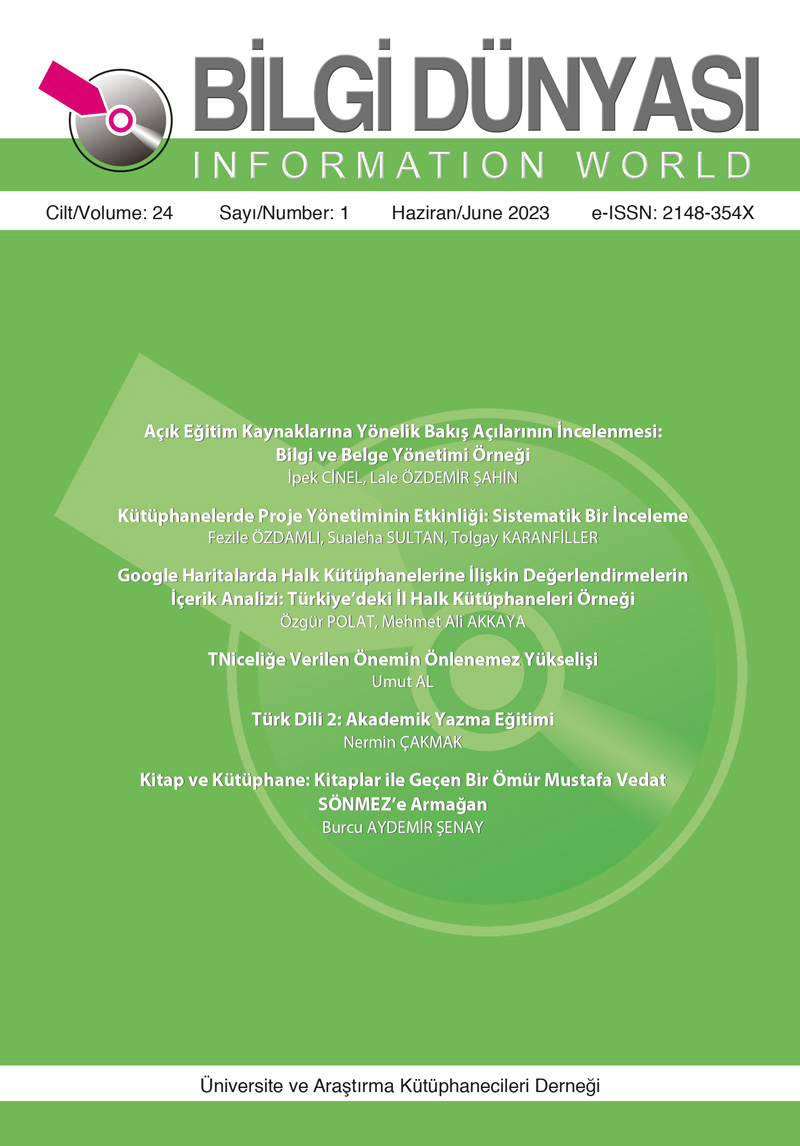
As a reflection of the prevalence of the internet world and the attraction it has created all fields of life and almost all disciplines take this medium and what it brings with it much more into consideration. At this point, the first actors that come to mind are social media tools and interactive online applications. The convergence in question undoubtedly encompasses the world of information centers as well. Scientific studies with different qualities and contents not only confirm this convergence, but also draw attention to the speed of change. In this study, it is aimed to draw attention to the importance of the application for libraries by analyzing the evaluations made about the provincial public libraries through the Google Maps application from different perspectives. Thus, the use of the Google Maps application, which is constantly increasing due to the fact that the evaluations and opinions can be freely expressed, especially due to the high level of interaction and satisfaction, and the different associations related to the map, are more referenced by the libraries and the data to be obtained will turn into service adequacy and user satisfaction. aimed to contribute. In the study, besides the written document and document analysis method, the descriptive method was used in the editing of the text. The population of the study consists of 81 provincial public libraries in Türkiye. Within the scope of the research, 6.314 evaluations made about the provincial public libraries over the Google Maps application were analyzed using the MAXQDA program. The findings revealed that the Google Maps application for other information centers in Türkiye, as well as the provincial public libraries, has extremely unique and reference data in terms of increasing service performance, user interaction, social perception, and acceptance. The research, which is the first study in the national literature in which the Google Maps application, which is frequently discussed with a scientific approach in different disciplines, is associated with the field of librarianship. It is considered that it will contribute to its transformation into a “good” library.
Keywords: Provincial public library, social media, online application, Google Maps, online assessment, library experience
References
- Akkaya, M. A. (2021). Bilgi kaynağı ve bilgiye erişim aracı olarak internet algısı: kuşaklararası yaklaşım farklılığının karşılaştırılması. Bilgi Yönetimi, 4(2), 222-239. https://doi.org/10.33721/by.947918
- Ateş, A. ve Sunar, H. (2019). İvriz Kültürel Peyzajı alanının çevrimiçi ziyaretçi yorumları ile analizi: Google Haritalar örneği. https://www.researchgate.net/publication/331727526_Ivriz_Kulturel_Peyzaji_Alaninin_Cevrimici_Ziyaretci_Yorumlari_ile_Analizi_Google_Haritalar_Ornegi
- Başaran, T. ve Somunca, M. (2021). Sürdürülebilir destinasyon için ziyaretçi görüşlerinin önemi: Assos antik kenti örneği. Ankara Üniversitesi Çevrebilimleri Dergisi, 8(2), 31-45. https://dergipark.org.tr/tr/pub/aucevrebilim/issue/67453/1036551
- Borrego, A. ve Navarra, M. C. (2020). What users say about public libraries: an analysis of Google Maps reviews. Online Information Review, 45(1), 84-98. https://doi.org/10.1108/OIR-09-2019-0291
- Dodsworth, E. ve Nicholson, A. (2012). Academic uses of Google Earth and Google Maps in a library setting. Information Technology and Libraries, 31(2), 102-117. https://doi.org/10.6017/ital.v31i2.1848
- Erdem, B. (2020). Çevrimiçi yorumların davranışsal niyete etkisi: Google Haritalar örneği. Social Mentality and Researcher Thinkers Journal, 6(30): 357-364. http://dx.doi.org/10.31576/smryj.477
- Google Play. (2023). Google haritalar. https://play.google.com/store/apps/details?id=com.google.android.apps.maps
- Goran, J., LaBerge, L. ve Srinivasan, R. (2017). Culture for a digital age. https://lediag.net/wp-content/uploads/2018/05/0-Culture-for-a-digital-age.pdf
- Halaç, H. H., Sarıaydın, E. U. ve Karaçor, F. (2021). Çevrimiçi ziyaretçi yorumlarında Çatalhöyük Neolitik Kenti. Hacı Bektaş Veli Üniversitesi SBE Dergisi, 11(3), 1506-1520. https://doi.org/10.30783/nevsosbilen.895902
- Karasar, N. (2016). Bilimsel araştırma yöntemi: Kavramlar ilkeler teknikler. (31. bs.). Nobel Akademi.
- Khan, A. M. ve Loan, F. A. (2022). Exploring the reviews of Google Maps to assess the user opinions about public libraries. Library Management, 43(8/9), 601-615. https://doi.org/10.1108/LM-05-2022-0053
- Korkmaz, H. (2020). Troya Müzesi elektronik ziyaretçi yorumlarının hizmet özellikleri, memnuniyet ve tavsiye açısından incelenmesi. Gastroia: Journal of Gastronomy and Travel Research, 4(1), 43-56. https://doi.org/10.32958/gastoria.708307
- Kronqvist-Berg, M. (2014). Social media and public libraries: Exploring ınformation activities of library professionals and users. Åbo Akademi University Press.
- Luers, A. L. (2021). Planetary intelligence for sustainability in the digital age: Five priorities. One Earth, 4(8), 772-775. https://doi.org/10.1016/j.oneear.2021.05.013
- Lund, N. F., Cohen, S. A. ve Scarles, C. (2018). The power of social media storytelling in destination branding. Journal of Destination Marketing & Management, 8, 271-280. http://dx.doi.org/10.1016/j.jdmm.2017.05.003
- Mancı, A. R. ve Tengilimoğlu, E. (2021). TripAdvisor ziyaretçi yorumlarının içerik analizi: Göbeklitepe örneği: Türk Turizm Araştırmaları Dergisi, 5(2), 1525-1545. http://dx.doi.org/10.26677/TR1010.2021.779
- Mathayomchan, B. ve Taecharungroj, V. (2020). “How was your meal?” Examining customer experience using Google maps reviews. International Journal of Hospitality Management, 90, 1-13. https://doi.org/10.1016/j.ijhm.2020.102641
- Mehta, H., Kanani, P. ve Lande, P. (2019). Google Maps. International Journal of Computer Applications, 178(8), 41-46. http://doi.org/10.5120/ijca2019918791
- Meredith, J. (2020). The power of social media to capture today’s consumer. https://www.forbes.com/sites/forbescommunicationscouncil/2020/06/25/the-power-of-social-media-to-capture-todays-consumer/?sh=5d762657789e
- Nenn, K. (2022). How and why to make use of Google Maps. https://doi.org/10.1002/npcr.32035
- Odabaş, H. ve Akkaya, M. A. (2018). Önsöz. Halk kütüphaneleri: Geçmişten geleceğe yönelimler ve yeni roller içinde (ss. 7-9). H. Odabaş ve M. A. Akkaya (Yay. Haz.). Hiperyayın.
- Patton, M. Q. (2014). Nitel araştırma ve değerlendirme yöntemleri. (3. Baskıdan Çeviri). Bütün, M. Bütün ve S. B. Demir (Çev. Ed.). Pegem Akademi.
- Seyidoğlu, H. (1992). Bilimsel araştırma ve yazma el kitabı. (4. bs.). Güzem.
- Vikipedi (2023a). Sosyal medya maddesi. https://tr.wikipedia.org/wiki/Sosyal_medya
- Vikipedi (2023b). Google haritalar maddesi. https://tr.wikipedia.org/wiki/Google_Haritalar
- Yıldırım, A. ve Şimşek, H. (2021). Sosyal bilimlerde nitel araştırma yöntemleri. (12. bs.). Seçkin.
- Zhuravskaya, E., Petrova, M. ve Enikolopov, R. (2020). Political effects of the internet and social media. Annual Review of Economics, 12, 415-438. https://doi.org/10.1146/annurev-economics-081919-050239
License
Copyright (c) 2023 The author(s). This is an open access article distributed under the Creative Commons Attribution License (CC BY), which permits unrestricted use, distribution, and reproduction in any medium or format, provided the original work is properly cited.