Abstract
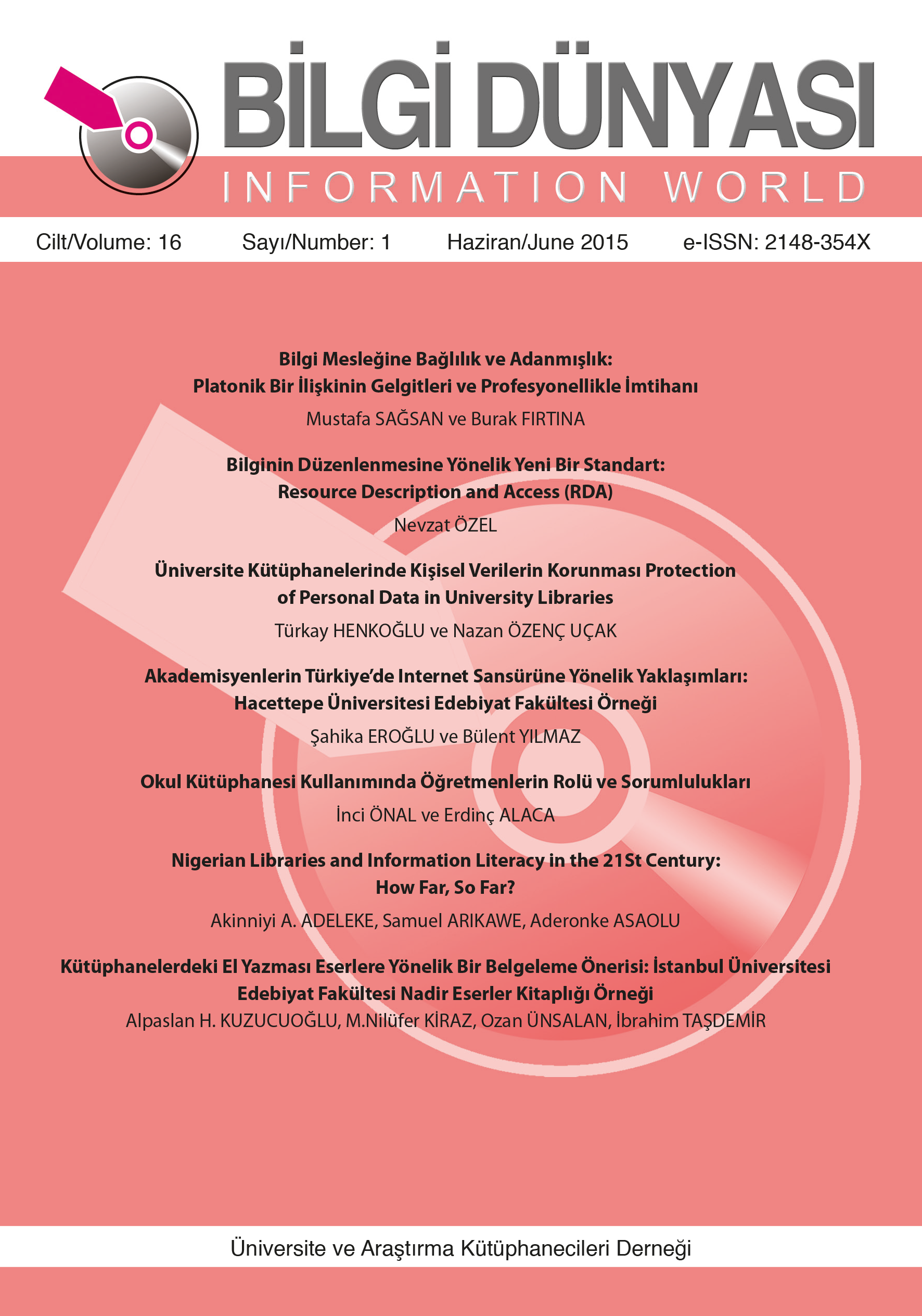
The Internet that referred as the printing press of our age has turn into a berely controlled platform due to the advancements of access and sharing facilities. In this context, it’s also referred in the literature that restriction of access to the Internet is described as the Internet censorship and that affects every user. In the light of this information, as one of the intensive user groups of the Internet, scholars’ perceptions on the Internet censorship were evaluated and their opinions were analysed via a web-based survey. The survey delivered to 218 scholars at Hacettepe University Faculty of Letters by e-mail and it is generated 47 responses. The findings obtained in this study reflected that, scholars are the intensive users of the Internet and social media and social media for the purpose education and research. Based on these findings, restrictions on the Internet affected scholars in many dimensions. In the end of the study, the requirements on description of boundaries about restrictions that will provide distinction between harmful and useful content is highlighted.
Keywords: Censorship, Internet censorship, Intellectual freedom, Academics, Turkey
References
- Akgül, M. (2009). İnternet yasakları: Bir hukuk ve adalet faciası mı?. TBB Dergisi, 84, 401-417.
- Akdeniz, Y. ve Altıparmak, K. (2008). Internet: restricted access a critical assessment. Internet content regulation and censorship in Turkey. İnsan Hakları Ortak Platformu.
- Bayzan, Ş. (2009). Türkiye ve Dünyada internet yasakları ve sansür kavramı ile zararlı içeriğe karşı yaptırım ve uygulamalara genel bir bakış. Akademik Bilişim 2009 Konferansı’nda sunulan bildiri. Şanlıurfa: Harran Üniversitesi 10 Ocak 2014 tarihinde http://ab.org.tr/ab09/kitap/bayzan_sansur_AB09.pdf adresinden erişildi.
- Dilmen, N. E. ve Akyazı, E. (2008). Sanal dünyada temiz toplum yaratma aracı olarak sansür. 10 Mart 2014 tarihinde http://www.academia.edu/3162953/Sanal_Dunyada_Temiz_Toplum_Yaratma_Araci_Olarak_Sansur
- Engelliweb. (2014). Kurum bazında istatistikler. 13 Ocak 2014 tarihinde http://engelliweb.com/istatistikler/ adresinden erişildi.
- Gök, M. S. (2012). 5651 Sayılı kanun ve bilgi güvenliği ilişkisi. Yayınlanmamış Yüksek Lisans Tezi. İstanbul: İstanbul Bilgi Üniversitesi.
- Freedom House. (2011). Meksika’da internet özgürlükleri raporu. 20 Nisan 2014 tarihinde http://www.freedomhouse.org/images/File/FotN/Mexico2011.pdf adresinden erişildi.
- Freedomhouse.org. (2014). Turkey. 24 Şubat 2014 tarihinde http://www.freedomhouse.org/sites/default/files/resources/FOTN%202013_Turkey.pdf adresinden erişildi.
- Internet Sansürü. (2013). Wikipedia web sitesinden 8 Ocak 2014 tarihinde http://tr.wikipedia.org/wiki/%C4%B0nternet_sans%C3%BCr%C3%BC adresinden erişildi.
- Internetworldstats. (2012). Top 10 countries in Europe. 20 Nisan 2014 tarihinde http://www.internetworldstats.com/stats4.htm adresinden erişildi.
- İnternet Ortamında Yapılan Yayınların Düzenlenmesi ve Bu Yayınlar Yoluyla İşlenen Suçlarla Mücadele Edilmesi Hakkında Kanun. (2007). T.C. Resmi Gazete, 26530 (23 Mayıs 2007).
- Ketteman, M. C. (2012). The UN Human Rights Council Resolution on Human Rights on the Internet: Boost or Bust for Online Human Rights Protection? 12 Mayıs 2014 tarihinde http://www.etcgraz.at/typo3/fileadmin/user_upload/ETC-Hauptseite/human_security/hs-perspectives/pdffiles/issue1_2012/11-HSP12_Kettemann__FINAL_.pdf adresinden erişildi.
- Klang, M. (2005). Controlling online information: censorship & cultural protection. WSIS, Internet Governance and Human Rights’da sunulan bildiri. 12 Mart 2014 tarihinde http://www.kus.uu.se/pdf/publications/ICT/klang_03_oct.pdf adresinden erişildi.
- Koç, S. (2013). Hukuksal bağlamda sosyal medya analizi ve kıyaslamalı mevzuat önerileri. Yayınlanmamış Yükseklisans Tezi. İstanbul: İstanbul Bilgi Üniversitesi.
- Köse, G. ve Özen, K. (2010). Internet’te sansür üzerine bir değerlendirme. Serap Kurbanoğlu ve diğerleri (Yay. Haz.). Bilgi Yönetiminde Teknolojik Yakınsama ve Sosyal Ağlar: 2. Uluslararası Değişen Dünyada Bilgi Yönetimi Sempozyumu, 22-24 Eylül 2010, Ankara, Türkiye. Bildiriler. içinde (s. 113-122). Ankara: Hacettepe Üniversitesi Bilgi ve Belge Yönetimi Bölümü.
- Oppenheim, C. ve Pollecutt, N. (2000). Professional associations and ethical issues in LIS. Journal of Librarianship and Information Science, 32(4), 187-203.
- Şamlı, R. ve Konak, E. S. (2011). Tedbir mi, kısıtlama mı?: Internet sansürü hakkında bir araştırma. Akademik Bilişim 2011 Konferansı’nda sunulan bildiri. 10 Ocak 2014 tarihinde http://ab.org.tr/ab11/bildiri/59.pdf adresinden erişildi.
- Subramanian, R. (2012). The Growth of global internet censorship and circumvention: a survey. Communications of the International Information Management Association içinde. 10 Mart 2014 tarihinde http://papers.ssrn.com/sol3/papers.cfm?abstract_id=2032098 adresinden erişildi.
- Toplu, M. (2007). Kütüphaneciliğin etik sorunu ve Türkiye yaklaşımı. Türk Kütüphaneciliği, 21(2), 186-217.
- Türk Dil Kurumu (2012). Güncel Türkçe sözlük. 3 Ocak 2014 tarihinde http://tdkterim.gov.tr/bts/ adresinden erişildi.
License
Copyright (c) 2015 The author(s). This is an open access article distributed under the Creative Commons Attribution License (CC BY), which permits unrestricted use, distribution, and reproduction in any medium or format, provided the original work is properly cited.