Abstract
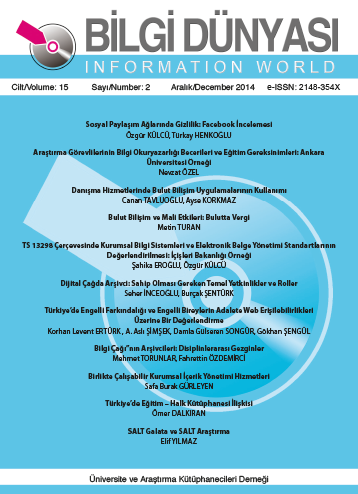
The continuous development in information and communication technologies has directly affected the environment for acquisition of information and learning as well as reshaping the structure of this environment. Thus the resources, tools, applications and services applied in this environment have also changed and they have been digitally presented. These innovations have made individuals adapt to the new environments in the context of lifelong learning. In other words, it becomes necessary for people to be equipped with “information literacy skills” including “defining the information needs”, “effective access to information”, “assessment of information”, “use of information” and “ transmission and presentation of information” which are indispensable parts of information age. There are significant contributions of educational activities organized by libraries in providing individuals with these skills. In this study, it is aimed to determine library usage of the research assistants at Ankara University, their levels of information literacy skills in the scope of information and communication technologies and identify their educational expectations concerning these issues. This research has been done with 556 participants among 1028 research assistants who have been anticipated to be involved. The descriptive method and a survey as a data collection technique have been used. The results have been analyzed through PASW (Predictive Analytics SoftWare). The results show that the research assistants at Ankara University have difficulty in all stages of research process and they require educational activities on information literacy prepared by libraries.
Keywords: Information literacy, Information literacy education, User education, Libraries
References
- ACRL Information Literacy Competency Standards Review Task Force. (2012). Task force recommendations. 20 Aralık 2013 tarihinde http://www.ala.org/acrl/sites/ala.org.acrl/files/content/standards/ils_recomm.pdf adresinden erişildi.
- Akkoyunlu, B. ve Kurbanoğlu, S. (2002). Öğretmenlere bilgi okuryazarlığı becerilerinin kazandırılması üzerine bir çalışma. Türk Kütüphaneciliği, 16(2), 123-138.
- Akkoyunlu, B. ve Kurbanoğlu, S. (2003). Öğretmen adaylarının bilgi okuryazarlığı ve bilgisayar öz yeterlik algıları üzerine bir çalışma. Hacettepe Üniversitesi Eğitim Fakültesi Dergisi, 24, 1-10.
- Albitz, R. S. (2007). The what and who of information literacy and critical thinking in higher education. Portal: Libraries and the Academy, 7(1), 97-109.
- Aldemir, A. (2004). Öğretmen adaylarının bilgi okuryazarlığı düzeyleri üzerine bir araştırma: Sakarya Üniversitesi örneği. Yayınlanmamış yüksek lisans tezi, Hacettepe Üniversitesi, Ankara.
- American Association of School Librarians [AASL] ve Association for Educational Communications and Technology [AECT]. (1998). Information literacy standards for student learning: Standards and indicators. Chicago: American Library Association.
- American Library Association [ALA]. (1989). Presidential Committee on Information Literacy: Final report. Washington: ALA. 3 Aralık 2012 tarihinde http://www.ala.org/ala/mgrps/divs/acrl/publications/whitepapers/presidential.cfm adresinden erişildi.
- Association of College and Research Libraries [ACRL]. (2000). Information literacy competency standards for higher education. Chicago: American Library Association.
- Ata, F. (2011). Üniversite öğrencilerinin Web 2.0 teknolojilerini kullanım durumları ile bilgi okuryazarlığı öz-yeterlik algıları arasındaki ilişkinin incelenmesi. Yayınlanmamış yüksek lisans tezi, Dokuz Eylül Üniversitesi, İzmir.
- Bargellini, M. L. ve Bordoni, L. (2001). The role of the library in a new learning scenario. The Electronic Library, 19(3), 153-157.
- Bawden, D. (2001). Information literacy and digital literacies: A review of concepts. Journal of Documentation, 57(2), 218-259.
- Besimoğlu, C. (2007). Akademisyenlerin elektronik dergi kullanımında disiplinler arasındaki farklılıklar. Yayınlanmamış yüksek lisans tezi, Hacettepe Üniversitesi, Ankara.
- Birch, R. G. (2012). The impact of information literacy instruction on the library anxiety and information competency of graduate students. Yayınlanmamış doktora tezi, Olivet Nazarene University, Illinois.
- Breivik, P. S. (1998). Student learning in the information age. Phoenix, Arizona: ORYX Press.
- Breivik, P. S. (2000). Information literacy for the skeptical library director. Proceedings of the IATUL Conferences. 13 Kasım 2012 tarihinde http://docs.lib.purdue.edu/iatul/2000/papers/5 adresinden erişildi.
- Bruce, C. S. (1994). Information literacy blueprint. 5 Aralık 2012 tarihinde https://courses.washington.edu/mlis560/su09/Module1/bruce_information_literacy_blueprint.pdf adresinden erişildi.
- Bruce, C. S. (2004). Information literacy as a catalyst for educational change: A background paper. P. A. Danaher, C. Macpherson, F. Nouwens ve D. Orr (Eds.). Lifelong Learning: Whose responsibility and what is your contribution? The 3rd International Lifelong Learning Conference, Yeppoon, Central Queensland, Australia 13-16 June 2004 içinde (ss. 8-19). Rockhampton, Qld: Central Queensland University Press.
- Bruce, C. S. ve Candy, P. (Eds.). (2000). Information literacy around the world. Wagga Wagga, Australia: Centre for Information Studies Charles Sturt University.
- Bundy, A. (2004). Australia and New Zealand information literacy framework: Principles, standards and practice (2nd ed.). Adelaide: Australian and New Zealand Institute for Information Literacy. 12 Aralık 2012 tarihinde http://www.library.unisa.edu.au/learn/infolit/Infolit-2nd-edition.pdf adresinden erişildi.
- Caravello, P. S., Herschman, J. ve Mitchell, E. (2001). Assessing the information literacy of undergraduates: Reports from the UCLA Library’s Information Competencies Survey Project. ACRL Tenth National Conference. 20 Temmuz 2013 tarihinde http://0-www.ala.org.catalog.wblib.org/acrl/sites/ala.org.acrl/files/content/conferences/pdf/caravallo.pdf adresinden erişildi.
- Carter, E. W. (2002). “Doing the best you can with what you have”: Lessons learned from outcomes assessment. Journal of Academic Librarianship, 28(1), 36-41.
- Chen, L. C. (2011). The effects of integrated information literacy in science curriculum on first-grade students’ memory and comprehension using the Super3 model. Knowledge Management & E-Learning: An International Journal, 3(3), 399-411.
- Chowdhury, G. G. ve Chowdhury, S. (2003). Introduction to digital libraries. London: Facet Publishing.
- Çalık, T. ve Sezgin, F. (2005). Küreselleşme, bilgi toplumu ve eğitim. Kastamonu Eğitim Dergisi, 13(1), 55-66.
- Demiralay, R. (2008). Öğretmen adaylarının bilgi ve iletişim teknolojilerini kullanımları açısından bilgi okuryazarlığı öz-yeterlik algılarının değerlendirilmesi. Yayınlanmamış yüksek lisans tezi, Gazi Üniversitesi, Ankara.
- Dikkaya, M. ve Özyakışır, D. (2006). Küreselleşme ve bilgi toplumu: Eğitimin küreselleşmesi ve neo-liberal politikaların etkileri. Uluslararası İlişkiler, 3(9), 151-172.
- Doğan, S. C. (2007). Tıp akademisyenlerinin elektronik veri tabanı ve elektronik dergi kullanımları: Hacettepe Üniversitesi örneği. Yayınlanmamış yüksek lisans tezi, Hacettepe Üniversitesi, Ankara.
- European Communities. (2006). Information society and education: Linking European polies. Luxembourg: Office for Official Publication of the European Communities. 10 Eylül 2012 tarihinde http://ec.europa.eu/information_society/newsroom/cf/itemlongdetail.cfm?item_id=3293 adresinden erişildi.
- Farmer, D. W. ve Mech, T. F. (Eds.). (1992). Information literacy: Developing students as independent learners. San Francisco: Jossey Bass.
- Feather, J. ve Sturges, P. (Eds.). (2003). International encyclopedia of information and library science. London: Routledge.
- Garner, S. D. (2006). High-Level Colloquium on Information Literacy and Lifelong Learning, Bibliotheca Alexandrina, Alexandria, Egypt November 6-9, 2005. 3 Aralık 2012 tarihinde http://archive.ifla.org/III/wsis/High-Level-Colloquium.pdf adresinden erişildi.
- Gaunt, J., Morgan, N., Somers, R., Soper, R. ve Swain, E. (2009). Handbook for information literacy teaching (HILT). Cardiff: Cardiff University.
- Godwin, P. (2007). The Web 2.0 challenge to information literacy. INFORUM 2007: 13th Conference on Professional Information Resources, Prague, May 22-24, 2007. 15 Aralık 2012 tarihinde http://www.inforum.cz/pdf/2007/godwin-peter.pdf adresinden erişildi.
- Gürdal, O. (2000). Yaşamboyu öğrenme etkinliği “enformasyon okuryazarlığı”. Türk Kütüphaneciliği, 14(2), 176-187.
- Head, A. J. ve Eisenberg, M. B. (2010). Truth be told: How college students evaluate and use information in the digital age. 20 Temmuz 2013 tarihinde http://projectinfolit.org/pdfs/PIL_Fall2010_Survey_FullReport1.pdf adresinden erişildi.
- Heine, M., Winkworth, I. ve Ray, K. (2000). Modeling service-seeking behavior in an academic library: a methodology and its application. The Journal of Academic Librarianship, 26(4), 233-247.
- Henri, J. ve Bonnano, K. (Eds.). (1999). The information literate school community: Best practice. Wagga Wagga, N.S.W.: Centre for Information Studies, Charles Sturt University.
- Hunt, F. ve Birks, J. (2004). Best practices in information literacy. Libraries and the Academy, 4(1), 27-39.
- Hunt, S. K., Hopper, K. M., Meyer, K. R., Thakkar, K. V., Tsoumbakopoulos, V. ve Van Hoose, K. J. (2006). Assessing information literacy skills of students in the basic communication course. 20 Temmuz 2013 tarihinde http://communication.illinoisstate.edu/kmeyer/research/documents/481InformationLiteracypaperCSCA.doc adresinden erişildi.
- Jacobson, T. E. ve Mark, B. L. (2000). Separating wheat from chaff: Helping first-year students become information savvy. Journal of General Education, 49(4), 256-278.
- Jain, V. (2006). LIS professionals as teachers and trainers: User education and information literacy for life-long learning. C. Khoo, D. Singh ve A. S. Chaudhry (Yay. Haz.). Proceedings of the Asia Pacific Conference on Library & Information Education & Practice 2006 (A-LIEP 2006), Singapore, 3-6 April 2006 içinde (ss.645-648). Singapore: School of Communication & Information, Nanyang Technological University.
- Kasowitz-Scheer, A. ve Pasqualoni, M. (2002). Information literacy instruction in higher education: Trends and issues. 6 Aralık 2012 tarihinde http://www.eric.ed.gov/PDFS/ED465375.pdf adresinden erişildi.
- Kerr, P. A. (2010). Conceptions and practice of information literacy in academic libraries: Espoused theories and theories-in-use. Yayınlanmamış doktora tezi, Graduate School - New Brunswick Rutgers, The State University of New Jersey, New Brunswick, New Jersey.
- Kızıl, M. (2007). Yükseköğrenimde bilgi okuryazarlığı: Selçuk Üniversitesi örneği. Yayınlanmamış yüksek lisans tezi, Selçuk Üniversitesi, Konya.
- Kızılaslan, D. (2007). Bilgi okuryazarlığı ve üniversite kütüphaneleri: Bilgi okuryazarlığı planı hazırlama unsurları. Yayınlanmamış yüksek lisans tezi, İstanbul Üniversitesi, İstanbul.
- Koenig, M. E. D. (2003). Knowledge management, user education and librarianship. Library Review, 52(1), 10-17.
- Kumar, B. R. ve Phil, M. (2009). User education in libraries. International Journal of Library and Information Science, 1(1), 1-5.
- Kurbanoğlu, S. (2006). Bilgi okuryazarlığı. 5 Aralık 2012 tarihinde http://www.ilipg.org/sites/ilipg.org/files/bo/sunumlar/serap_kurbanoglu_bilgi_okuryazarligi.pdf adresinden erişildi.
- Kurbanoğlu, S. S. (2010). Bilgi okuryazarlığı: Kavramsal bir analiz. Türk Kütüphaneciliği, 24(4), 723-747.
- Kurbanoğlu, S. ve Akkoyunlu, B. (2001). Öğrencilere bilgi okuryazarlığı becerilerinin kazandırılması üzerine bir çalışma. Hacettepe Üniversitesi Eğitim Fakültesi Dergisi, 21, 81-88.
- Kurbanoğlu, S. ve Akkoyunlu, B. (2002). Bilgi okuryazarlığı: Bir ilköğretim okulunda yürütülen uygulama çalışması. Türk Kütüphaneciliği, 16(1), 20-40.
- Lederer, N. (2000). New form(at): Using the Web to teach research and critical thinking skills. Reference Services Review, 28(2), 130-153.
- Mahapatra, G. (2006). Towards e-information literacy: Quest for interoperable Web based information system. 4th International Convention CALIBER-2006, Gulbarga, 2-4 February, 2006. 10 Aralık 2012 tarihinde http://ir.inflibnet.ac.in/bitstream/handle/1944/1151/72.pdf adresinden erişildi.
- Mittermeyer, D. ve Quirion, D. (2003). Information literacy: Study of incoming first-year undergraduates in Quebec. Quebec: National Library of Canada. 20 Temmuz 2013 tarihinde http://www.crepuq.qc.ca/documents/bibl/formation/studies_ang.pdf adresinden erişildi.
- Mortimer, M. (2007). Library speak: A glossary of terms in librarianship and information management. Friendswood: Total Recall.
- New Media Consortium. (2005). A global imperative: the report of the 21st Century Literacy Summit. Stanford, California: The New Media Consortium. 14 Kasım 2012 tarihinde http://www.nmc.org/pdf/Global_Imperative.pdf adresinden erişildi.
- Numanoğlu, G. (1999). Bilgi toplumu- eğitim- yeni kimlikler- II: Bilgi toplumu ve eğitimde yeni kimlikler. Ankara Üniversitesi Eğitim Bilimleri Fakültesi Dergisi, 32(1), 331-339.
- Ocak, G. (2008). Web tabanlı çoklu öğrenme ortamlarının öğrencilerin bilgi okuryazarlığı performansı üzerine etkisi. Yayınlanmamış yüksek lisans tezi, Hacettepe Üniversitesi, Ankara.
- Polat, C. (2005a). Üniversitelerde kütüphane merkezli bilgi okuryazarlığı programlarının geliştirilmesi: Hacettepe Üniversitesi örneği. Yayınlanmamış doktora tezi, Hacettepe Üniversitesi, Ankara.
- Polat, C. (2005b). Üniversite öğrencilerinin bilgi okuryazarlığı becerilerindeki zorlanma düzeyleri üzerine bir araştırma. Türk Kütüphaneciliği, 19(4), 408-431.
- Saatçioğlu, Ö., Özmen, Ö. ve Özer, P. S. (2003). Bilgi okuryazarlığı becerilerinin geliştirilmesinde kütüphanelerin rolü ve Dokuz Eylül Üniversitesi uygulaması. Bilgi Dünyası, 4(1), 45-63.
- Samson, S. ve Granath, K. (2001). Information literacy and the academy. The Montana Professor, 11(2). 24 Ekim 2012 tarihinde http://mtprof.msun.edu/Spr2001/Samson.html adresinden erişildi.
- Secker, J. ve Coonan, E. (2011). A new curriculum for information literacy: Curriculum and supporting documents. 5 Aralık 2013 tarihinde http://ccfil.pbworks.com/f/ANCIL_final.pdf adresinden erişildi.
- Society of College, National and University Libraries. (1999). Information skills in higher education: A SCONUL position paper. 3 Aralık 2012 tarihinde http://www.sconul.ac.uk/groups/information_literacy/sp/papers/Seven_pillars2.pdf adresinden erişildi.
- Spitzer, K., Eisenberg, M. ve Lowe, C. (1998). Information literacy: Essential skills for the information age. New York: Syracuse University.
- Stern, C. (2003). Measuring students’ information literacy competency. A. Martin ve H. Rader (Eds.). Information and IT literacy: Enabling learning in the 21st century içinde (ss. 112-119). London: Facet.
- Swanson, T. A. (2004). A radical step: Implementing a critical information literacy model. Libraries and the Academy, 4(2), 259-273.
- Tiefel, V. M. (1995). Library user education: examining its past, projecting its future. Library Trends, 44(2), 318-338.
- Tiemensma, L. (2012). Information literacy education in higher education institutions in South Africa. R. Gwyer, R. Stubbings ve G. Walton (Eds.). The road to information literacy: Librarians as facilitators of learning içinde (s. 155-168). Berlin/Munich: De Gruyter Saur.
- United Nations Educational, Scientific and Cultural Organization [UNESCO]. (2006). Using ICT to develop literacy. Bangkok: UNESCO. 16 Ağustos 2012 tarihinde http://www2.unescobkk.org/elib/publications/088/Using_ICT_to_Develop_Literacy.pdf adresinden erişildi.
- Wang, X. (2010). Integrating information literacy into higher education curricula: An IL curricular integration model. Yayınlanmamış yüksek lisans tezi, Queensland University of Technology, Brisbane.
- Wooliscroft, M. (1997). From library user education to information literacy: Some issues arising in this evolutionary process. 12 Ekim 2009 tarihinde http://www.library.otago.ac.nz/pdf/tandlpapers_MJW.pdf adresinden erişildi.
- Wurman, R. S., Leifer, L., Sume, D. ve Whitehouse, K. (2001). Information anxiety 2. Indianapolis, Indiana: Que.
- Yüksel İleri, F. (2011). Okul kütüphanelerinde bilgi okuryazarlığı eğitimi ve bir örnek: Marmara Eğitim Kurumları İlköğretim Okulu. Yayınlanmamış yüksek lisans tezi, Marmara Üniversitesi, İstanbul.
License
Copyright (c) 2014 The author(s). This is an open access article distributed under the Creative Commons Attribution License (CC BY), which permits unrestricted use, distribution, and reproduction in any medium or format, provided the original work is properly cited.