

Öz
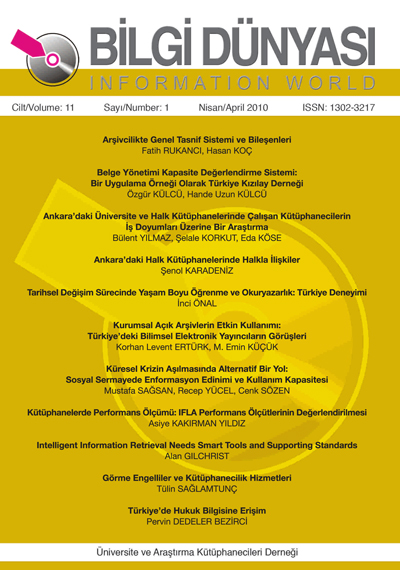
Entelektüel sermaye; bir örgütün soyut varlıklarını harekete geçirerek, ona uzun dönemli yaşam kaynağı sağlayan ve bilânçolarında görünmeyen varlıklar olarak tanımlanan, bilgiye dayalı yeni bir sermaye türüdür. Örgütün aldığı patentler ve ticari markalar, örgütün itibarı, müşteri bağlılığı gibi unsurlar soyut, diğer bir deyişle bilgi varlıkları olarak gösterilmekte ve bu tür sermayenin temelini teşkil etmektedir. Bu varlıklar, entelektüel sermayeyi üç temel bileşene ayırmaktadır. Bunlardan ilki; insan sermayesidir ve örgüt çalışanının geçmiş tecrübelerine, iş yapma becerilerine atıfta bulunmaktadır. İkincisi olan, yapısal sermaye örgütün kültürü ve yapısı içerisine yerleşmiş iş yapma alışkanlığını ve profesyonelliğini içermektedir. Üçüncüsü ise ilişkisel veya sosyal sermayedir ve entelektüel sermayenin en önemli bileşendir. Bu sermaye türü, örgütün çevresinde birlikte iş yaptığı diğer örgütlerle olan bağlantısına dayanmaktadır. Sosyal bir ağ, bu düzenek içerisinde bulunan üyelerin bağlarına dayalı oluşturdukları kapasite kullanımı demektir. Bu ağ düzeneği içerisinde aktörler, örgütün kendisi veya birimler etkin rol alabilmektedir. Bu çalışma; küresel krizden etkilenen fi rmalara, krizden çıkış yolu olarak sosyal sermayeyi kullanma kapasitesinin nasıl artırılabileceğine yönelik ipuçları ve öneriler sunmaktadır. Bu nedenle araştırmada, alternatif bir yaklaşım yolu olarak fi rmaların krizden çıkabilmeleri için sosyal ağ düzeneklerini nasıl yapılandırmaları, ilişkisel sermayelerini nasıl ve ne şekilde harekete geçirmeleri gerektiği, temel sorunsal olarak saptanmıştır.
Anahtar Kelimeler: Entelektüel sermaye, Sosyal sermaye, Sosyal ağ düzeneği, Küresel kriz
Referanslar
- Alavi, M. (2000). Managing organizational knowledge. R.W. Zmud (Ed.) Framing the domains of IT management projecting the future through the past içinde (ss.15-28). Cincinnati, OH: Pinnaflex Education Resources, Inc.
- Ariely, G. (2006). Intellectual capital and knowledge management. D. Schwartz (Der.) Encyclopedia of Knowledge Management içinde (ss.281-288). London: Idea Group Reference.
- Arıduru, A. Kriz nedir? Ne değildir? 5 Ocak 2010 tarihinde http://www.fortune.com.tr/kriznedir.asp adresinden erişildi.
- Barney, J. (1991). Firm resources and sustained competitive advantage. Journal of Management, 17, 99-120.
- Barney, J. (1997). Gaining and sustaining competitive advantage. Reading, MA: Addison-Wesley.
- Barney, J. (2002). Gaining and sustaining competitive advantage. Upper Saddle River, NJ: Prentice Hall.
- Bart, C. (2001). Measuring the mission effect in human intellectual capital. Journal of Intellectual Capital Research, 2(3), 320-330.
- Beckert, J. (2003). Economic sociology and embeddedness: How shall we conceptualize economic action? Journal of Economic Issues, 37 (3), 769-787.
- Bergeron, B. (2003). Essentials of knowledge management. NJ: John Wiley & Sons Inc.
- Bontis, N. (2001). Assessing knowledge assets: A review of the models used to measure intellectual capital. International Journal of Management Reviews, 3, 41-61.
- Bontis, N. (2002). The rising star of the Chief Knowledge Officer. Ivey Business Journal, March/April, 20-25.
- Bourdieu, P. (1986). The Forms of capital. J. Richardson (Ed.) Handbook of Theory and Research for the Sociology of Education içinde (ss.241-258). New York: Greenwood Press.
- Bueno, E.; Salmador, P.M. ve Rodriguez, O. (2004). The role of social capital in today’s economy. Journal of Intellectual Capital, 5 (4), 556-574.
- Bukowitz, W. ve Williams, R. (2000). The knowledge management fieldbook. London: Printice Hall.
- Burt, S. R. (1992). Structural holes: The social structure of competition. Harvard University Press.
- Burt, S.R. (1997). The contingent value of social capital. Administrative Science Quarterly, 42, 339-365.
- Burt, S.R. (2005). Brokerage and closure. New York: Oxford University Press.
- Coleman, J. S. (1988). Social capital in the creation of human capital. American Journal of Sociology, 94, 95-120.
- Coleman, J. S. (1990). Foundations of social theory. Cambridge, MA: Harvard University Press.
- Dalkir, K. (2005). Knowledge management in theory and practice. Amsterdam: Elsevier.
- Dierickx, I., ve Cool, K. (1989). Asset stock accumulation and sustainability of competitive advantage. Management Science, 35, 1504-1511.
- Edvinsson, L., ve Malone, M. S. (1997). Intellectual capital. New York: Harper Business.
- Edvinson, L., Sullivan, P. (1996). Developing a model for managing intellectual capital. European Management Journal, 14 (14).
- Ercan, M.; Öztürk, B. ve Demirgüneş, K. (2003). Değere dayalı yönetim ve entelektüel sermaye. Ankara: Gazi Kitabevi.
- Flamant, M. ve Singer-Kerel, J. (1970). Crises et récessions économiques. P.U.F., Paris.
- Gargiulo, M. ve Benassi, M. (2000). Traped in your own net? Network cohesion, structural holes, and the adaptation of social capital. Organization Science, 11 (2): 183-196.
- Granovetter, M. (1973). Strength of weak ties. American Journal of Sociology, 78, 1360-1380.
- Granovetter, M. (1983). The strength of weak ties: A network theory revisited. Sociological Theory, 1, 201-233.
- Granovetter, M. (1985). Economic action and social structure: The problem of embeddedness. American Journal of Sociology, 91(3), 481-510.
- Granovetter, M. (1992). Economic institutions as social constructions: A framework for analysis. Acta Sociologica, 35 (3), 3-11.
- Granovetter, M. ve Swedberg, R. (1992). The sociology of economic life. San Fransisco: Westview Press.
- Hazleton, V. ve Kennan, W. (2000). Social capital: Reconceptualizing the bottom line. Corporate Communication: An International Journal, 5 (2), 81-86.
- Hunt, S. D. (2000). A general theory of competition. Thousand Oaks, CA: Sage.
- Jennex, M.E. ve Croasdell, D. (2007). Knowledge management as a discipline. (Murray E. Jennex Ed.) Knowledge Management in Modern Organization içinde (ss. 10-17). Hershey, London: Idea Group publishing.
- Kaplan, R. ve Norton, D. (1996). The balanced scorecard: Translating strategy into action. Boston: Harvard Business School.
- Kaplan, R. S., ve Norton, D.P. (1992). The balanced scorecard: Measures that drive performance. Harvard Business Review, Jan-Feb.
- Klein, D. A ve Prusak, L. (1994). Characterising intellectual capital. Cambridge, MA, Centre for Business Innovation, Ernst and Young.
- Koenig, M. E. D. (1999). Education knowledge management. Information Services and Use, 19, 17-31.
- Leana, R. C. ve Buren, V. H. J. (1999). Organizational social capital and employment practices. Academy of Management Review, 24 (3), 538-555.
- McElroy, M. (1999). The knowledge life cycle. ICM Conference on KM, Miami: FL.
- Meyer, M. ve Zack, M. (1996). The design and implementation of information products. Sloan Management Review, 37(3), 49-59.
- Mykytyn, K., Bordoloi, B., Mckinney, V., ve Bandyopadhyay, K. (2002). The role of software patents in sustaining IT-enabled competitive advantage: A call for research. Journal of Strategic Information Systems, 11, 59-82.
- Nonaka, I. ve Takeuchi, H. (1995). The knowledge creating company: How Japanese companies create the dynamics of innovation. New York, Oxford: Oxford University press.
- Nonaka, I. (2002). A dynamic theory of organizational knowledge creation. C.W. Choo ve N. Bontis (Ed.), The strategic management of intellectual capital and organizational knowledge içinde New York: Oxford University Press.
- Paxton, P. (1999). Is social capital declining in the United States? A multiple indicator assessment. American Journal of Sociology, 105 (1), 88-127.
- Pike, S., Rylander, A., ve Roos, G. (2002). Intellectual capital: Management and disclosure. C.W. Choo ve N. Bontis (Ed.). The strategic management of intellectual capital and organizational knowledge içinde New York: Oxford University Press.
- Podolny, J. M. (2001). Networks as the pipes and prisms of the market. The American Journal of Sociology, 107 (1), 33-60.
- Polanyi, K. (1944). The great transformation. Boston: Beacon Press.
- Sağsan, M. (2007). Knowledge management from application to discipline: A field study. Amme İdaresi Dergisi, 40 (4), 103-131.
- Sağsan, M. (2009). Knowledge management discipline: Test for an undergraduate program in Turkey. Electronic Journal of Knowledge Management, 7 (5), 627-636, 5 Mart 2010 tarihinde http://www.ejkm.com/volume-7/v7-5/v7-i5-art9.htm adresinden erişildi.
- Sattar, A. ve Higgins, S. E. (2001). Perspectives on education for knowledge management, 67th IFLA Council and General Conference, 16-25 August, 1-9.
- Schwartz, D. G. (2007). A birds-eye view of knowledge management: Creating a disciplined whole from many interdisciplinary parts. Murray E. Jennex (Ed.), Knowledge Management in Modern Organization içinde (ss. 18-29), Hershey, London: Idea Group Publishing.
- Sözen, C. (2007). Bağlam kapsamında örgütlerarası ağ düzenekleri: Dayanıklı ev aletleri sektörü örneği. Yayınlanmamış Doktora Tezi. Ankara: Başkent Üniversitesi Sosyal Bilimler Enstitüsü Yönetim ve Organizasyon Anabilim Dalı.
- Stankosky, M. A. (Ed.) (2005). Advance in knowledge management: University research toward a discipline. Creating the discipline of knowledge management: The latest in university research içinde (ss. 1-14). Oxford: Elsevier.
- Steward, T. A. (1997). Entelektüel sermaye: Örgütlerin yeni zenginliği. İstanbul: MESS yayınları.
- Sveiby, K. E. (1997). The new organizational wealth: Managing and measuring knowledge-based assets. SanFrancisco: Berrett-Koehler Publishers.
- Sveiby, K. E. (1998). Intellectual capital: Thinking ahead. Australian CPA.
- Uzzi, B. (1996). The sources and consequences of embeddedness for the economic performance of organizations: the network effect. American Sociological Review, 61 (4), 674-698.
- Uzzi, B. (1999). Embeddedness in the making of financial capital: How social relations and networks benefit firms seeking financing. American Sociological Review, 481-505.
- Uzzi, B. ve Lanchester, R. (2003). Relational embeddedness and learning: The case of bank loan managers and their clients. Management Science, 49 (4), 383-389.
- Uzzi, B. ve Lanchester, R. (2004). Embeddedness and price formation in the corporate law market. American Sociological Review, 69, 319-344.
- Van Buren, M.E. (1999). A yardstick for knowledge management. Training and Development, 53, 71-78.
- Wiig, K. (1993). Knowledge Management Foundations. Arlington, TX: Schema press.
Lisans
Telif Hakkı (c) 2010 Yazar(lar). Açık erişimli bu makale, orijinal çalışmaya uygun şekilde atıfta bulunulması koşuluyla, herhangi bir ortamda veya formatta sınırsız kullanım, dağıtım ve çoğaltmaya izin veren Creative Commons Attribution License (CC BY) altında dağıtılmıştır.