

Öz
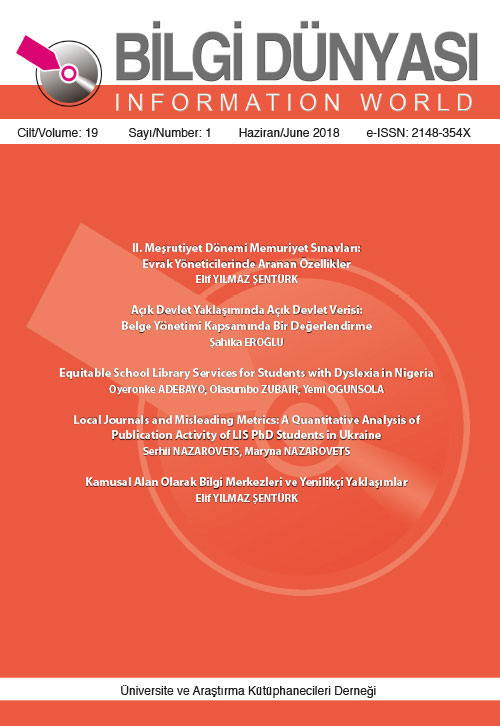
Ukrayna kütüphane ve enformasyon bilimi/çalışmaları, kütüphane personelinin kaliteli eğitimini engelleyen birçok problemi tespit etmiştir. Ukrayna’da eğitimin ve bilimin reform sürecinde, kütüphanecilik bilimindeki araştırmalar da dâhil olmak üzere Ukraynalı bilim insanlarınca yapılacak olan araştırmaların ve sunumlarının kalitesinin geliştirilmesi için bir dizi yasal girişimlerde bulunulmuştur. Özellikle, Ukrayna’da bir doktora derecesi alabilmek için doktor adayının yabancı bir dergide makale yayımlaması gerekmektedir ki bu, hükümetin girişimlerini destekleyenlerce dünyada Ukraynalı bilim insanlarının bilimsel başarılarının sunulması için bir fırsat olarak değerlendirilmektedir. Bu araştırmada, Ukrayna kütüphanecilik bilimindeki (2015- 2017) doktora öğrencilerinin yayın faaliyetlerinin incelenmesinin sonuçları sunulmaktadır. Ukrayna kökenli olmayan dergilerdeki makalelerin bilgileri açık erişimi bulanan tezlerin özet kısmından alınmıştır. Makalelerin yayımlandığı bu dergiler hakem değerlendirme sürecindeki bilgiler kapsamında menşei ülke, yayın dilleri, öz (abstrakt) ve atıf veri tabanlarında dizinlenme ve “yanıltıcı metrikler” bakımından analiz edilmiştir. Sonuçlar, kütüphane ve enformasyon alanındaki Ukraynalı doktora öğrencilerinin makalelerini kısıtlı okuyucusu olan başlıca Ukrayna dergilerinde ve Ukrayna’ya sınır olan ülkelerin dergilerinde yayımladıklarını göstermektedir. Bazı dergilerde dikkat çeken şüpheli editörlük politikaları bulunmaktadır. Bu araştırmada, bunların nedenleri tartışılmakla birlikte istenmeyen uygulamaların önüne geçilebilmesi için bazı tavsiyelerde bulunulmuştur.
Anahtar Kelimeler: Lisansüstü eğitim, yayımcılık faaliyeti, doktora, tez, kütüphane ve enformasyon bilimi, Ukrayna
Referanslar
- Anwar, M. (2004). From doctoral dissertation to publication. Journal of Librarianship and Information Science, 36(4), 151-157. doi: 10.1177/0961000604050565
- Beall, J. (2016a). Best practices for scholarly authors in the age of predatory journals. The Annals of The Royal College of Surgeons of England, 98(2), 77-79. doi: 10.1308/rcsann.2016.0056
- Beall, J. (2016b, November 3). Beall’s list of predatory journals and publishers: Misleading metrics. Retrieved from https://beallslist.weebly.com/misleading-metrics.html
- Benz, S. (2009). Ukrainian libraries of yesterday, today, and tomorrow: Impressions from an American fulbright librarian. Slavic & East European Information Resources, 10(4), 326-331. doi: 10.1080/15228880903278322
- Cabinet of Ministers of Ukraine. (1999, March 01). Resolution on approval of the regulations on training scientific-pedagogical and scientific cadres No. 309. Retrieved from http://zakon2.rada.gov.ua/laws/show/309-99-п
- Cabinet of Ministers of Ukraine. (2017, November 22). Resolution on approval of the procedure for granting a higher education institution a national status, confirmation or deprivation of the status No 912. Retrieved from http://zakon3.rada.gov.ua/laws/show/912-2017-п
- Directory of Open Access Journals. (2018). Retrieved from https://doaj.org/
- Emmelhainz, C. (2017). Supporting the expatriate social scientist: Faculty research and information access in post-Soviet Kazakhstan. Journal of Librarianship and Information Science, 49(1), 69-81. doi: 10.1177/0961000615591651
- Gibradze, L. (2001). Libraries in the South Caucasus. Slavic & East European Information Resources, 2(1), 17–21. doi: 10.1300/J167v02n01_03
- Global Library Statistics. (2018). Retrieved from https://www.oclc.org/en/global-library-statistics.html
- Grančay, M., Vveinhardt, J., & Šumilo, Ē. (2017). Publish or perish: How central and Eastern European economists have dealt with the ever-increasing academic publishing requirements 2000–2015. Scientometrics, 111(3), 1813-1837. doi: 10.1007/s11192-017-2332-z
- Haigh, M. (2007). Escaping Lenin’s library: Library and information science education in independent Ukraine. International Information and Library Review, 39(2), 72–79. doi: 10.1080/10572317.2007.10762735
- Haigh, M. (2009). Two steps forward, one step back: Ideological and historical aspects of library and information science education in independent Ukraine. In W. Graves, J. M. Nyce, J. Golden, D. E. Williams (Eds.), Advances in Library Administration and Organization: Vol. 27 (pp. 1–24). United Kingdom: Emerald. doi: 10.1108/S0732-0671(2009)0000027006
- Ifijeh, G. (2017). Emergence of predatory publishing in library and information science: Issues and implications for scholarship among academic librarians in Nigeria. Bilgi Dünyası, 18(1), 149-161. doi: 10.15612/bd.2017.572
- Internet Archive: Wayback Machine. (n. d.). Retrieved from http://archive.org/web/
- Ivanović, D., & Ho, Y. (2014). Highly cited articles in the information science and library science category in social science citation index: A bibliometric analysis. Journal of Librarianship and Information Science, 48(1), 36-46. doi: 10.1177/0961000614537514
- Jalalian, M. (2015). The story of fake impact factor companies and how we detected them. Electron Physician, 7(2), 1069–1072. Retrieved from http://www.ephysician.ir/index.php/browseissues/2015/2/173-1069-1072
- Jalaluddin Haider, S., & Mahmood, K. (2007). MPhil and PhD library and information science research in Pakistan: An evaluation. Library Review, 56(5), 407-417. doi: 10.1108/00242530710750590
- Johnson, I. (2013a). Library development in Armenia: Problems and progress since the dissolution of the USSR. The International Information & Library Review, 45(1-2), 50-62. doi: 10.1016/j.iilr.2013.08.003
- Johnson, I. (2013b). The rehabilitation of library and information services and professional education in the post-Soviet Republics. Information Development, 30(2), 130-147. doi: 10.1177/0266666913479389
- Larivière, V. (2011). On the shoulders of students? The contribution of PhD students to the advancement of knowledge. Scientometrics, 90(2), 463-481. doi: 10.1007/s11192-011-0495-6
- Levitt, J. M., & Thelwall, M. (2009). The most highly cited Library and Information Science articles: Interdisciplinarity, first authors and citation patterns. Scientometrics, 78(1), 45–67. doi: 10.1007/s11192-007-1927-1
- Ministry of Education and Science of Ukraine. (2015, July 14). Order on publishing dissertations and official opponents reviews No. 758. Retrieved from http://zakon4.rada.gov.ua/laws/show/z0885-15
- Ministry of Education and Science of Ukraine. (2016, January 14) Order on approval of the Procedure for assigning scientific degree to scientific and research workers No. 13. Retrieved from http://zakon2.rada.gov.ua/laws/show/z0183-16/
- Ministry of Education and Science of Ukraine. (2018a). Scientific professional journals. Retrieved from https://mon.gov.ua/ua/nauka/nauka/atestaciya-kadriv-vishoyi-kvalifikaciyi/naukovi-fahovi-vidannya
- Ministry of Education and Science of Ukraine. (2018b, January 15) Order on approval of the Procedure for the formation of the List of scientific professional publications of Ukraine No. 32. Retrieved from http://zakon3.rada.gov.ua/laws/show/z0148-18?info=1
- Ministry of Education and Science, Youth and Sports of Ukraine. (2011, September 14). Regulations on specialized academic council No. 1059. Retrieved from http://zakon2.rada.gov.ua/laws/show/z1170-11
- Ministry of Education and Science, Youth and Sports of Ukraine. (2012a, October 17). Order about publication of the results of theses for obtaining scientific degrees of the doctor and candidate of sciences No. 1112. Retrieved from http://zakon2.rada.gov.ua/laws/show/z1851-12
- Ministry of Education and Science, Youth and Sports of Ukraine. (2012b, October 17). Order on approval of the Procedure for the formation of the List of scientific professional journals of Ukraine No. 1111. Retrieved from http://zakon4.rada.gov.ua/laws/show/z1850-12
- Rahmatullaev, M., Ganieva, B., & Khabibullaev, A. (2017). Library and information science education in Uzbekistan. Slavic & East European Information Resources, 18(1-2), 41-48. doi: 10.1080/15228886.2017.1322381
- Skogen, M., & Smith, M. G. (2009). Internet as an information resource in Eurasia. In W. Graves, J. M. Nyce, J. Golden, D. E. Williams (Eds.), Advances in Library Administration and Organization: Vol. 27 (pp. 193–219). United Kingdom: Emerald. doi: 10.1108/S0732-0671(2009)0000027015
- Verkhovna Rada of Ukraine. (2014, July 01). Law On higher education No. 1556-VII. Retrieved from http://zakon0.rada.gov.ua/laws/show/1556-18/card2#Card
- Xia, J., Harmon, J., Connolly, K., Donnelly, R., Anderson, M., & Howard, H. (2014). Who publishes in “predatory” journals? Journal of the Association for Information Science and Technology, 66(7), 1406-1417. doi: 10.1002/asi.23265
Lisans
Telif Hakkı (c) 2018 Yazar(lar). Açık erişimli bu makale, orijinal çalışmaya uygun şekilde atıfta bulunulması koşuluyla, herhangi bir ortamda veya formatta sınırsız kullanım, dağıtım ve çoğaltmaya izin veren Creative Commons Attribution License (CC BY) altında dağıtılmıştır.