

Öz
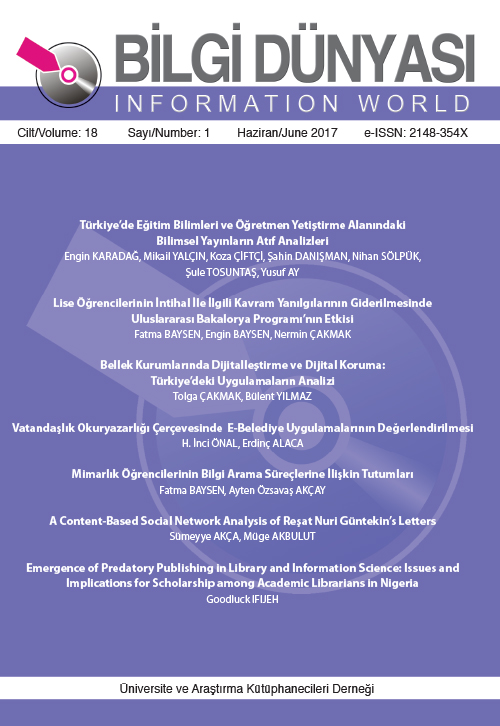
Bu araştırmada, Türkiye’nin eğitim bilimleri ve öğretmen yetiştirme alanındaki bilimsel yayınların atıf analizlerinin yapılması amaçlanmıştır. Bu amaç doğrultusunda, ilgili alanda faaliyet gösteren 32 hakemli dergide 2005-2014 yılları arasında yayımlanan 7.681 makale üzerinden kapsamlı bir atıf analizi gerçekleştirilmiştir. Araştırmada elde edilen sonuçlara bakıldığında; incelenen 7.681 makalenin kaynakçasında yer alan farklı türlerdeki kaynaklara toplam 249.335 atıf yapılmıştır ve atıfların yarısından fazlasını dergiler oluşturmaktadır. Yapılan atıf sayılarında yıllara göre bir artış görülmekte olup söz konusu artışın kaynağı dergilere yapılan atıflardır. Makalelerde toplam 65.537 farklı kaynağa atıf yapılmış olup en fazla atıf yapılan ilk üç eser araştırma yöntemleri kitaplarıdır. Atıf yapılan kaynakların yarı yaşamı 9,64 olup makalelerin yarı yaşam yılı ile yazar sayısı, bildiri ve diğer atıf sayıları arasında negatif; toplam atıf, kitap atıf ve dergi atıf sayıları arasında pozitif ilişki saptanmıştır.
Anahtar Kelimeler: Eğitim bilimleri, öğretmen yetiştirme, bilimsel yayın, atıf analizi
Referanslar
- Aksnes, D. W. (2005). Citations and their use as indicators in science policy: Studies of validity and applicability issues with a particular focus on highly cited papers (Yayımlanmamış doktora tezi). University of Twente, Twente.
- Al, U. (2008). türkiye’nin bilimsel yayın politikası: atıf dizinlerine dayalı bibliyometrik bir yaklaşım (Yayımlanmamış doktora tezi). Hacettepe Üniversitesi Sosyal Bilimler Enstitüsü, Ankara.
- Al, U. ve Coştur, R. (2007). Türk Psikoloji Dergisi’nin bibliyometrik profili. türk Kütüphaneciliği, 21(2), 142-163.
- Al, U. ve Soydal, İ. (2010). Bilgibilim alanında kendine atıf üzerine bir çalışma. Bilgi dünyası, 11(2), 349-364.
- Al, U. ve Soydal, İ. (2012). Dergi kendine atıfının etkisi: Energy education science and technology örneği. türk Kütüphaneciliği, 26(4), 699-714.
- Al, U. ve Tonta, Y. (2004). Atıf analizi: Hacettepe Üniversitesi Kütüphanecilik Bölümü tezlerinde atıf yapılan kaynaklar. Bilgi dünyası, 5(1), 19-47.
- Al, U., Soydal, İ., ve Yalçın, H. (2010). Bibliyometrik özellikleri açısından Bilig’in değerlendirilmesi. Bilig, 55, 1-20.
- Amudhavalli, A. (1997). Impact of electronic publishing on collection development. dESıdoC Bulletin of ınformation technology, 17(1), 7-10.
- Baker, D. R. (1990). Citation analysis: A methodological review. Social Work research & abstracts, 26(3), 3‐10.
- Barca, M. ve Hızıroğlu, M. (2009). 2000’li yıllarda Türkiye’de stratejik yönetim alanının entellektüel yapısı. Eskişehir osmangazi üniversitesi iiBf dergisi, 4(1), 113-148.
- Biehl, M., Kim, H. ve Wade, M. (2006). Relationships among the academic business disciplines: A multi method citation analysis. omega, 34, 359‐371.
- Bonzi, S. ve Snyder, H. W. (1991). Motivations for citation: A comparison of self citation and citation to others. Scientometrics, 21(2), 245-254.
- Broadus, R. N. (1971). The literature of the social science: A survey of the citation studies. ınternational Social Sciences Journal, 23, 236-243.
- Burton, R. E. ve Kebler, R. W. (1960). The “half-life” of some scientific and technical literatures. american documentation, 11, 18-22.
- Carr, J. E. ve Britton, L. N. (2003). Citation trends of applied journals in behavioral psychology: 1981-2000. Journal of applied Behavior analysis, 36(1), 113‐117.
- Chikate, R. V. ve Patil, S. K. (2008). Citation analysis of theses in library and ınformation science submitted to university of pune: a pilot study. http://digitalcommons.unl.edu adresinden erişildi.
- Cronin, B., Synder, H. ve Atkins, H. (1997). Comparative citation rankings of authors in monographic and journal literature: A study of sociology. Journal of documentation, 53, 263-273.
- Csako, G. (2007). Analysis of the most highly cited articles from the 50-year history of CCA. Clinica Chimica acta, 375 (1/2), 43-48.
- Curtis, D. (2005). E-Journals: a how-to-do-it-manual for building, managing, and supporting electronic journal collections. New York: Neal-Schuman.
- de Bellis, N. (2009). Bibliometrics and citation analysis: from the Science Citation ındex to cybermetrics. Plymouth: The Scarecrow Press.
- Denkel, A., Kâğıtçıbaşı, Ç., Pak, N. K. ve Pamuk, Ş. (1996). uluslararası atıf endeksleri verilerine göre türkiye’de sosyal bilimlerin yayın performansı. Ankara: TÜBA.
- Denkel, A., Kâğıtçıbaşı, Ç., Pak, N. K. ve Pamuk, Ş. (1999). türkiye’de sosyal bilimlerin uluslararası yayın performansı. Ankara: Türkiye Bilimler Akademisi.
- Earle, P. ve Vickery, B. (1969). Social science literature use in the UK as indicated by citations. Journal of documentation, 25, 123-141.
- Emrecan, B. (2007). Bilimsel çalışmalarda atıfların önemi. akademik dizayn dergisi, 1, 22-25.
- Eto, H. (2003). Interdisciplinary information input and output of a nano-technology project. Scientometrics, 58(1), 5-33.
- Garfield, E. (1955). Citation indexes for science: A new dimension in documentation through association of ideas. Science, 122(3159), 108–111.
- Garfield, E. (1965). Can citation indexing be automated? http://www.garfield.library.upenn.edu/essays/V1p084y1962-73.pdf adresinden erişildi.
- Garfield, E. (1997). Concept of citation indexing.http://www.upenn.edu adresinden erişildi.
- Giles, C. L., Bollacker, K. ve Lawrence, S. (1998). CiteSeer: An auomatic citation indexing system. I. Witten, R. Akscyn, F. Shipman (Eds.), third aCM Conference on digital libraries içinde (ss. 89-98). New York: ACM Press.
- Glänzel, W. (2009). History of bibliometrics and its present-day tasks in research evaluation. http://iam.metu.edu.tr adresinden erişildi.
- Gross, P. L., & Gross, E. M. (1927). College libraries and chemical education. Science, 66(1713), 385-399.
- Gökkurt, Ö. (1997). Citation indesks ve citation analizi: Enformetrik bir model çalışması. (Yayımlanmamış doktora tezi). Ankara Üniversitesi, Ankara.
- Hoffmann, K. ve Doucette, L. (2012). A review of citation analysis methodologies for collection management. College & research libraries, 73(4), 321-335.
- Huang, M. ve Chang, Y. (2008). Characteristics of research output in social sciences and humanities: From a research evaluation perspective. Journal of the american Society for ınformation Science and technology, 59(11), 1819-1828.
- Hyland, K. (2003). Self‐citation and self‐reference: Credibility and promotion in academic publication. Journal of the american Society for ınformation Science and technology, 54(3), 251-259.
- Judge, T. A., Cable, D. M. ve Rynes, S. L. (2007). What causes a management article to be cited ‐ article, author, or journal? academy of Management Journal, 50(3), 491-506.
- Karataş-Çetin, Ç. ve Özer-Çaylan, D. (2015). Stratejik yönetim yazınının entelektüel yapısında değişim: 2001-2013 yılları arası bibliyometrik bir değerlendirme. atatürk üniversitesi iktisadi ve idari Bilimler dergisi, 29(1), 101-120.
- Khaparde, V. (2011). Pattern of information use by researchers in library and information science. ınternational Journal of Humanities and Social Science, 12(1), 174-186.
- Kyvik, S. (2003). Changing trends in publishing behaviour among university faculty: 1980-2000. Scientometrics, 58, 35-48.
- Larivière, V., Sugimoto, C. R. ve Cronin, B. (2012). A bibliometric chronicling of library and information science’s first hundred years. Journal of the american Society for ınformation Science and technology, 63(5), 997-1016.
- Lawani, S. M. (1982). On the heterogeneity and classification of author self-citations. Journal of the american Society for ınformation Science, 33(5), 281-284.
- Lindholm-Romantschuk, Y. ve Warner, J. (1996). The role of monographs in scholarly communication: An empirical study of philosophy, sociology and economics. Journal of documentation, 52, 389-404.
- Line, M. B. ve Sandison, A. (1974). “Obsolescence” and changes in the use of literature with time (progress in documentation). Journal of documentation, 30(3), 283-350.
- McBurney, M. K. ve Novak, P. L. (2002). What is bibliometrics and why should you care? http://ieeexplore.ieee.org/document/1049094/ adresinden erişildi.
- Meadows, A. J. (1967). The citation characteristics of astronomical research literature. Journal of documentation, 23, 28-33.
- Meho, L. I. (2007). the rise and rise of citation analysis. http://eprints.rclis.org adresinden erişildi.
- Moed, H. F., De Bruin, R. E. ve Van Leeuwen, N. (1995). New bibliometric tools for the assessment of national research performance: Database description, overview of indicators and first applications. Scientometrics, 33(3), 381-422.
- Nederhof, A. J. (2006). Bibliometric monitoring of research performance in the social sciences and the humanities: A review. Scientometrics, 66(1), 81-100.
- Orbay, M., Karamustafaoğlu, O. ve Öner, F. (2007). What does Hirsch index evolution explain us? A case study: Turkish Journal of Chemistry. Biblios, 8 (27), 1-5.
- Osareh, F. (1996). Bibliometrics, citation analysis and co- citation analysis: A review of literature. libri, 46, 149-158.
- Phelan, T. J. (1999). A compendium of issues for citation analysis. Scientometrics, 45(1), 117-136.
- Porter, M. E. (1980). Competitive Strategy. New York: Free Press.
- Ramos-Rodríguez, A. R. ve Ruíz-Navarro, J. (2004). Changes in the intellectual structure of strategic management research: A bibliometric study of the Strategic Management Journal, 1980-2000. Strategic Management Journal, 25(10), 981-1004.
- Ravichandra Rao, I. K. (1973). Obsolescence and utility factors of periodical publications: A case study. library Science with a Slant to documentation, 10(3), 297-307.
- Schreiber, M. (2008). The influence of self-citation corrections on Egghe’s index. Scientometrics, 76(1), 187-200.
- Smith, L. C. (1981). Citation analysis. library trends, 30, 83-106.
- Snyder, H. ve Bonzi, S. (1998). Patterns of self-citation across disciplines (1980-1989). Journal of ınformation Science, 24(6), 431-435.
- Swales, J. (1986). Citation analysis and discourse analysis. applied linguistics, 7, 39-56.
- The University of Toledo Libraries. (2009). using JCr (Journal Citation reports). https://www.utoledo.edu adresinden erişildi.
- Tonta, Y. ve İlhan, M. (1997). Sosyal bilimlerde Türkiye’nin dünyadaki yeri. türk psikoloji dergisi, 12(40), 67-75.
- Uçak, N. (1997). Bilim adamlarının bilgi arama davranışları ve bunu etkileyen nedenler. (Yayımlanmamış doktora tezi). Hacettepe Üniversitesi, Ankara.
- White, E. C. (1985). Bibliometrics: From curiosity to convention. Special libraries, 76(1), 35-42.
- Wohlin, C. (2008). An analysis of the most cited articles in software engineering journals-2001. ınformation and Software technology, 50(1–2), 3-9.
- Yurtsever, E., Gülgöz, S., Yedekçioğlu, Ö.A. ve Tonta, M. (2001). Sosyal Bilimler atıf dizini’nde (SSCı) türkiye: 1970-1999. Ankara: TÜBA.
- Ziman, J. M. (1968). public knowledge: an essay concerning the social dimension of science. Cambridge: Cambridge University Press
Lisans
Telif Hakkı (c) 2017 Yazar(lar). Açık erişimli bu makale, orijinal çalışmaya uygun şekilde atıfta bulunulması koşuluyla, herhangi bir ortamda veya formatta sınırsız kullanım, dağıtım ve çoğaltmaya izin veren Creative Commons Attribution License (CC BY) altında dağıtılmıştır.