

Öz
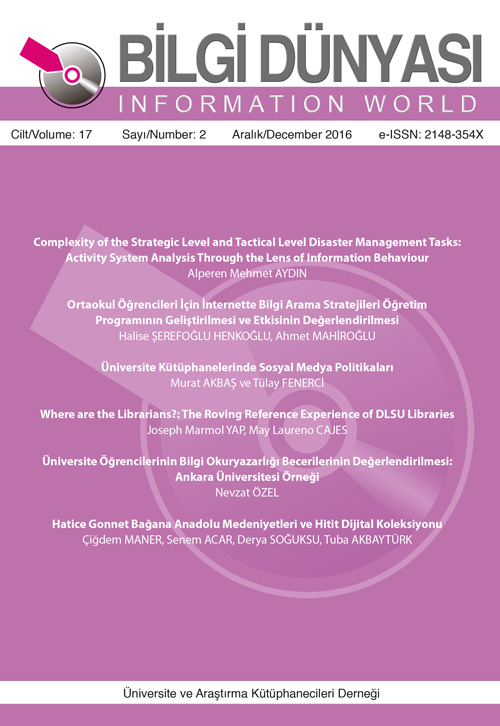
Bu çalışmada afet durumlarında acil müdahaleden sorumlu olan stratejik ve taktiksel seviye acil müdahale personelinin bilgi davranışları incelenmektedir. Araştırmanın amacı acil durum personelinin karmaşık ve zaman kısıtlı görevleri yerine getirirken bilgiyi ne şekilde işlediğinin gözlenmesi ve analiz edilmesidir. Bu çalışma betimsel bir calışma olup, geçmişte yapılan görev çalışmalarından farklı olarak sahada gözlem ve analizlerden oluşmaktadır ve bu durum çalışmanın sonuçlarının gerçek hayatla örtüştüğünü kanıtlamaktadır. Alan çalışması AKOM (Afet Kordinasyon Merkezi) ve İstanbul İtfaiyesinin birimlerinde yapılmıştır. Veriler görüşme ve alanda gözlem tekniğiyle toplanmış ve verilerin analizi de niceliksel metodlar kullanılarak yapılmıştır. Byström ve Jarvelin (1995)’in iş görevleri hakkında yapmış olduğu terimselleştirme araştırmacı tarafından acil durum görevlerinin analizinde kullanılmıştır. Kültürel ve Tarihsel Aktivite Teorisi kuramsal, terimsel ve analitik çerçeve olarak değerlendirilmiş ve bu kuramın hiyerarşik yapısı (Leont’ev, 1978; Wilson, 2006b, 2008) analitik çözümleme için kullanılmıştır. Bulgular zaman baskısı ve görev karmaşıklığının acil müdahale personeli üzerinde kayda değer etkilerinin olduğunu göstermiştir. Afet durumlarındaki kritik kararlar, stratejik ve taktiksel seviye, personelin karşılıklı sağlıklı bilgi paylaşabilecekleri ortam sağlandığı durumlarda hızlı ve etkin olmaktadır. Karşılıklı bilgi paylaşımı somut ve soyut vasıtalarla mümkün olmaktadır. Pratik etkileri bakımından araştırmada acil müdahale birimleri ellerinde mevcut bilgi ve haberleşme vasıtalarını karşılıklı ve sağlıklı iletişim kurmaya elverişli duruma getirmelidir ve farklı acil müdahale birimlerinin afet zamanlarında tek bir birimmiş gibi ortak hareket etmesi sağlanmalıdır sonuçlarına ulaşılmıştır.
Anahtar Kelimeler: Görev karmaşıklığı, bilgi davranışı, acil müdahale
Referanslar
- Aydın, A. M. (2015). The influence of task and time on information behaviour in organisations (Unpublished doctoral dissertation). Leeds University Business School, UK.
- Byström, K. (1999). Task complexity, information types and information sources: examination of relationships (Unpublished doctoral dissertation). University of Tampere, Finland.
- Byström, K. (2002). Information and information sources in tasks of varying complexity. Journal of the American Society for Information Science, 53, 581-591.
- Byström, K. (2007). Approaches to “task” in contemporary information studies. Information Studies, 12, 1-12.
- Byström, K., & Hansen, P. (2005). Conceptual framework for tasks in information studies. Journal of American Society for Information Science and Technology, 56, 1050-1061.
- Byström, K., & Jarvelin, K. (1995). Task complexity affects information seeking and use. Information Processing & Management, 31, 191-213.
- Case, D. O. (2002). Looking for information: a survey of research on information seeking, needs, and behavior. San Diego: Academic Press.
- Cyert, R. M., & Williams, J. R. (1993). Organizations, decision making and strategy: Overview and comment. Strategic Management Journal, 14, 5-10.
- Daft, R. L., & Lengel, R. H. (1983). Information richness: A new approach to managerial behavior and organization design (No. TR-ONR-DG-02). Texas A and M Univ. College Station Coll. of Business Administration.
- Dervin, B., & Nilan, M. (1986). Information needs and uses. Annual Review of Information Science and Technology, 21, 3-33.
- Franz, T. M., & Larson, J. R. (2002). The impact of experts on information sharing during group discussion. Small Group Research, 33, 383-411.
- Gigone, D., & Hastie, R. (1993). The common knowledge effect: Information sharing and group judgment. Journal of Personality and Social Psyhology, 65, 959-974.
- Hickson, D. J., Butler, R. J., Cray, D., Mallory, G. R., & Wilson, D. C. (1986). Top decisions: Strategic decision-making in organizations. Oxford: Basil Blackwell.
- Hyldegård, J., & Ingwersen, P. (2007). Task complexity and information behaviour in group based problem solving. Information Research, 12, Retrieved from http://www.informationr.net/ir/12-4/colis/colis27.html
- Jonassen, D. H., & Rohrer-murphy, L. (1999). Activity theory as a framework for designing constructivist learning environments. Educational Technology Research & Development, 47, 61-79.
- Kaptelinin, V. (ed.) (1996). Activity theory: Implications for human-computer interaction. Massachusetts: MIT Press.
- Karunakaran, A., Reddy, M. C., & Spence, P. R. (2013). Toward a model of collaborative information behavior in organizations. Journal of the American Society for Information Science and Technology, 64, 2437-2451.
- Klein, G. (2008). Naturalistic decision making. Human Factors, 50, 456-460.
- Klein, G. A., & Calderwood, R. (1991). Decision models some lessons from the field. Ieee Transactions on Systems Man and Cybernetics, 21, 1018-1026.
- Kulthau, C. (2004). Seeking meaning. Greenwich: Ablex Publishing Co.
- Kuutti, K. (Ed.). (1995). Activity Theory as a potential framework for human-computer interaction. Cambridge: MIT Press.
- Leont’ev, A. N. (1978). Activity, consciousness, and personality. Retrieved from http://www.marxists.org/archive/leontev/works/1978/index.htm
- March, J. G. (1996). Understanding how decisions happen in organizations. In Z. Shapira (Ed.), Organizational Decision Making (pp. 9-32). New York: Cambridge University Press.
- Mckenzie, M. L. (2005). Managers look to the social network to seek information. Information Research: An International Electronic Journal, 10(2).
- Michailova, S., & Husted, K. (2004). Decision making in organizations hostile to knowledge sharing. Journal for East European Management Studies, 9, 7-19.
- Mishra, J. L., Allen, D. K., & Pearman, A. D. (2011a). Activity Theory as a methodological and analytical framework for information practices in emergency management. Proceedings of 8th International ISCRAM Conference. Retrieved from http://citeseerx.ist.psu.edu/viewdoc/download?doi=10.1.1.465.7940&rep=rep1&type=pdf
- Mishra, J. L., Allen, D. K., & Pearman, A. D. (2011b). Information sharing during multi-agency major incidents. Proceedings of the American Society for Information Science and Technology, 48(1), 1-10.
- Mishra, J. L., Allen, D. K., & Pearman, A. D. (2013). Information use, support and decision making in complex, uncertain environments. Proceedings of the American Society for Information Science and Technology, 50(1), 1-10.
- O’Reilly, C. A. (1982). Variations in decision makers’ use of information sources: the impact of quality and accessibility of information. The Academy of Management Journal, 25, 756-771.
- Paul, S. A. (2010). Understanding together: Sensemaking in collaborative information seeking (Unpublished doctoral dissertation). The Pennsylvania State University, Pennsylvania.
- Reddy, M. C., & Jansen, B. J. (2008). A model for understanding collaborative information behavior in context: A study of two healthcare teams. Information Processing & Management, 44, 256-273.
- Reddy, M. C., & Spence, P. R. (2008). Collaborative information seeking: A field study of a multidisciplinary patient care team. Information Processing & Management, 44, 242-255.
- Savolainen, R. (2006). Time as a context of information seeking. Library & Information Science Research, 28, 110-127.
- Scholten, L., Van Knippenberg, D., Nijstad, B. A., & De Dreu, C. K. W. (2007). Motivated information processing and group decision-making: Effects of process accountability on information processing and decision quality. Journal of Experimental Social Psychology, 43, 539-552.
- Simon, H. A. (1987). Making management decisions: The role of intuition and emotion. The Academy of Management Executive (1987-1989), 1, 57-64.
- Schrah, G. E., Dalal, R. S., & Sniezek, J. A. (2006). No decision-maker is an Island: integrating expert advice with information acquisition. Journal of Behavioral Decision Making, 19, 43-60.
- Simon, H. A., Dantzig, G. B., Hogarth, R., Plott, C. R., Raiffa, H., Schelling, T. C., Shepsle, K. A., Thaler, R., Tversky, A., & Winter, S. (1987). Decision making and problem solving. Interfaces, 17, 11-31.
- Stasser, G., Stewart, D. D., & Wittenbaum, G. M. (1995). Expert roles and information exchange during discussion: the importance of knowing who knows what. Journal of Experimental Social Psychology, 31, 244-265.
- Stasser, G., & Titus, W. (1985). Pooling of unshared information in group decision making: biased information sampling during discussion. Journal of Personality and Social Psyhology, 48, 1467-1478.
- Stasser, G., & Titus, W. (2003). Hidden profiles: A brief history. Psychological Inquiry, 14, 304-313.
- Vakkari, P. (1999a). Task complexity, information types, search strategies and relevance: integrating studies on information seeking and retrieval. In T. D. Wilson, & D. K. Allen (Eds.), Exploring the Contexts of Information Behaviour (pp. 35-85). London: Taylor Graham Publishing.
- Vakkari, P. (1999b). Task complexity, problem structure and information actions: Integrating studies on information seeking and retrieval. Information Processing & Management, 35, 819-837.
- Vakkari, P. (2003). Task-based information searching. Annual Review of Information Science and Technology, 37, 413-464.
- Weick, K. E. (1993). Sense making in organizations: Small structures with large consequences. Englewood Cliffs, NJ: Prentice Hall.
- Widén-Wulff, G., & Davenport, E. (2007). Activity systems, information sharing and the development of organizational knowledge in two Finnish firms: An exploratory study using Activity Theory. Information Research, 12(3). Retrieved from http://files.eric.ed.gov/fulltext/EJ1104883.pdf
- Wilson, T. D. (2006a). 60 years of the best in information research: On user studies and information needs. Journal of Documentation, 62, 658-670.
- Wilson, T. D. (2006b). A re-examination of information seeking behaviour in the context of activity theory. Information Research-an International Electronic Journal, 11(4), 1.
- Wilson, T. D. (ed.). (2008). Activity Theory and Information Science. Melford, NJ: Information Today, Inc.
- Winquist, J. R., & Larson, J. R. (1998). Information pooling: When it impacts group decision making. Journal of Personality and Social Psyhology, 74, 371-377.
- Wittenbaum, G. M., Hollingshead, A. B., & Botero, I. C. (2004). From cooperative to motivated information sharing in groups: Moving beyond the hidden profile paradigm. Communication Monographs, 71, 286-310.
- Yin, R. K. (2009). Case study research: Design and methods. California, USA: Sage Publications, Inc.
Lisans
Telif Hakkı (c) 2016 Yazar(lar). Açık erişimli bu makale, orijinal çalışmaya uygun şekilde atıfta bulunulması koşuluyla, herhangi bir ortamda veya formatta sınırsız kullanım, dağıtım ve çoğaltmaya izin veren Creative Commons Attribution License (CC BY) altında dağıtılmıştır.