

Öz
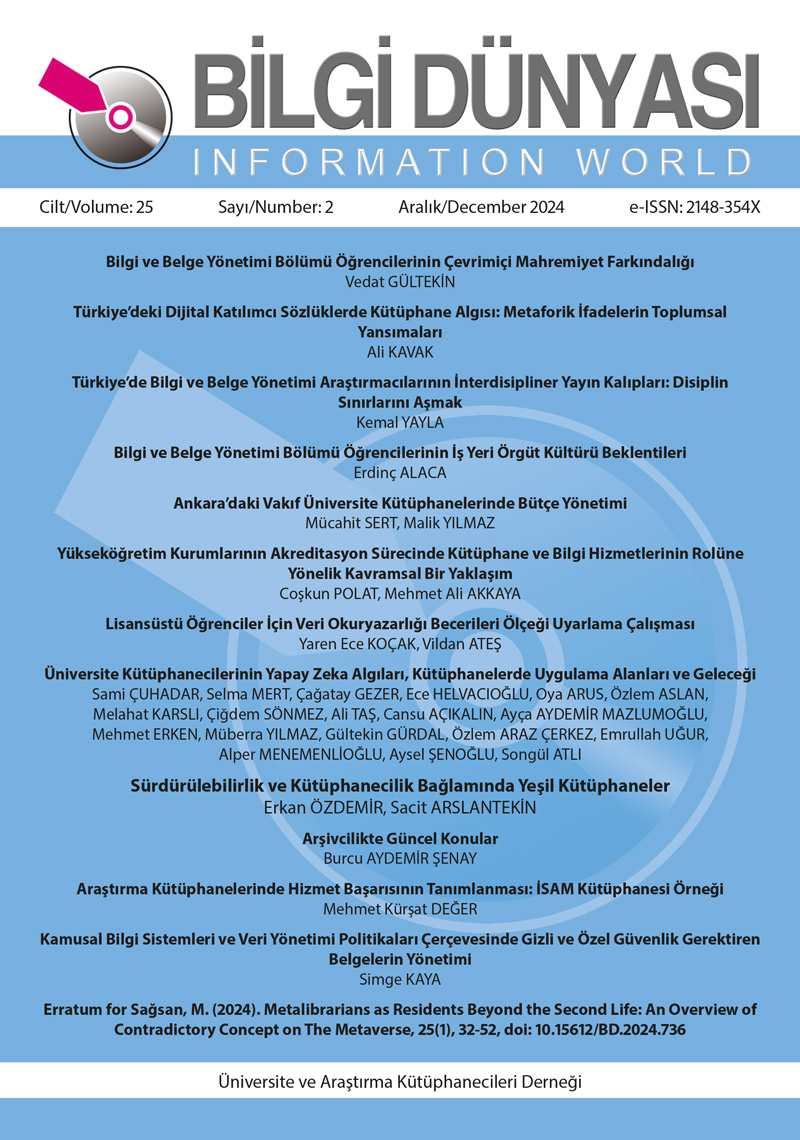
This study examines the interdisciplinary publication patterns of Information and Document Management (IDM) / Information and Records Management researchers in Turkey, determining whether their academic publishing trends align with global tendencies in the field. A data-driven and reproducible research methodology was adopted. Journal articles of 100 IDM researchers from 13 active universities in Turkey were compiled from the YÖK Academic database. Additionally, the publications were analyzed using respective journals obtained from the TR Dizin database. Word2Vec was utilized to identify semantic relationships, UMAP was used for visualization, and the Radius of Gyration (ROG) was computed to express researchers’ interdisciplinary tendencies quantitatively. T-tests and ANOVA were applied to assess differences based on demographic variables. The findings reveal that the average ROG value of IDM researchers in Turkey is 7.23, indicating a general tendency to transcend disciplinary boundaries. No significant differences in interdisciplinary tendencies were found based on academic rank, gender, or institution. The study deepens the understanding of the interdisciplinary nature of the IDM field, introduces methodological innovations through advanced data analysis methods, and contributes to the literature by creating a unique dataset. Future research should explore interdisciplinary tendencies in the IDM field by utilizing more extensive datasets and conducting international comparative analyses.
Anahtar Kelimeler: Kütüphanecilik ve Bilgi Bilim, interdisipliner araştırma, dönme yarıçapı, UMAP, Word2vec, yayın örüntüsü
Referanslar
- Adam Holland, G. (2008). Information science: An interdisciplinary effort? Journal of Documentation, 64(1), 7-23. https://doi.org/10.1108/00220410810844132
- Adams, J., ve Szomszor, M. (2022). A converging global research system. Quantitative Science Studies, 3(3), 715-731. https://doi.org/10.1162/qss_a_00208
- Arafat, S., Buckland, M., Feinberg, M., Ibekwe‐SanJuan, F., Shaw, R., ve Warner, J. (2014). Pluri, multi‐, trans‐ meta‐ and interdisciplinary nature of LIS. Does it really matter? Proceedings of the American Society for Information Science and Technology, 51(1), 1-5. https://doi.org/10.1002/meet.2014.14505101010
- Aram, J. D. (2004). Concepts of interdisciplinarity: Configurations of knowledge and action. Human Relations, 57(4), 379-412. https://doi.org/10.1177/0018726704043893
- Arslantekin, S. (2024). Disiplinlerarası bakış ile bilgi ve belge yönetimi. İçinde P. Bezirci ve I. Sert (Ed.), Cumhuriyet’in 100. Yılında Bilgi ve Belge Yönetimi Teknolojisinde Güncel Yaklaşımlar (ss. 833-851). Istanbul University Press. https://doi.org/10.26650/B/ SS53.2024.015.32
- Austin, T. R., Rauch, A., Blau, H., Yudice, G., Van Den Berg, S., Robinson, L. S., Henkel, J., Murray, T., Schoenfield, M., Traub, V., ve De Marco Torgovnick, M. (1996). Defining Interdisciplinarity. Publications of the Modern Language Association of America, 111(2), 271-282. https://doi.org/10.2307/463106
- Bates, M. J. (1999). The invisible substrate of information science. Journal of the American Society for Information Science, 50(12), 1043-1050. https://doi.org/10.1002/(SICI)10974571(1999)50:12<1043::AID-ASI1>3.0.CO;2-X
- Bates, M. J. (2007). Defining the information disciplines in encyclopedia development. Information Research, 12(4). https://informationr.net/ir/12-4/colis/colis29.html
- Bawden, D. (2007). Organised complexity, meaning and understanding: An approach to a unified view of information for information science. Aslib Proceedings, 59(4/5), 307-327. https://doi.org/10.1108/00012530710817546
- Blei, D. M., Ng, A. Y., ve Jordan, M. I. (2003). Latent dirichlet allocation. The Journal of Machine Learning Research, 3, 993-1022.
- Bonaccorsi, A., Melluso, N., ve Massucci, F. A. (2022). Exploring the antecedents of interdisciplinarity at the European Research Council: A topic modeling approach. Scientometrics, 127(12), 6961-6991. https://doi.org/10.1007/s11192-022-04368-9
- Bonnici, L. J., Subramaniam, M. M., ve Burnett, K. (2009). Everything old is new again: The evolution of library and information science education from LIS to iField. Journal of Education for Library and Information Science, 263-274.
- Buckland, M. (2012). What kind of science can information science be? Journal of the American Society for Information Science and Technology, 63(1), 1-7. https://doi.org/10.1002/asi.21656
- Burnett, K., ve Bonnici, L. J. (2013). Rhizomes in the iField: What does it mean to be an iSchool? KO Knowledge Organization, 40(6), 408-413. https://doi.org/10.5771/09437444-2013-6-408
- Carayol, N., ve Thi, T. U. N. (2005). Why do academic scientists engage in interdisciplinary research? Research Evaluation, 14(1), 70-79. https://doi.org/10.3152/147154405781776355
- Chang, Y., ve Huang, M. (2012). A study of the evolution of interdisciplinarity in library and information science: Using three bibliometric methods. Journal of the American Society for Information Science and Technology, 63(1), 22-33. https://doi.org/10.1002/ asi.21649
- Chang, Y.-W. (2018). Exploring the interdisciplinary characteristics of library and information science (LIS) from the perspective of interdisciplinary LIS authors. Library & Information Science Research, 40(2), 125-134. https://doi.org/10.1016/j. lisr.2018.06.004
- Cronin, B. (2012). The waxing and waning of a field: Reflections on information studies education. Information Research: An International Electronic Journal, 17(3), n3.
- Darbellay, F. (2015). Rethinking inter- and transdisciplinarity: Undisciplined knowledge and the emergence of a new thought style. Futures, 65, 163-174. https://doi.org/10.1016/j.futures.2014.10.009
- Evans, E. D. (2016). Measuring Interdisciplinarity Using Text. Socius: Sociological Research for a Dynamic World, 2, 237802311665414. https://doi.org/10.1177/2378023116654147
- Frodeman, R. (2011). Interdisciplinary research and academic sustainability: Managing knowledge in an age of accountability. Environmental Conservation, 38(2), 105-112. https://doi.org/10.1017/S0376892911000038
- Frodeman, R., ve Mitcham, C. (2007). New directions in interdisciplinarity: Broad, deep, and critical. Bulletin of Science, Technology & Society, 27(6), 506-514. https://doi.org/10.1177/0270467607308284
- Glänzel, W., ve Debackere, K. (2022). Various aspects of interdisciplinarity in research and how to quantify and measure those. Scientometrics, 127(9), 5551-5569. https://doi.org/10.1007/s11192-021-04133-4
- González, M. C., Hidalgo, C. A., ve Barabási, A.-L. (2008). Understanding individual human mobility patterns. Nature, 453(7196), 779-782. https://doi.org/10.1038/nature06958
- Gowanlock, M., ve Gazan, R. (2013). Assessing researcher interdisciplinarity: A case study of the University of Hawaii NASA Astrobiology Institute. Scientometrics, 94(1), 133-161. https://doi.org/10.1007/s11192-012-0765-y
- Hjørland, B. (2014). Information science and its core concepts: Levels of disagreement. Içinde F. Ibekwe-SanJuan ve T. M. Dousa (Ed.), Theories of Information, Communication and Knowledge (C. 34, ss. 205-235). Springer Netherlands. https://doi.org/10.1007/97894-007-6973-1_9
- Huutoniemi, K., Klein, J. T., Bruun, H., ve Hukkinen, J. (2010). Analyzing interdisciplinarity: Typology and indicators. Research Policy, 39(1), 79-88. https://doi.org/10.1016/j. respol.2009.09.011
- Karakaş, H. S. (2014). Disiplinlerarası yaklaşımlar ve bilgi ve belge yönetimindeki yansımaları. İçinde N. Özel ve N. Er-Koçoğlu (Ed.), Ankara Üniversitesi Bilgi ve Belge Yönetimi Bölümü 60.yıl armağan kitabı (ss. 65-80). Ankara Üniversitesi Yayınları.
- Kayaoğlu, H. D. (2019). Türkiye’de Kütüphane ve Bilgibilimi Araştırmalarında Kuram Kullanımı: Bir İçerik Analizi. Türk Kütüphaneciliği, 33(4), 249-266.
- Keseroğlu, H. S. (2010). Bilginin bilgisi: Kütüphane ve bilgibilim kuramı sorunsalı. Türk Kütüphaneciliği, 24(4), 685-704.
- Koch, T., ve Vanderstraeten, R. (2021). Journal editors and journal indexes: Internationalization pressures in the semi‐periphery of the world of science. Learned Publishing, 34(4), 519-527. https://doi.org/10.1002/leap.1390
- Kumar, S., Zöphel, C., Martius, A., Cabadag, R., Plewnia, F., Pruditsch, N., Sakowski, B. A., ve Möst, D. (2019). Stronger together—A framework for measuring interdisciplinary understanding. WIREs Energy and Environment, 8(6), e348. https://doi.org/10.1002/ wene.348
- Larivière, V., ve Gingras, Y. (2010). On the relationship between interdisciplinarity and scientific impact. Journal of the American Society for Information Science and Technology, 61(1), 126-131. https://doi.org/10.1002/asi.21226
- Lau, L., ve Pasquini, M. W. (2004). Meeting grounds: Perceiving and defining interdisciplinarity across the arts, social sciences and sciences. Interdisciplinary Science Reviews, 29(1), 49-64. https://doi.org/10.1179/030801804225012437
- Lopatovska, I., ve Ransom, E. (2016). The state of L-Schools: Intellectual diversity and faculty composition. Journal of Librarianship and Information Science, 48(1), 18-35. https://doi.org/10.1177/0961000614533718
- Mansilla Boix, V. (2006). Assessing expert interdisciplinary work at the frontier: An empirical exploration. Research Evaluation, 15(1), 17-29. https://doi.org/10.3152/147154406781776075
- McInnes, L., Healy, J., Saul, N., ve Großberger, L. (2018). UMAP: Uniform Manifold Approximation and Projection. Journal of Open Source Software, 3(29), 861. https://doi.org/10.21105/joss.00861
- Mikolov, T., Chen, K., Corrado, G., ve Dean, J. (2013). Efficient estimation of word representations in vector space. arXiv preprint arXiv:1301.3781.
- Morillo, F., Bordons, M., ve Gómez, I. (2003). Interdisciplinarity in science: A tentative typology of disciplines and research areas. Journal of the American Society for Information Science and Technology, 54(13), 1237-1249. https://doi.org/10.1002/ asi.10326
- Mugabushaka, A.-M., Kyriakou, A., ve Papazoglou, T. (2016). Bibliometric indicators of interdisciplinarity: The potential of the Leinster–Cobbold diversity indices to study disciplinary diversity. Scientometrics, 107(2), 593-607. https://doi.org/10.1007/s11192016-1865-x
- Okamura, K. (2019). Interdisciplinarity revisited: Evidence for research impact and dynamism. Palgrave Communications, 5(1), 141. https://doi.org/10.1057/s41599-019 0352-4
- Özdemirci, F. (2017). Belge ve arşiv yönetiminde yeni ufuklar ve kuramsal yaklaşımlar. İçinde B. Yılmaz, M. Dişli, S. Öztemiz, ve T. Baş (Ed.), Bilgi ve Belge Yönetimi: Kuramsal yaklaşımlar. Hiperlink.
- Pham, H.-S., Vancraeynest, B., Poelmans, H., Vancauwenbergh, S., ve Ali-Eldin, A. (2023). Identifying interdisciplinary research in research projects. Scientometrics, 128(10), 5521-5544. https://doi.org/10.1007/s11192-023-04810-6
- Pilkington, A., ve Liston‐Heyes, C. (1999). Is production and operations management a discipline? A citation/co‐citation study. International Journal of Operations & Production Management, 19(1), 7-20. https://doi.org/10.1108/01443579910244188
- Porter, A. L., Cohen, A. S., David Roessner, J., ve Perreault, M. (2007). Measuring researcher interdisciplinarity. Scientometrics, 72(1), 117-147. https://doi.org/10.1007/s11192-0071700-5
- Porter, A. L., ve Rafols, I. (2009). Is science becoming more interdisciplinary? Measuring and mapping six research fields over time. Scientometrics, 81(3), 719-745. https://doi.org/10.1007/s11192-008-2197-2
- Prebor, G. (2010). Analysis of the interdisciplinary nature of library and information science. Journal of Librarianship and Information Science, 42(4), 256-267. https://doi.org/10.1177/0961000610380820
- Raimbault, J. (2019). Exploration of an interdisciplinary scientific landscape. Scientometrics, 119(2), 617-641. https://doi.org/10.1007/s11192-019-03090-3
- Rhoten, D., ve Pfirman, S. (2007). Women in interdisciplinary science: Exploring preferences and consequences. Research Policy, 36(1), 56-75. https://doi.org/10.1016/j.respol.2006.08.001
- Saracevic, T. (1999). Information science. Journal of the American Society for Information Science, 50(12), 1051-1063. https://doi.org/10.1002/(SICI)1097-4571(1999)50:12<1051::AIDASI2>3.0.CO;2-Z
- Sayama, H., ve Akaishi, J. (2012). Characterizing interdisciplinarity of researchers and research topics using web search engines. PLoS ONE, 7(6), e38747. https://doi.org/10.1371/journal.pone.0038747
- Shu, F., Larivière, V., Mongeon, P., Julien, C.-A., ve Piper, A. (2016). On the evolution of library and information science doctoral dissertation topics in North America (1960–2013). Journal of Education for Library and Information Science, 57(2), 131-142. https://doi.org/10.3138/jelis.57.2.131
- Shu, F., ve Mongeon, P. (2016). The evolution of iSchool movement (1988-2013): A bibliometric view. Education for Information, 32(4), 359-373. https://doi.org/10.3233/ EFI-160982
- Slonim, N., Friedman, N., ve Tishby, N. (2002). Unsupervised document classification using sequential information maximization. Proceedings of the 25th Annual International ACM SIGIR Conference on Research and Development in Information Retrieval, 129-136. https://doi.org/10.1145/564376.564401
- Song, C., Koren, T., Wang, P., ve Barabási, A.-L. (2010). Modelling the scaling properties of human mobility. Nature Physics, 6(10), 818-823. https://doi.org/10.1038/nphys1760
- Sugimoto, C. R. (2009). Proposal and application of the interdisciplinarity borrowing index: Determining the degrees of interdisciplinarity of ILS dissertations. Proceedings of the American Society for Information Science and Technology, 46(1), 1-6. https://doi.org/10.1002/meet.2009.1450460392
- Sugimoto, C. R., Ni, C., Russell, T. G., ve Bychowski, B. (2011). Academic genealogy as an indicator of interdisciplinarity: An examination of dissertation networks in Library and Information Science. Journal of the American Society for Information Science and Technology, 62(9), 1808-1828. https://doi.org/10.1002/asi.21568
- Tonta, Y. (2012). Kütüphanecilik ve bilgibilim eğitiminde gelişmeler ve program değişiklikleri. Türk Kütüphaneciliği, 26(2), 227-261. http://www.tk.org.tr/index.php/ TK/article/view/314
- Torunlar, M. (2020). Belge/Bilgi Yönetimi disiplininde olası paradigma değişiklikleri: Yeni Bir rota teklifi. Bilgi Yönetimi, 3(2), 143-156. https://doi.org/10.33721/by.777442
- Vakkari, P. (2024). What characterizes LIS as a fragmenting discipline? Journal of Documentation, 80(7), 60-77. https://doi.org/10.1108/JD-10-2023-0207
- Van Noorden, R. (2015). Interdisciplinary research by the numbers. Nature, 525(7569), 306-307. https://doi.org/10.1038/525306a
- Vienni-Baptista, B., Fletcher, I., Lyall, C., ve Pohl, C. (2022). Embracing heterogeneity: Why plural understandings strengthen interdisciplinarity and transdisciplinarity. Science and Public Policy, 49(6), 865-877. https://doi.org/10.1093/scipol/scac034
- Wang, X., Wang, Z., Huang, Y., Chen, Y., Zhang, Y., Ren, H., Li, R., ve Pang, J. (2017). Measuring interdisciplinarity of a research system: Detecting distinction between publication categories and citation categories. Scientometrics, 111(3), 2023-2039. https://doi.org/10.1007/s11192-017-2348-4
- Wiggins, A., ve Sawyer, S. (2012). Intellectual diversity and the faculty composition of iSchools. Journal of the American Society for Information Science and Technology, 63(1), 8-21. https://doi.org/10.1002/asi.21619
- Wu, D., He, D., Jiang, J., Dong, W., ve Vo, K. T. (2012). The state of iSchools: An analysis of academic research and graduate education. Journal of Information Science, 38(1), 1536. https://doi.org/10.1177/0165551511426247
- Yegros-Yegros, A., Rafols, I., ve D’Este, P. (2015). Does interdisciplinary research lead to higher citation impact? The different effect of proximal and distal interdisciplinarity. PLoS ONE, 10(8), e0135095. https://doi.org/10.1371/journal.pone.0135095
- Zhuge, H. (2006). Discovery of knowledge flow in science. Communications of the ACM, 49(5), 101-107. https://doi.org/10.1145/1125944.1125948
Lisans
Telif Hakkı (c) 2024 Yazar(lar). Açık erişimli bu makale, orijinal çalışmaya uygun şekilde atıfta bulunulması koşuluyla, herhangi bir ortamda veya formatta sınırsız kullanım, dağıtım ve çoğaltmaya izin veren Creative Commons Attribution License (CC BY) altında dağıtılmıştır.