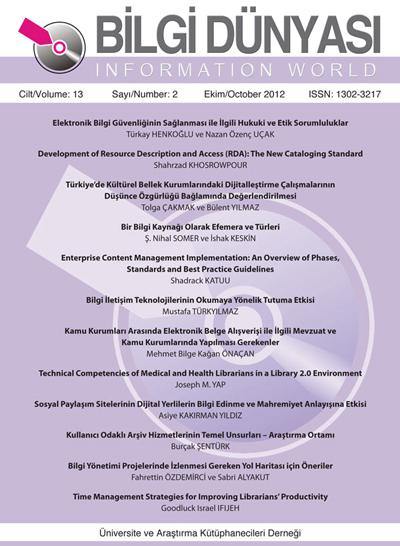
Abstract
Nowadays, information centers have become cultural centers where everyone could gain access to information without time and place limitations. This situation has made the information centers and professionals take some new legal and ethical responsibilities. If necessary precautions are taken, this will prevent information centers from facing serious problems in terms of both fi nancial and ethical issues in near future.
In this study, both ethical and legal issues and responsibilities of information centers and professionals related to the security of electronic data resources are investigated within the scope of Turkish Law Legislation and professional ethical rules. In this process, related literature was reviewed to discover the contradictions and administrative and technical defi ciencies in terms of ethical and legal responsibilities of information centers and professionals, which in turn has resulted in new applicable solutions for this area. In addition, in scope of the current study, legal regulations related to this issue were discussed in order to propose new ethical practices which do not confl ict with the legal ones. At the end of the study, importance of raising awareness of information managers about information security and make them more knowledgeable their legal and ethical responsibilities in this subject are emphasized.
Keywords: Information security, Information centers, Information professionals, Rules of law, Professional ethics
References
- ALA. (2007). Privacy tool kit. 17 Mart 2012 tarihinde http://www.ala.org/offices/oif/iftoolkits/toolkitsprivacy/introduction/introduction adresinden erişildi.
- ALA. (2008). Code of ethics of the American Library Association. 17 Mart 2012 tarihinde http://www.ala.org/advocacy/sites/ala.org.advocacy/files/content/proethics/codeofethics/Code%20of%20Ethics%20of%20the%20American%20Library%20Association.pdf adresinden erişildi.
- Avrupa Konseyi. (2001). Convention on cybercrime. 14 Temmuz 2012 tarihinde http://conventions.coe.int/Treaty/en/Treaties/Html/185.htm adresinden erişildi.
- Bozkurt, A. (2010). Türkiye de “Sanal Suçlar Sözleşmesi”ni imzaladı. Bilişim Dergisi. 127, 10-12.
- BSI. (2012). Bundesamt für Sicherheit in der Informationstechnik. BSI-Informationen. https://www.bsi.bund.de/DE/Home/home_node.html adresinden erişildi.
- COPPA. (1998). COPPA - Children’s Online Privacy Protection Act. 17 Mart 2012 tarihinde Federal Trade Commission: http://www.ftc.gov/ogc/coppa1.htm adresinden erişildi.
- CSI. (2011). Computer crime and security survey. 24 Mart 2012 tarihinde http://reports.informationweek.com/abstract/21/7377/Security/research-2010-2011-csi-survey.html adresinden erişildi.
- Çelik, A. ve Tonta, Y. (1996). Düşünce özgürlüğü, bilgi edinme özgürlüğü ve bilgi hizmetleri. 17 Mart 2012 tarihinde http://yunus.hacettepe.edu.tr/~tonta/yayinlar/beozgur.html adresinden erişildi.
- Doğan, Y. H. (2005). Özel hayata ve hayatın gizli alanına karşı suçlar. 17 Mart 2012 tarihinde http://www.ceza-bb.adalet.gov.tr/makale/146.doc adresinden erişildi.
- Henkoğlu, T. (2011). Adli bilişim - dijital delillerin elde edilmesi ve analizi. İstanbul: Pusula Yayıncılık.
- Hürman, H. ve Özmen, S. (2011). İnternette mahremiyet: başlangıcı ve sonu…. 17 Mart 2012 tarihinde http://siviltoplumakademisi.org.tr/index.php?option=com_content&view=article&id=809:internette-mahremiyet-&catid=65:mansetler&Itemid=121 adresinden erişildi.
- Karagülmez, A. (2009). Bilişim suçları ve soruşturma-kovuşturma evreleri. Ankara: Seçkin Yayıncılık.
- Karasözen, B. ve Gürgüz, E. (2004). ODTÜ Kütüphanesi performans bütçeleme projesi ve toplam kalite çalışmaları. Ankara: ODTÜ Kütüphane ve Dokümantasyon Daire Başkanlığı.
- Ketizmen, M. (2008). Türk Ceza Hukukunda bilişim suçları. Ankara: Adalet Yayınevi.
- ODTÜ BİDB. (2008a). ODTÜ yerel alan ağında 5651 sayılı kanun uyarınca uyulması gereken kurallar. 26 Mart 2012 tarihinde http://www.metu.edu.tr/5651/files/5651_sayili_kanunun_uygulanma_kurallari_v1.0.pdf adresinden erişildi.
- ODTÜ BİDB. (2008b). 5651 Sayılı kanun ile ilgili sıkça sorulan sorular. 26 Mart 2012 tarihinde http://www.metu.edu.tr/5651/sss.php adresinden erişildi.
- TBD. (2012). Ulusal siber güvenlik yasa tasarısı acilen yasalaştırılmalı. Bilişim Dergisi. 141, 14-15.
- TBMM. (2004). Türk Ceza Kanunu. 30 Mart 2012 tarihinde http://www.tbmm.gov.tr/kanunlar/k5237.html adresinden erişildi.
- TBMM. (2007). İnternet ortamında yapılan yayınların düzenlenmesi ve bu yayınlar yoluyla işlenen suçlarla mücadele edilmesi hakkında kanun. 26 Mart 2012 tarihinde http://www.tbmm.gov.tr/kanunlar/k5651.html adresinden erişildi.
- T.C. Başbakanlık. (2007). İnternet ortamında yapılan yayınların düzenlenmesine dair usul ve esaslar hakkında yönetmelik. 26 Mart 2012 tarihinde http://www.mevzuat.adalet.gov.tr/html/27666.html adresinden erişildi.
- T.C. Başbakanlık. (2009). E-Devlet ve bilgi toplumu kanun tasarısı taslağı. 16 Temmuz 2012 tarihinde http://akgul.bilkent.edu.tr/e-devlet/taslak.pdf adresinden erişildi.
- TKD. (1996). BBY Haber. 18 Mart 2012 tarihinde http://www.bbyhaber.com/bby/wp-content/uploads/dosyalar/mevzuat/Mesleki-Etik-Kurallari.pdf adresinden erişildi.
- TKD. (2010). Türk Kütüphaneciler Derneği mesleki etik ilkeleri. 18 Mart 2012 tarihinde http://www.kutuphaneci.org.tr/index.php?view=article&catid=45%3Atkd-bildirgeler&id=115%3Atkdmeslek-etik&format=pdf&option=com_content&Itemid=101 adresinden erişildi.
- Toplu, M. (2007). Kütüphaneciliğin etik sorunu ve Türkiye yaklaşımı. Türk Kütüphaneciliği, 21(2), 186-217.
- Winter, K. (1997). Privacy and the rights and responsibilities of librarians. 17 Mart 2012 tarihinde http://www.cstone.net/~kwinter/articles/ksr4_winter.pdf adresinden erişildi.
License
Copyright (c) 2012 The author(s). This is an open access article distributed under the Creative Commons Attribution License (CC BY), which permits unrestricted use, distribution, and reproduction in any medium or format, provided the original work is properly cited.