Abstract
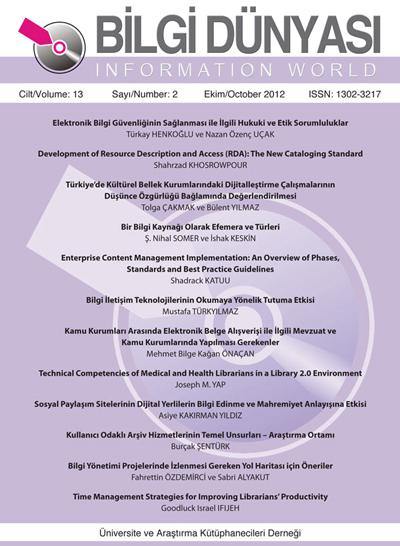
The management of digital records has been a subject of numerous scholarly discussions for several years. Discussions on the application systems used to manage these records and other digital content have often used diff erent terminology, frequently interchangeably, with little regard to nuanced diff erences. In addition, a number of standards and best practice guidelines have been developed in diff erent countries to address the challenges of assessing and implementing these applications. While it may look like a lot of resources are available to records professionals as they tackle the challenges of implementing software applications, there is need to clarify terminology and identify implementation phases, as well, as the appropriate standards and best practice guidelines. This article, using primarily a review of literature, suggests definitional clarity and connectedness of diff erent terms used for Enterprise Content Management (ECM) applications. It identifies the various phases of implementation of ECM applications and off ers an overview of standards and best practice guidelines. Lastly it provides an assessment of the connection between phases of implementation in relation to standards and best practice guidelines, providing a gap analysis while also suggesting ways of addressing the variance.
Keywords: Document management, Enterprise content management, Electronic document management systems, Electronic records management, Standards
References
- Abbott, B. S. (2000). Preserving electronic memory: An investigation into the role played by the National Archives of South Africa in the management of electronic records of central government. Unpublished Master Thesis, University of Natal, Natal.
- Adam, A. (2008). Implementing electronic document and record management systems. Boca Raton: Auerbach Publications.
- AIIM. (2010). What is Enterprise content management. Retrieved March 5, 2011, from http://www.aiim.org/What-is-ECM-Enterprise-Content-Management.aspx
- Bailey, S. (2008a). Electronic records management survey. Retrieved March 5, 2011, from http://www.jiscinfonet.ac.uk/records-management/erm-survey/
- Bailey, S. (2008b). Has EDRMS been a success? The case for the prosecution. Paper presented at the 2008 Records Management Society Conference. Retrieved March 5, 2011, from https://docs.google.com/Doc?id=dc52qjsm_1chn77zdw
- Baca, M., Harpring, P., Ward, J. & Beecroft., A. (2008). Metadata standards crosswalk. In M. Baca (Ed.), Introduction to Metadata Version 3.0. Los Angeles: J. Paul Getty Trust.
- Bell, T., Shegda, K. M., Gilber, M. R. & Chin, K. (2010). Magic quadrant for enterprise content management. Retrieved March 5, 2011, from http://www.gartner.com/DisplayDocument?doc_cd=206900
- Blatt, R. (2011). ECM? EDRM? EC3M?. Retrieved April 5, 2011, from http://www.aiim.org/Infonomics/ECM-EDRM-ec3m-rm.aspx
- Cain, P. (2002). Model Requirements for the Management of Electronic Records (MoReq): A critical evaluation. Records Management Journal, 12(1), 14-18.
- CMS Watch. (2010). The ECM report 2010. Retrieved March 25, 2011, from http://replay.waybackmachine.org/20090524222117/http://www.cmswatch.com/ECM/Report/
- Cunningham, A. (2010). International Council on Archives Project - Principles and Functional Requirements for Records in Electronic Office Environments. Retrieved March 24, 2012, from http://www.naa.gov.au/Images/Adrian%20Cunningham_tcm16-37084.pps
- Cvision Technologies. (2011). Electronic document management. Retrieved June 11, 2011, from http://www.cvisiontech.com/pdf/pdf-document/electronic-document-management.html?lang=eng
- Department of Defense [United States]. (2012). Records Management Application: DoD 5015.02 STD RMA Design Criteria Standard. Retrieved March 27, 2012, from http://jitc.fhu.disa.mil/cgi/rma/standards.aspx
- DLM Forum Foundation. (2011). Moreq2010 - Modular Requirements for Records Systems. Retrieved June 11, 2011, from http://moreq2010.eu/pdf/moreq2010_vol1_v1_1_en.pdf
- DLM Forum. (2011). MoReq2010 press release. Retrieved March 24, 2012, from http://www.dlmforum.eu/index.php?option=com_content&view=article&id=124%3Ajune-8-2011press-release&catid=18%3Anews&Itemid=48&lang=en
- Duranti, L. & Rogers, C. (2011). Educating for trust. Archival Science, 11(3-4), 373-390.
- Duranti, L. & Thibodeau, K. (2006). The Concept of record in interactive, experiential and dynamic environments: the View of InterPARES. Archival Science, 6, 13-68.
- Eastwood, T. (2006). Building archival knowledge and skills in the digital age. Archival Science, 6, 163-170.
- European Commission. (2001). Model Requirements for the Management of Electronic Records (MoReq). Retrieved April 3, 2011, from http://www.cornwell.co.uk/EDRM/moreq.asp
- European Commission. (2008). Model Requirements for the Management of Electronic Records (MoReq) 2. Retrieved April 1, 2011, from http://www.moreq2.eu/moreq2
- Fernandez, L. & Sprehe, J. T. (2003). Integrating an ERDMS in an IT environment. The Information Management Journal, Retrieved March 5, 2011, from https://www.arma.org/bookstore/files/lessons_0703.pdf
- Gargeya, V. B. & Brady, C. (2005). Success and failure factors of adopting SAP in ERP system implementation. Business Process Management Journal, 11(5), 501-516.
- Garrido, B. G. (2008). Organizing electronic documents: the user perspective: A case study at the European Central Bank. Records Management Journal, 18(3), 180-193.
- Gartner. (2003). Magic quadrant for integrated document management. Retrieved March 5, 2011, from http://www.project-consult.net/Files/Gartner_QM2003_IDM.pdf
- Godby, C. J., Young, J. A. & Childress, E. (2004). A Repository of metadata crosswalks. D-Lib Magazine. Retrieved March 25, 2012 from http://www.dlib.org/dlib/december04/godby/12godby.html
- Gunnlaugsdottir, J. (2008). Registering and searching for records in electronic records management systems. International Journal of Information Management, 28(4), 293-304.
- Gunnlaugsdottir, J. (2009). The human side of ERMS: An Icelandic study. Records Management Journal, 19(1), 54-72.
- Hawari, A. & Heeks, R. (2010). Explaining ERP failure in developing countries: A Jordanian case study. iGovernment working paper. Retrieved March 25, 2012, from http://www.sed.manchester.ac.uk/idpm/research/publications/wp/di/documents/di_wp45.pdf
- Healy, S. (2010). ISO 15489 Records Management: Its development and significance. Records Management Journal, 20(1), 96-103.
- Heeks, R. (2002). Failure, success and improvization of information systems projects in developing countries. iGovernment working paper. Retrieved March 25, 2012, from http://www.sed.manchester.ac.uk/idpm/research/publications/wp/di/documents/di_wp11.pdf
- Henriksen, H. Z. & Andersen, K. V. (2008). Electronic records management systems implementation in the Pakistani local government. Records Management Journal, 18(1), 40-52.
- Henttonen, P. (2009). A comparison of MoReq and SAHKE metadata and functional requirements. Records Management Journal, 19(1), 26-36.
- Hsu, F., Chen, T. & Wang, S. (2009). Efficiency and satisfaction of electronic records management systems in e-government in Taiwan. The Electronic Library, 27(3), 461-473.
- Inefuku, H. (2010). Crosswalk of functional and activity models - InterPARES, OAIS, PAIM, Tufts/Yale. Retrieved September 21, 2012, from http://works.bepress.com/cgi/viewcontent.cgi?article=1009&context=hinefuku
- International Standards Organization. (2010a). ISO 16175-1:2010 Principles and functional requirements for records in electronic office environments -- part 1: Overview and statement of principles. Geneva: International Standards Organization.
- International Standards Organization. (2010b). ISO 16175-3:2010 Principles and functional requirements for records in electronic office environments -- part 3: Guidelines and functional requirements for records in business systems. Geneva: International Standards Organization.
- International Standards Organization. (2011). ISO 16175-2:2011 Principles and functional requirements for records in electronic office environments -- part 2: Guidelines and functional requirements for digital records management systems. Geneva: International Standards Organization.
- InterPARES 3 - TEAM Canada. (2010). City of Surrey, legislative services and information technology divisions. Retrieved April 1, 2011, from http://www.interpares.org/ip3/ip3_case_studies.cfm?team=1#cs14
- InterPARES Project. (2012). The InterPARES Project: International Research on Permanent Authentic Records in Electronic Systems. Retrieved March 24, 2012, from http://www.interpares.org/
- JISC infoNet. (2007). Implementing an Electronic Document and Records Management (EDRM) system. Retrieved April 1, 2011, from http://www.jiscinfonet.ac.uk/InfoKits/edrm
- Johare, R., Hussin, N. & Jamaludin, A. (2011). Management of court records: Functional requirements framework for electronic recordkeeping system. Asia-Pacific Conference On Library & Information Education & Practice. Retrieved March 27, 2012, from http://eprints.ptar.uitm.edu.my/3524/
- Kampffmeyer, U. (2004). Trends in record, document and enterprise content management. Retrieved October 4, 2011, from http://www.project-consult.net/Files/ECM_Handout_english_SER.pdf
- Kampffmeyer, U. (2006). Enterprise content management. Retrieved October 4, 2011, from http://www.project-consult.net/Files/ECM_White%20Paper_kff_2006.pdf
- Katuu, S. (2000). Management of Electronic Records: An overview. Information Development, 16(1), 34-35.
- Katuu, S. (2004). Report on an investigation of electronic records in the Commonwealth. Unpublished Research Report. University of Botswana, Botswana.
- Katuu, S. (2012). Enterprise Content Management (ECM) implementation in South Africa. Records Management Journal, 22(1), 37-56.
- Keakopa, S. M. (2006). Management of electronic records in Botswana, Namibia and South Africa: opportunities and challenges. Unpublished Phd dissertation, University of London, London.
- Kemoni, H. N. (2007). Records management practices and public service delivery in Kenya. Unpublished Phd Thesis, University of KwaZulu, Natal.
- Kemoni, H. N. (2009). Management of electronic records - review of empirical studies from the Eastern, Southern Africa Regional Branch of the International Council on Archives (ESARBICA) region. Records Management Journal, 19(3), 190-203.
- Kulcu, O. (2009). Evolution of e-records management practices in e-government: A Turkish perspective. The Electronic Library, 27(6), 999-1009.
- Kwatsha, N. (2010). Factors affecting the implementation of Electronic Document and Records Management Systems. Unpublished Phd Thesis, University of Stellenbosch.
- Lips, M. & Rapson, A. (2009). Emerging records management in 21st century New Zealand Government – part 2. Retrieved March 27, 2012, from www.e-government.vuw.ac.nz/research_projects_2009/Emerging_Records_%20Management_pt2.pdf
- Luyombya, D. (2010). Framework for effective public digital records management in Uganda. Unpublished Phd Thesis, University College London, London.
- MacNeil, H. & Mak, B. (2007). Constructions of Authenticity. Library Trends, 56(1), 26-56.
- Maguire, R. (2005). Lessons learned from implementing an electronic records management system. Records Management Journal, 15(3), 150-157.
- Makhura, M. M. (2001). The role of electronic records management in a service organization. Unpublished Master Thesis, Rands Afrikaans University, Johannesburg.
- McDonald, J. (2011). Personal email.
- McLeod, J. (2010). Managing electronic records - systems/technology approaches for your organization. Future of RM in a Web 2.0 world. Retrieved March 27, 2012, from http://www.irma.is/Portals/6/Fraedsluerindi/icelandic%20rm%20assoc%20seminar1%209%20April%202010.pdf
- McLeod, J. & Hare, C. (2010). Development of RMJ: A mirror of the development of the profession and discipline of records management. Records Management Journal, 20(1), 9-40.
- Mokhtar, U. A. & Yusof, Z. M. (2009). Electronic records management in the Malaysian public sector: the existence of policy. Records Management Journal, 19(3), 231 - 244
- Molla, A. & Loukis, I. (2005). Success and failure of ERP technology transfer: A framework for analysing congruence of host and system cultures. iGovernment working paper. Retrieved March 25, 2012, from http://www.sed.manchester.ac.uk/idpm/research/publications/wp/di/documents/di_wp24.pdf
- Moloi, J. (2006). An investigation of e-records management in government: Case study of Botswana. Unpublished Master Thesis, University of Botswana.
- Moore, C. & Markham, R. (2003). Market leaders emerging in enterprise content management. Retrieved March 5, 2011, from http://www.forrester.com/rb/Research/market_leaders_emerging_in_enterprise_content_management/q/id/30139/t/2
- Mutiti, N. (2002). Computerization of archives and records in the ESARBICA region. ESARBICA Journal, 21, 114-119.
- National Archives and Records Administration [United States]. (2012). Department of Defense (DOD) Standard 50515.2. Retrieved March 24, 2012, from http://www.archives.gov/recordsmgmt/initiatives/dod-standard-5015-2.html
- National Archives and Records Service of South Africa. (2006). Circular 4 of 2006. Retrieved April 22, 2011, from http://www.national.archives.gov.za/rms/circulars/circular4_2006.htm
- National Archives of Australia. (2007). Guidelines for implementing the specification for electronic records management systems software. Retrieved March 5, 2011, from http://www.naa.gov.au/records-management/publications/ERMS-guidelines.aspx
- Nengomasha, C. (2008). A study of electronic records management in the public service of Namibia in the Context of E-Government. Unpublished Phd. dissertation, University of Namibia.
- Nguyen, L. T., Swatman, P. M. C. & Fraunholz, B. (2007). EDMS, ERMS, ECMS or EDRMS: Fighting through the acronyms towards a strategy for effective corporate records management. 18th Australasian Conference on Information Systems. Retrieved March 25, 2011, from http://acis2007.usq.edu.au/assets/papers/132.pdf
- Nguyen, L. T., Swatman, P. M. C., Fraunholz, B. & Salzman, S. (2009). EDRMS Implementations in the Australian Public Sector. ACIS 2009 Proceedings Paper 16. Retrieved March 27, 2012, from http://aisel.aisnet.org/acis2009/16/
- Pember, M. (2006). Sorting out the standards: What every records and information professional should know. Records Management Journal, 16(1), 21-33.
- Prom, C. (2011). Requirements for electronic records management systems. Retrieved March 24, 2012, from http://e-records.chrisprom.com/?p=1908
- Riofrio, H. & Matsuura, S. R. (2004). DOD 5015.2: An overview. Retrieved April 5, 2011, from http://www.aiim.org/Resources/Archive/Magazine/2004-May-Jun/28244
- Saffady, W. (2009). Managing electronic records (4th edition ed.). ARMA International.
- Sejane, L. (2004). An investigation into the management of electronic records in the public sector in Lesotho. Unpublished Master Thesis, University of KwaZulu Natal, Pietermaritzburg.
- Shegda, K. (2001). Integrated document management software: Perspective. Retrieved April 4, 2011, from http://www.emory.edu/BUSINESS/et/552fall2001/collaboration/int2.pdf
- Shegda, K. M., Chin, K., Logan, D. & Lundy, J. (2004). Building the magic quadrant for ECM 2004. Retrieved April 5, 2011, from http://www.gartner.com/DisplayDocument?doc_cd=124032
- Smith, K. (2007). Planning and implementing electronic records management: A practical guide. London: Facet Publishing.
- Sprehe, J. T. (2004). A framework for EDMS/ERMS integration. The Information Management Journal, November/December, 54-62.
- Sprehe, J. T. (2005). The positive benefits of electronic records management in the context of enterprise content management. Government Information Quarterly, 22(2), 297-303.
- Sprehe, J. T. & McClure, C. R. (2005). Lifting the burden. The Information Management Journal Retrieved March 27, 2012, from http://www.arma.org/bookstore/files/Sprehe1.pdf
- Stanforth, C. (2010). Analysing e-Government project failure: Comparing factoral, systems and interpretive approaches. iGovernment working paper. Retrieved March 25, 2012, from http://www.sed.manchester.ac.uk/idpm/research/publications/wp/igovernment/documents/iGovWkPpr20.pdf
- State Information Technology Agency [South Africa]. (2002). Awarded tenders - Groupware software. Retrieved March 25, 2012, from http://www.sita.co.za/TendersAdministration/ViewAwarded.asp?tenderid=56
- State Information Technology Agency [South Africa]. (2005). Awarded tender - Supply of Enterprise Content Management Solutions. Retrieved March 25, 2012, from http://www.sita.co.za/TendersAdministration/ViewAwarded.asp?tenderid=3743
- The National Archives [United Kingdom]. (2008). Functional requirements. Retrieved April 5, 2011, from http://collections.europarchive.org/tna/20080108102455/http://www.nationalarchives.gov.uk/electronicrecords/function.htm
- Thibodeau, K. & Prescott, D. R. (1996). Reengineering records management: The U.S Department of Defense, records management task force. Archivi & Computer, 6(1), 71-78.
- Trace, C. (2005). InterPARES: Securing the future of our electronic records. Bulletin of the American Society for Information Science and Technology, 27(1), 24-26.
- Wamukoya, J. & Mutula, S. (2005). Capacity-building requirements for e-records management: The case of East and Southern Africa. Records Management Journal, 15(2), 71-79.
- Wilhelm, P. (2009). An evaluation of MoReq2 in the context of national EDRMS standard developments in the UK and Europe. Records Management Journal, 19(2), 117-134.
- Wilkins, L., Swatman, P. M. C. & Holt, D. (2009). Achieved and tangible benefits: Lessons learned from a landmark EDRMS implementation. Records Management Journal, 19(1), 37-53.
- Willemin, G. (2006). The International Committee of the Red Cross (ICRC) official e-mail system: An example of records management. Records Management Journal, 16(2), 82-90.
- Williams, D. J. (2005). EDRM implementation at the National Weights and Measures Laboratory. Records Management Journal, 15(3), 158-166.
- World Bank Group Archives. (2003). Electronic records strategy. Retrieved March 24, 2012, from http://go.worldbank.org/RT8ZQUE090
- Yeo, K. T. (2002). Critical failure factors in information system projects. International Journal of Project Management, 20(3), 241-246.
License
Copyright (c) 2012 The author(s). This is an open access article distributed under the Creative Commons Attribution License (CC BY), which permits unrestricted use, distribution, and reproduction in any medium or format, provided the original work is properly cited.