Abstract
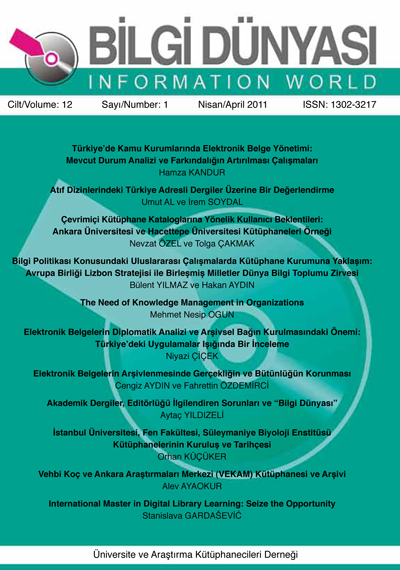
Records have become to be managed in electronic media ever since information technologies were used in institutional structures intensively. The use of electronic records in institutional structures makes it compulsory to make a good archiving, and hence to realize the protection of the authenticity and integrity of electronic records. It is significantly important to find sustainable solutions to this for the success of management systems of electronic records. In this article, the necessary issues in order to provide the sustainable archiving of electronic records and protecting the authenticity and integrity of them are explained.
Keywords: Electronic records management, e-Archiving, Integrity of e-records, Authenticity of e-records, Digital preservation, Digital signature
References
- Aydın, C. (2003). Bilgi teknolojilerindeki gelişmeler ışığında arşivcinin değişen rolü. Yayımlanmamış yüksek lisans tezi, Marmara Üniversitesi, İstanbul.
- Aydın, C. (2010). Elektronik belgelerin arşivlenmesi ve erişim. Yayımlanmamış doktora tezi, Ankara Üniversitesi, Ankara.
- Bearman, D. (1999). Reality and chimeras in the preservation of electronic records. D-Lib Magazine, 5(4). 25 Ocak 2010 tarihinde http://www.dlib.org/dlib/april99/bearman/04bearman.html adresinden erişildi.
- California Records and Information Management. (2002). Electronic records management handbook: State of California Records Management Program. 20 Ağustos 2010 tarihinde http://www.documents.dgs.ca.gov/osp/recs/ERMHbkall.pdf adresinden erişildi.
- Çölkesen, R. ve Örencik, B. (2008). Bilgisayar haberleşmesi ve ağ teknolojileri. İstanbul: Papatya Yayıncılık.
- Dickman, J. C. (2002). Information preservation: Changing role. Information Management Journal, 36(5), 54-59.
- Dollar, C. M. (1999). Selecting storage media for long-term access to digital records. Information Management Journal, 33(3), 36-43.
- Duranti, L. (2001). The impact of digital technology on archival science. Archival Science, 1(1), 39-55.
- Hollier, A. (2001). The archivist in the electronic age. HEP Libraries Webzine. 23 Ağustos 2010 tarihinde http://eprints.rclis.org/bitstream/10760/4251/1/archivist_in_the_electronic_age.pdf adresinden erişildi.
- İmamoğlu, F. (2008). Sistem ve ağ temelleri. İstanbul: Bilge Adam Yayınları.
- Kandur, H. (1999a). Management of electronic records: Educating archivist and records managers. Arşiv Araştırmaları Dergisi, 1(1), 35-45.
- Kandur, H. (1999b). Elektronik arşivler ve arşivcilik mesleğinin geleceği. M. Akbulut ve F. Subaşıoğlu (Hazl.). Bilgi Çağı, Bilgi Merkezler ve Bilgi Teknolojileri” Sempozyumu 7-8 Mayıs 1997: Bildiriler içinde (ss.15-21). Ankara: Ankara Üniversitesi.
- Kurnaz, S. (2008). Veri yapıları ve algoritma temelleri. İstanbul: Papatya Yayıncılık.
- Menkus, B. (1996). Defining electronic records. Records Management Quarterly, 30, 1-6.
- Minnesota Historical Society. (2004). Electronic records management guidelines. 15 Temmuz 2010 tarihinde http://www.mnhs.org/preserve/records/electronicrecords/erguidelinestoc.html adresinden erişildi.
- Moore, R. (2004). Preservation enviroments. NASA Goddard Conference, April. 17 Ocak 2011 tarihinde http://www.sdsc.edu/NARA/Publications/Interop-archive.ppt adresinden erişildi.
- A National Electronic Commerce Coordinating Council E-Sign Policy Workgroup. (2001). Electronic records management guidelines for State Government: Ensuring the security, authenticity, integrity, and accessibility of electronic records. 15 Ocak 2010 tarihinde http://www.dir.state.tx.us/standards/NEC3-Records_Mgmt_ED.pdf adresinden erişildi.
- North Dakota Information Technology Department (2011). Electronic records management guidelines. 11 Mart 2011 tarihinde http://www.nd.gov/itd/standards/records-management/electronic-records-management-guidelines adresinden erişildi.
- Oatway, D. (2004). Electronic records in long-term care. Nursing Homes, 53(9), 84-89.
- Özdemirci, F. ve Yalçınkaya, B. (2009, Ekim). Belge yönetiminde değişim süreci: e-belgelere çok yönlü yaklaşım. 8. Ulusal Büro Yönetimi ve Sekreterlik Kongresinde sunulan bildiri. 10 Ocak 2011 tarihinde http://beyas.ankara.edu.tr/dosyalar/Yararli_dokumanlar/8_buro_yon_sem.pdf adresinden erişildi.
- Public Records Office of Victoria. (2000). System requirement for archiving electronic records. 14 Ekim 2008 tarihinde http://www.prov.vic.gov.au/vers/standard/ver1/99-7-1.pdf adresinden erişildi.
- Rhodes, S. B. (1991). Archival and records management automation. Records Management Quarterly, 25(1), 12-43.
- Saraçoğlu, T. (2006). Veri depolama ağları ve yeni gelişen teknolojiler. İntransa, 16 Mayıs 2010 tarihinde http://www.if.com.tr/pages/tr/yayinlar.htm adresinden erişildi.
- Shamir, H. A. (1996). New technologies for records management. Records Management Quarterly, 30(3), 9-14.
- Shepherd, E. (1994). Managing electronic records. Records Management Journal, 4(1), 39-49.
- Sitts, M. K. Yay. Haz.). (2000). Handbook for digital projects: A management tool for preservation and access. Northeast: Northeast Document Conservation Center.
- Sproull, R. F. ve Eisenberg, J. Yay. Haz.). (2005). Building an electronic records archive at the national archives and records administration: Recomendation for a long-term strategy. Washington DC: National Academies Press.
- Stamatiadis, D. (2005). Digital archiving in the pharmaceutical industry. Information Management Journal, 39(4), 54-59.
- State of North Dakota. (1998). Electronic records management guidelines. 23 Eylül 2008 tarihinde http://www.nd.gov/itd/records/erguide.pdf adresinden erişildi.
License
Copyright (c) 2011 The author(s). This is an open access article distributed under the Creative Commons Attribution License (CC BY), which permits unrestricted use, distribution, and reproduction in any medium or format, provided the original work is properly cited.