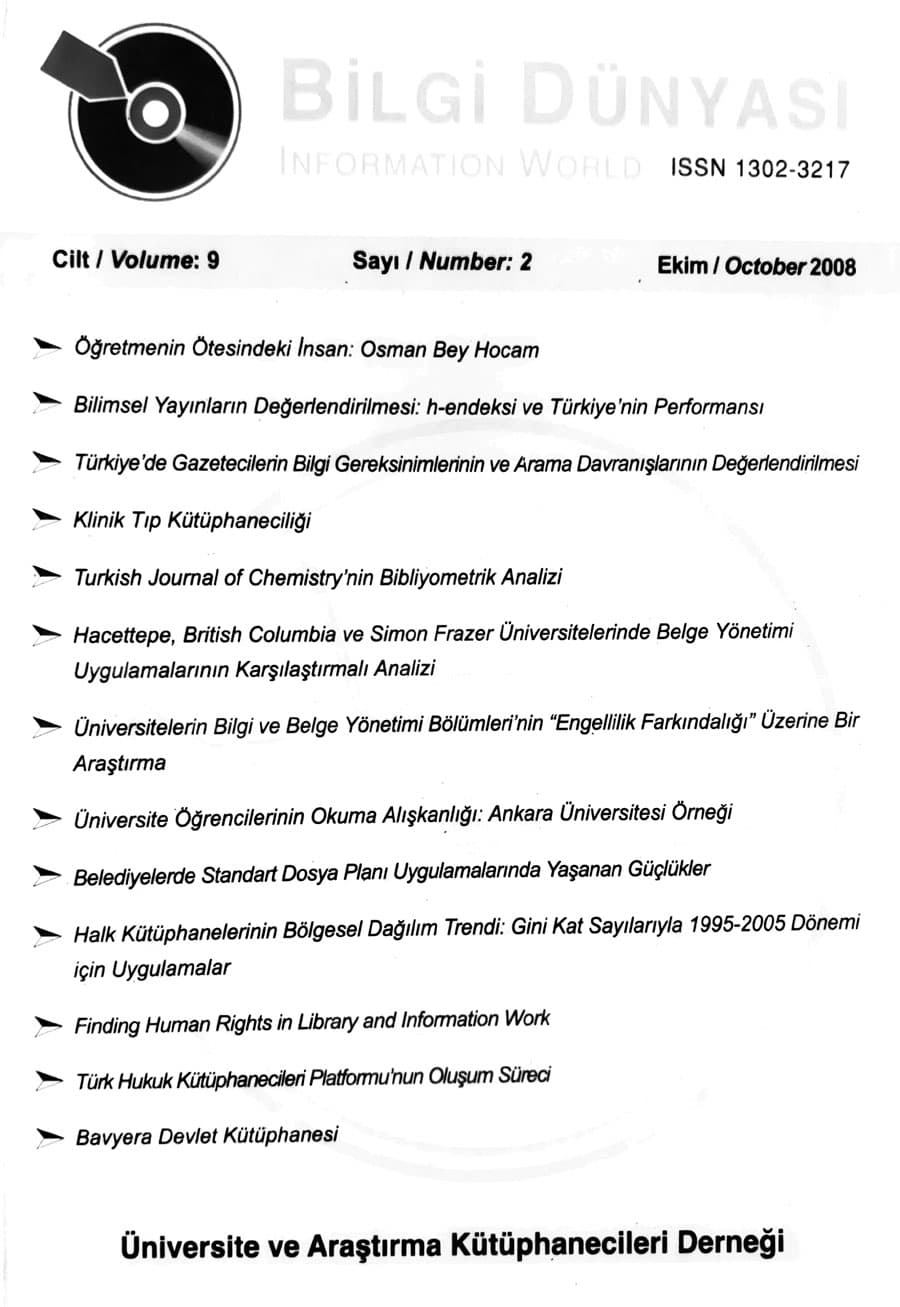
Abstract
This discussion paper touches on aspects of the philosophy of librarianship, moral and ethical aspects of librarianship, human rights, social action, social justice, citizen participation in social change, and professional ethics of librarianship.
Keywords: Librarians, Information, Human rights, Ethical aspects, Social justice, Professional ethics
References
- American Library Association. (2005). Resolution on workplace speech. Adopted 26 June 2005.
- Andersen, A. (2005). Information criticism: Where is it?. Progressive Librarian Issue, 25.
- Capurro, R. (1992). What is information science for? A philosophical reflection. Peter Vakkari and Blaise Cronin (eds). In Conceptions of library and information science: Historical, empirical and theoretical perspectives (pp. 90-93). London: Taylor Graham.
- Civallero, E. (2004). Indigenous libraries, utopia and reality: proposing an Argentine model. Aboriginal Libraries Project. National University, Córdoba.
- Culture, Media and Sport Committee. (2005). Public libraries: Third report of session 2004-05. Retrieved October 26, 2006, from http://www.publications.parliament.uk/pa/cm200405/cmselect/cmcumeds/81/81i.pdf.
- Durrani, S. (2004, July 3). Social forum, documentation and libraries deadline. Message posted to Libplic.
- Esquivel, A. P. (2004). Between the walls of information and freedom. Proceedings of the 70th IFLA General Conference and Council, 22-27 August, Buenos Aires. Retrieved November 8, 2006, from http://www.ifla.org/IV/ifla70/ps-Perez_Esquivel-e.htm.
- Faveri, A. D. (2006, May 16). Petition: CLA Interest Group. Message posted to Toni Samek.
- IFLA. (1983). Resolution on behalf of librarians who are victims of violation of human rights. adopted by the 49th IFLA Council and General Conference in Munich, Germany, 1983. Retrieved October 26, 2006, from http://www.ifla.org/faife/policy/munich.htm.
- IFLA. (1989). Resolution on freedom of expression, censorship and libraries. adopted by the 55th IFLA Council and General Conference, Paris, 1989. Retrieved October 26, 2006, from http://www.ifla.org/faife/policy/paris_e.htm.
- Pawley, C. (1998). Hegemony’s handmaid? The library and information studies curriculum from a class perspective. Library Quarterly 68(2), 123-144.
- Raseroka, K. (2005). Strateic plan for IFLA President’s report. World Library and Information Congress. 71st IFLA General Conference and Council, 1-16 August, Oslo.
- Rosenzweig, M. (2001). What progressive librarians believe: an international perspective. Innovation, 22, 1-5.
- Schiller, H. I. (1996). Information Inequality: The deepening social crisis in America. New York: Routledge.
- Shachaf, P. (2005). A global perspective on library association codes of ethics. presented at the Association for Library and Information Science Education Annual Conference: Boundary Crossings, 13 January, Boston, MA. Retrieved October 26, 2006, from http://ella.slis.indiana.edu/~shachaf/ALISE%202005.ppt.
- Wiegand, W. A. (1999). Tunnel vision and blind spots: what the past tells us about the present; reflections on the twentieth-century history of American librarianship. Library Quarterly 69(1), 1-32.
License
Copyright (c) 2008 The author(s). This is an open access article distributed under the Creative Commons Attribution License (CC BY), which permits unrestricted use, distribution, and reproduction in any medium or format, provided the original work is properly cited.
How to Cite
Samek, T. (2008). Finding Human Rights in Library and Information Work. Information World, 9(2), 527-540. https://doi.org/10.15612/BD.2008.316