Abstract
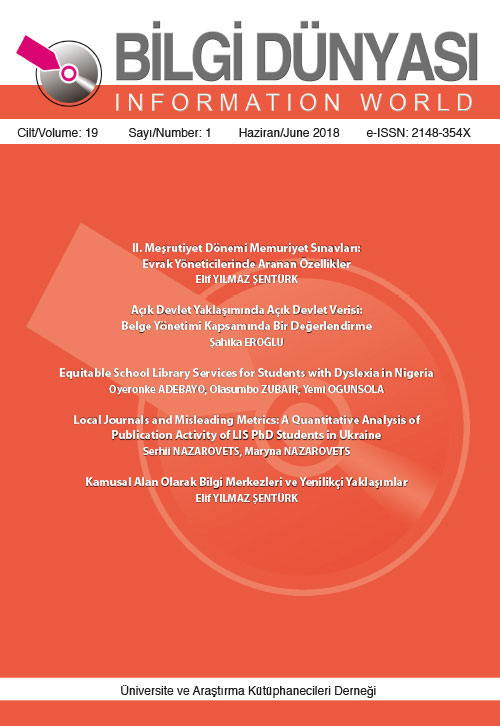
The paper attempts to establish ways in which school libraries in Nigeria can make available the right information resources to students suffering from dyslexia. Dyslexia is a mental disability and individuals that are dyslexic find it difficult to read, comprehend, lack ability to synchronize letters amongst others. The paper tried to establish what dyslexia is, the cause and symptoms. It also identified what stands as a barrier to efficient library use for the dyslexic. It also looked into the information resources that could be used by a dyslexic to get maximum satisfaction of having used the library. These resources include media resources such as audio books, music and pictograms. The role of stakeholders in ensuring that school libraries are established and well equipped was also discussed. The paper concludes that all hands must be on deck to ensure that disabled student, especially the dyslexic are not left out in the information world.
Keywords: Dyslexia, school libraries, disabilities, Nigeria, information resources, Nigerian School Library Association (NSLA)
References
- Abbott, A. A.(2016, December 17). Why dyslexia doesn’t stop you reading. Retrieved from http://aaabbott.co.uk/2016/12/why-dyslexia-doesnt-stop-you-reading/
- Adebayo, O., Fagbohun, M., Osayande, O., & Owolabi, E. S. (2015). Dealing with difficult patrons in libraries: A case study of some libraries in Ondo state Nigeria. Annals of Library and Information Studies, 62(2), 90–93.
- Adepoju, S. O., Oluwatola, I. K., & Abomoge, S. O. (2015). Perception of secondary school administrators towards school library development and use in Akinyele Local Government, Moniya Ibadan, Nigeria. ARPN Journal of Science and Technology. 5(8), 341-349.
- Ahmad, F. K. (2015). Use of assistive technology in inclusive education: making room for diverse learning needs. Transcience, 6(2): 62-77.
- Ajoku-Christopher, O. A. (2012). Factors influencing the lack of dyslexia awareness and its impact on inclusive learning in selected primary schools in Owerri West Local Government Area, Imo state, Nigeria (Unpublished doctoral dissertation). University of Greenwich, London, England. Retrieved from http://gala.gre.ac.uk/8956/5/Onyenachi%20Ada%20Ajoku-Christopher%202012%20-%20redacted.pdf
- Allen, K. L., & Hughes-Hassell, S. (2010). Meeting the needs of students with disabilities. School Library Monthly, 27(1), 52 – 54.
- Baro, E. E., & Eze, M. E. (2016). Enhancing quality learning: The impact of school library services to students in Nigeria. School Libraries Worldwide. 22(1). Retrieved from https://www.questia.com/read/1P3-4039509771/enhancing-quality-learning-the-impact-of-school-library
- Bickenbach, J., Degener, T., Melvin, J., Quinn, G., Posarac, A., Schulze, M., … Watson, N. (2011). Understanding disability. In S. Hartley et al. (Eds.), World report on disability (pp.1-17). Geneva: World Health Organization (WHO). Retrieved from http://www.who.int/disabilities/world_report/2011/report.pdf
- Blaesius, N., & Fleck, S. (2015). 15 minutes of video game for the treatment of dyslexia. In l’Interaction Homme-Machine IHM’15 Proceedings of the 27th Conference on l’Interaction Homme-Machine (article 30). ACM, New York, NY: USA. doi: 10.1145/2820619.2825010
- Bonacina, S., Cancer, A., Lanzi, P. L., Lorusso, M. L., & Antonietti, A. (2015). Improving reading skills in students with dyslexia: The efficacy of a sublexical training with rhythmic background. Frontiers in Psychology, 6(OCT). http://doi.org/10.3389/fpsyg.2015.01510
- Bookshare.org. (2018). Retrieved from https://www.bookshare.org/cms/
- Colour Clarity LLC (2017). Colored overlay example. Retrieved from http://color-clarity.com/colored-overlay-example
- Czepita, D., & Łodygowska, E. (2006). Role of the organ of vision in the course of developmental dyslexia. Klinika Oczna, 108(1–3), 110–123. Retrieved from http://www.scopus.com/inward/record.url?eid=2-s2.0-34447618651&partnerID=40&md5=473f71150af1cb528ee715906d1a7720
- Daniel, J. (2013, February 18). Lack of funds hampers library development in Nigeria: An interview with remium times. Retrieved from https://www.premiumtimesng.com/news/top-news/120838lack-of-funds-hampers-library-development-in-nigeria-chief-librarian.html
- Dequin, H. C., Schilling, I., & Huang, S. (1988). The attitudes of academic librarians toward disabled persons. Journal of Academic Librarianship, 14(1), 28–31.
- Epp, M. A. (2006). Closing the 95 percent gap: Library resource sharing for people with printdisabilities. Library Trends, 54(3) 411-419.
- Gori, S., Franceschini, S., Ruffino, M., Viola, S., Molteni, M., & Facoetti, A. (2013). Video games training increases reading abilities in children with dyslexia. Journal of Vision, 13(9), 282-282.
- Grant, D., & French, H. E. (2017). That’s the way I think: Dyslexia, dyspraxia, ADHD and dyscalculia explained (3rd ed.). London: Routledge. Retrieved from http://doi.org/10.4324/9781315647005
- Ikediashi, N. (2012). Dyslexia: Causes, management and implications for the Nigerian primary school child. African Research Review. 6(2), 258-265 Retrieved from https://www.ajol.info/index.php/afrrev/article/view/77060
- International Dyslexia Association. (2012). Fact sheet 3. Retrieved from https://dyslexiaida.org/fact-sheet-3/
- International Federation of Library Associations and Institutions. (2015). In B. Schultz, & D. Oberg (Eds), IFLA school library guidelines (2nd Rev. ed.). Retrieved from https://www.ifla.org/files/assets/school-libraries-resource-centers/publications/ifla-school-library-guidelines.pdf
- Iwu-James, J., & Itsekor, V. (2012). Enhancing Information Access and Use for The Dyslexics Adopting New Strategies for Public Libraries In Nigeria. Nigerian Journal Library, Archival and Information Science, 1(13), 45-52.
- Malawi Government. (2012). Malawi disability act (Act No. 10 of 2012). Retrieved from https://www.malawilii.org/mw/legislation/act/2012/10
- Martin, G. N, Carlson, N. R, & Buskist, C. (2007). Psychology. England: Pearson Education Limited.
- McCandliss, B. D, & Noble K. G (2003). The development of reading impairment: A cognitive neuroscience model. Mental Retard Development Disabilities, 9(3), 196-204. Retrieved from https://www.ncbi.nlm.nih.gov/pubmed/12953299
- National Institute of Neurological Disorder and Stroke. (2010). Dyslexia information page. Retrieved from https://www.ninds.nih.gov/Disorders/All-Disorders/Dyslexia-Information-Page
- North Shore Pediatric Therapy. (2012). Dyslexia signs and characteristics. Retrieved from https://nspt4kids.com/parenting/dyslexia-signs-and-characteristics/
- Owate, C. N., & Iroha, O. (2013). The availability and utilization of school library resources in some selected Secondary Schools (High School) in Rivers State. Educational Research and Reviews, 8(16), 1449–1460.
- Oyeronke, A. (2012). Information as an economic resource: The role of oublic libraries in Nigeria. Chinese Librarianship: An International Electronic Journal, 34,, 66–75. Retrieved from www.iclc.us/cliej/cl34oyeronke.pdf
- Russell, S. E., & Huang, J. (2009). Libraries’ role in equalizing access to information. Library Management, 30(1/2), 69–76. doi: http://doi.org/10.1108/01435120910927538
- Ryan, M. (2004). What does the dyslexic person feel? Retrieved from http://dyslexiahelp.umich.edu/parents/living-with-dyslexia/home/social-emotional-challenges/what-does-dyslexicperson-feel
- Skat Nielsen, G. (2001). Guidelines for library services to persons with dyslexia. Paper presented at the 67th IFLA Council and General Conference, August 15th-25th 2001. Retrieved from http://www.ifla.org/IV/ifla67/papers/162-150e.pdf
- The understood team. (n.d). Dyslexia signs and symptoms. Retrieved from https://www.understood.org/en/learning-attention-issues/child-learning-disabilities/dyslexia/understanding-dyslexia
- United Nations Children’s Fund [UNICEF]. (2009). Child-friendly schools: Emerging practices in Eastern and Southern Africa: A human rights-based approach. Retrieved from https://www.unicef.org/esaro/CFS_Emerging_Practices_in_ESAR.pdf
- United Nations Secretariat for the Convention on the Rights of Persons with Disabilities. (n. d.). Fact sheet on persons with disabilities: Overview. Retrieved from: http://www.un.org/disabilities/documents/toolaction/pwdfs.pdf
- Uzuegbu, C. P, & Onyekweodiri, N. E. (2011). The professional visibility of the Nigerian Library Association: A report of survey findings. Library Philosophy and Practice (e Journal). Retrieved from https://digitalcommons.unl.edu/libphilprac/640/
- World Federation of Neurologists. (1968). Report of research group on dyslexia and World illiteracy. Dallas: WFN.
- World Health Organization (WHO) & World Bank. (2011). In S. Hartley et al. (Eds.), World report on disability. Retrieved from http://www.who.int/disabilities/world_report/2011/report.pdf
License
Copyright (c) 2018 The author(s). This is an open access article distributed under the Creative Commons Attribution License (CC BY), which permits unrestricted use, distribution, and reproduction in any medium or format, provided the original work is properly cited.