Abstract
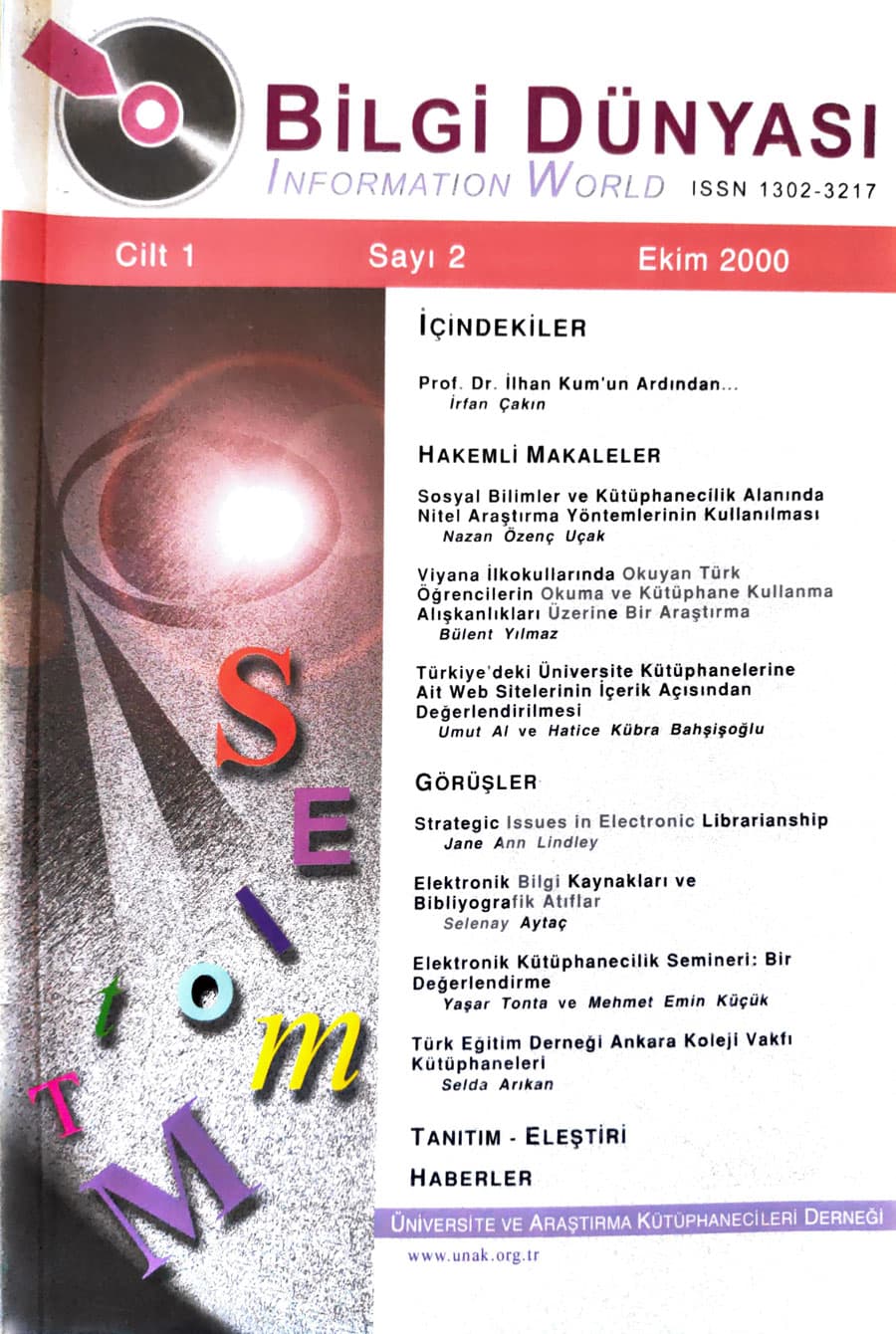
This paper reports the findings ot a research project on the reading and library use habits of Turkish students of primary schools in Vienna. Data were gathered through a number of questionnaires which were filled out by 108 fourth grade students of Turkish descent based in 7 Viennese primary schools, 94 parents, 17 classroom teachers, 7 Turkish language teachers, 7 headmasters, 12 public librarians and 1 school librarian. Both formal and informal interviews were also conducted with the same subjects. We found that students lack proper reading and library use habits. Parents and teachers, who should play an important role in this process, are not adequately involved. Schools have a serious library problem. Students experience difficulties in finding books in Turkish. School and classroom libraries are not adequate and they are mostly dysfunctional. Reading and library use habits are negatively affected by heavy viewing of television programs. We conctude that parents and teachers should be educated; that school libraries should be made functional and stocked with Turkish material of good quality; and that the number of hours of Turkish language courses should be increased and the contents of such courses should be revised.
Keywords: Reading habits, Library use habits, Multicultural society
References
- ALA. (1978). Book reading and library usage; a study of habits and perceptions. New Jersey: Gallup.
- Bamberger, R. (1990). Okuma alışkanlığını geliştirme. Ankara: Kültür Bakanlığı.
- BMUK. (1998a). Abt. V/B/5, SchülerInnen mit nichtdeutscher Muttersprache, Informationsblätter. 2198, Ocak 1998. Viyana: BMUK.
- BMUK. (1998b). Österreichische Schulstatistik Heft 47, 97/98. Viyana: BMUK, Stadtschulrat für Wien, Schulberatungsstelle für MigrantInnen.
- Çıngı, H. (1990). Örnekleme kuramı. Ankara: Hacettepe Üniversitesi Fen Fakültesi.
- Freire, P. ve Macedo, D. (1998). Okuryazarlık: Sözcükleri ve dünyayı okuma. (Çev. Ankara: İmge).
- IFLA. (1992). Halk kütüphaneleri için hizmet kılavuzu. (Çev. Sevgi Hisım). Ankara: Kültür Bakanlığı.
- Mylopoulos, C. (1985). Trends in multicultural programming. Canadian Library Journal, 42(1), 23-25.
- OSTAT. (1998). Österreichisches Statistisches Zentralamt Bevölkerung JD 1997. Viyana: OSTAT.
- Sağlamtunç, T. (1986). Federal Almanya halk kütüphanelerinde Türklere verilen hizmetin yaygınlaştırılmasında Türk ve Alman kütüphanecilerin işbirliği. Türk Kütüphaneciler Derneği Bülteni, 35(3), 3-13.
- Simsova, S. (1980). Library training for services to minority ethnic groups: Concepts and general principles. Library Trends, 29(2), 245-258.
- Simsova, S. (1992). Multicultural populations: Their nature and needs. Multicultural Librarianship: An International Handbook içinde (s. 11-43). Münih: K.G. Saur.
- Stadler, A. (1980). Children of guest workers in Europe: Social and cultural needs in relation to library services. Library Trends, 29(2), 325-334.
- Vogt, H. J. (1980). Library resources for ethnic minorities in the Federal Republic of Germany. Library Trends, 29(2), 293-298.
- Yılmaz, B. (1993). Okuma alışkanlığında halk kütüphanelerinin rolü. Ankara: Kültür Bakanlığı.
- Yılmaz, B. (2000). Çok kültürlü toplumlarda etnik azınlık çocuklarının okuma ve kütüphane kullanma alışkanlıkları. Türk Kütüphaneciliği, 14(4), 451-465.
License
Copyright (c) 2000 The author(s). This is an open access article distributed under the Creative Commons Attribution License (CC BY), which permits unrestricted use, distribution, and reproduction in any medium or format, provided the original work is properly cited.