Abstract
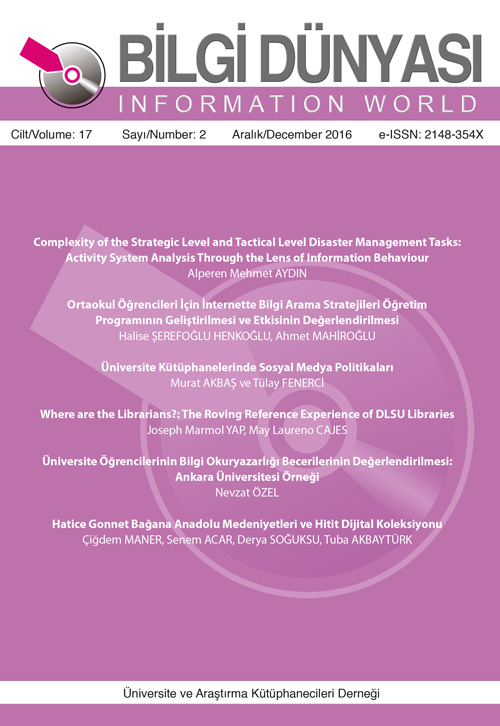
Socialmedia, the phenomenon of our era, has been usedby people and organizations widely and profoundly all over the world. This new communication and sharing platform offers many opportunities to its users. However, it has some threats. Therefore, operating, managing and controlling of social media accounts become important and creating a social media policy arises as a necessity.
In this article, it has been determined whether the university libraries using social media have a social media policy and it has been tried todetermine the awareness level of the librarians with respect to whether they think that social media policy is a need. A survey has been conducted upon 90 university libraries that use social media and the responses of 67 (74,4 %) participants have been evaluated. The results show that only 7,4 % of the participant have a social media policy created for their library, and the librarians mostly (82%) believe that a document like social media policy should be used by the libraries. With regard to this, a social media policy, which is thought to be a guiding instrument for Turkish university libraries is proposed and presented in this study.
Keywords: Social media, policy, university libraries, social media policy, social media guidance
References
- Akbaş, M. (2015). Üniversite kütüphanelerinde sosyal medya politikaları (Yayımlanmamış yüksek lisans tezi). Ankara Üniversitesi, Ankara.
- Aras, B. B. (2014). University libraries and social media policies. Journal of Balkan Libraries Union, 2(1), 21-27.
- Burclaff, N. ve Johnson, C. (2014). Developing a social media strategy: Tweets, pins, and posts with a purpose. College & Research Libraries News, 75(7) 366-369.
- CPP. (2015). CPP university library social media policy. https://www.cpp.edu/~library/about/socialmedia-policy.shtml adresinden erişildi.
- CSU. (2015). CSU policy: Social media. http://policylibrary.colostate.edu/policy.aspx?id=497 adresinden erişildi.
- Drexel, U. (2011). Drexel University Queen Lane Library social media policy. http://www.pages.drexel.edu/~kmc368/queenlane/smpolicy.html adresinden erişildi.
- Farkas, M. G. (2007). Social software in libraries: Building vollaboration, communication and community online. Medford, New Jersey: Information Today Inc.
- Garber, M. B. (2011). Social media policy on campus: A case study of the development and implementatiton of a social media policy for university administrations, faculty, and staff. (Yayımlanmamış doktora tezi). Mercer University, Georgia (USA).
- Garofalo, D. A. (2013). Building communities: Social networking for academic libraries. İngiltere: Chandos Publishing.
- GSU. (2015). GSU policies (library social media policy). http://library.gsu.edu/files/2012/12/Library_Social_Software_Policy.pdf adresinden erişildi.
- Johnson, C. ve Burclaff, N. (2013). Making social media meaningful: Connecting missions and policies. http://www.ala.org/acrl/sites/ala.org.acrl/files/content/conferences/confsandpreconfs/2013/papers/JohnsonBurclaff_Making.pdf adresinden erişildi.
- Junco, R. (2011). The need for student social media policies. EDUCAUSE Review, 46(1) 60-61.
- Kooy, B. K. ve Steiner, S. K. (2010). Protection, not barriers: Using social software policies to guide and safeguard students and employees. Reference & User Services Quarterly, 50(1), 59-71.
- Kroski, E. (2009). Should your library have a social media policy. School Library Journal, (October), 44-46.
- Lenartz, A. J. (2012a). All my rowdy “friends”: The use of social media in higher education. (Yayımlanmamış doktora tezi). Northern Arizona University, USA.
- Lenartz, A. J. (2012b). Establishing guidelines for the use of social media in higher education. L. Wankel ve C. Wankel (Eds.), Cutting-edge technologies in higher education (s. 333-353). UK: Emerald Group Publishing.
- Maranto, G. ve Barton, M. (2010). Paradox and promise: MySpace, Facebook, and the sociopolitics of social networking in the writing classroom. Computers and Composition, 27(1), 36-47.
- Mathews, B. (2011). Why does my library use social media. http://chronicle.com/blognetwork/theubiquitouslibrarian/2/011/07/06/why-does-my-library-use-social-media/ adresinden erişildi.
- McNeill, T. (2012). ‘‘Don’t affect the share price’’: Social media policy in higher education as reputation management. http://www.researchinlearningtechnology.net/index.php/rlt/article/view/19194 adresinden erişildi.
- Moulaison, H. L. ve Corrado, E. M. (2011). Staying free from “corporate marketing machines”: Library policy for Web 2.0 tools. D. Gupta ve R. Savard (Eds.), Marketing libraries in a Web 2.0 World içinde (s. 43-57). Almanya: IFLA.
- SNÜ. (2015). Sinop Üniversitesi Kütüphanesi sosyal medya politikası. http://kutuphane.sinop.edu.tr/dosyalar/4.Sosyal%20medya%20politikas%C4%B1.pdf adresinden erişildi.
- Solomon, L. (2011). Doing social media so it matters: A librarian’s guide. USA: ALA.
- Statistic Brain. (2014a). Facebook statistics. http://www.statisticbrain.com/facebook-statistics adresinden erişildi.
- Statistic Brain. (2014b). Twitter statistics. http://www.statisticbrain.com/twitter-statistics adresinden erişildi.
- Steiner, S. K. (2012). Strategic planning for social media in libraries. USA: ALA.
- Swanson, T. A. (2012). Managing social media in libraries: Finding collaboration, coordination, and focus. UK: Chandos Publishing.
- Tavluoğlu, C. (2013). Üniversite kütüphanelerinde web 2.0 araçlarının kullanımı (Yayımlanmamış yüksek lisans tezi). Hacettepe Üniversitesi, Ankara.
- UTAH. (2015). UTAH Med.Library social media policy. http://library.med.utah.edu/lib/EHSL_SocialMediaPolicy.pdf adresinden erişildi.
- WSU. (2015). WSU libraries social media policy. http://www.wsulibs.wsu.edu/policies/social-media adresinden erişildi.
- Yalçın, H. (2014). Sosyal ağlar ve bilgi hizmetleri: Ağ kuşağının kütüphanelerden beklentileri. (Yayımlanmamış doktora tezi). Hacettepe Üniversitesi, Ankara.
License
Copyright (c) 2016 The author(s). This is an open access article distributed under the Creative Commons Attribution License (CC BY), which permits unrestricted use, distribution, and reproduction in any medium or format, provided the original work is properly cited.